
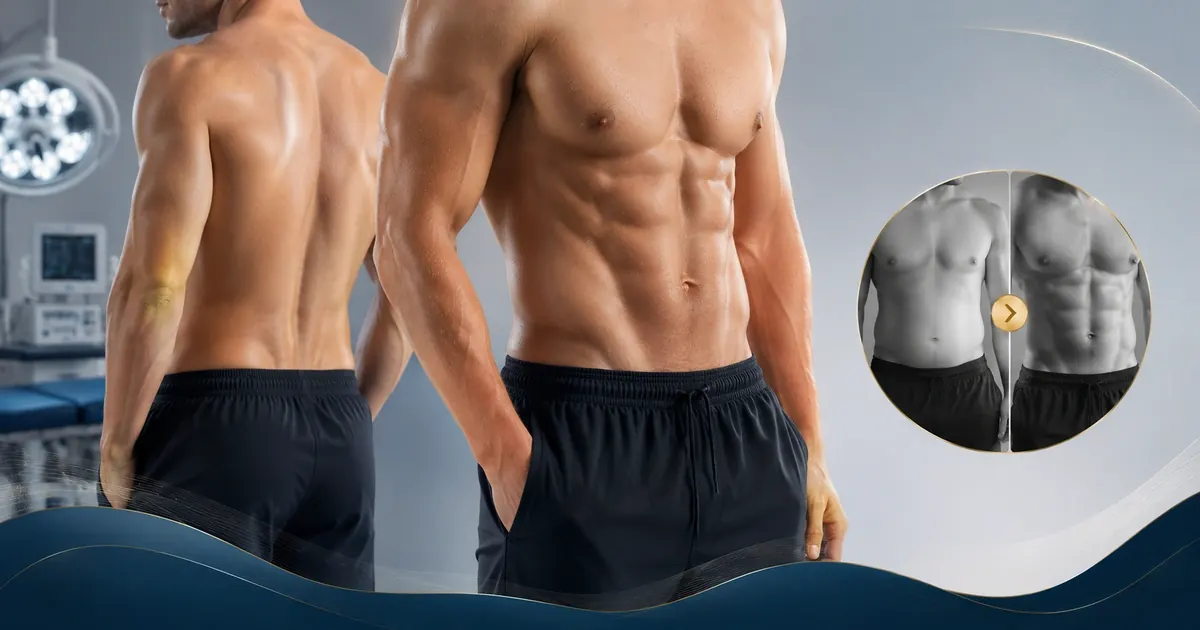
How Liposuction Differs for Men
Male liposuction uses the same fundamental technique as female liposuction — but several biological differences affect how the procedure is planned and performed. A published clinical review of liposuction considerations in men identifies the following key anatomical differences:1
- Denser, more fibrous fat: Male subcutaneous fat contains more fibrous connective tissue (fibrous septa) woven through it. This makes the fat more resistant to aspiration through standard manual cannula movement. As a result, power-assisted liposuction (PAL) or ultrasound-assisted liposuction (VASER) is more frequently recommended for men — particularly in the abdomen, flanks, and chest.
- Different fat distribution: Men typically accumulate fat in the upper abdomen, flanks, love handles, and chest — rather than the thighs, hips, and buttocks that are more common treatment areas in women.
- Less skin laxity concern: Male skin tends to have more collagen and better elasticity than female skin at equivalent ages — meaning the skin-retraction outcome after fat removal is often better.
- Different aesthetic goals: Men typically seek angular definition and a flatter, firmer contour — as opposed to the soft curves more commonly requested by female patients. This changes technique planning, particularly for abdominal work where muscular definition may be the primary goal.
A review of male body contouring techniques confirms that understanding these distinctions is essential for achieving results that align with masculine aesthetic ideals rather than inadvertently feminising the contour.2 For information on every treatable zone — including those most popular with male patients — visit our body areas overview.
Common Treatment Areas for Men
The most commonly requested male liposuction areas — in approximate order of frequency:
- Love handles (flanks) — the most common request; the lateral fat roll above the hip bone that persists despite diet and exercise in many men
- Abdomen — lower and upper; often combined with flanks in a single session
- Male chest — pseudo-gynecomastia (fat only); not to be confused with true gynecomastia (see below)
- Chin and neck — double chin removal; effective under local anaesthesia
- Back and bra roll area — posterior fat along the mid-back and lumbar region
- High-definition abdomen — abdominal etching for visible muscle definition in lean men; VASER is the established technique for this goal
Male Chest: Liposuction vs Gynecomastia Surgery
Male chest enlargement has two distinct causes that require different treatments. Getting this distinction wrong leads to disappointing results:
- Pseudo-gynecomastia — male chest fullness caused entirely by fat deposits. The chest feels soft to the touch. Liposuction (or VASER liposuction) effectively removes this fat and flattens the chest. A study of tumescent liposuction for the enlarged male breast found excellent results in patients with predominantly fat-based chest fullness.4
- True gynecomastia — enlargement caused by glandular breast tissue (not fat) beneath the nipple-areola complex. The gland feels firm or rubbery. Liposuction alone cannot remove glandular tissue. True gynecomastia requires surgical excision of the gland through a small incision at the areolar margin — often combined with liposuction for any surrounding fat component.
- Mixed (most common) — the majority of cases involve a combination of glandular tissue and fat. Combined liposuction + gland excision is the standard approach.
A detailed study on masculinised male chest contouring describes the "armour plate" technique — using VASER to create defined pectoral borders and remove the fat that softens the chest contour in lean but undefined male patients.3
Important: If you have firm tissue beneath the nipple, this must be assessed by a surgeon before any chest liposuction — liposuction alone on true gynecomastia will not produce a flat result and may make revision harder.
Results & Realistic Expectations
Male liposuction results are typically visible and significant when fat is the primary issue. Men often respond particularly well to abdominal and flank liposuction because the improvement in the waist-to-shoulder ratio creates a proportional change that reads as a dramatic body transformation.
Realistic expectations for men:
- Liposuction removes localised fat — it does not create abdominal muscle definition unless muscle is already present and the overlying fat is removed (HD/etching approach)
- Results are best when BMI is under 30 and weight has been stable — men who are actively losing weight get better long-term results from waiting until weight is stable
- The flanks/love handles respond particularly well — often the area where men see the most dramatic single-session improvement
- Fibrous male fat means longer recovery swelling — results in men may take slightly longer to fully emerge compared to female patients for equivalent areas
Recovery for Men
Recovery timelines for male liposuction are equivalent to female recovery for the same areas — the compression garment requirements, activity restrictions, and return-to-work timeline do not differ significantly by sex. See our full recovery timeline guide for week-by-week expectations.
Male-specific notes:
- Male chest procedures: a firm compression vest is worn for 4–6 weeks post-operatively; most men can return to sedentary work within 5–7 days
- Due to denser male fat, fibrosis (firmness under skin) may be slightly more pronounced in men and may take longer to resolve — continue lymphatic massage as recommended
- Manual work and physical jobs require longer time off (3–4 weeks minimum); discuss with your surgeon based on the scope of the procedure
Cost
Male liposuction costs are broadly comparable to female procedures for equivalent treatment areas, with the following typical ranges:
| Area | US Total | Turkey All-Inclusive |
|---|---|---|
| Love handles only | $3,500–$7,000 | $1,200–$2,500 |
| Abdomen + love handles | $6,000–$14,000 | $1,800–$3,500 |
| Male chest (pseudo-gynecomastia) | $3,500–$7,000 | $1,200–$2,500 |
| Chin / neck | $2,500–$5,500 | $800–$1,800 |
| HD abdominal etching | $6,000–$15,000+ | $2,500–$5,000 |
VASER (frequently recommended for male fibrous fat) adds approximately 15–35% to baseline tumescent pricing. Read our liposuction cost guide for a detailed country-by-country breakdown, technique premiums, and what each price typically includes.
Frequently Asked Questions
-
Yes — male fat is denser and more fibrous, and is distributed differently (abdomen, flanks, chest). This often requires VASER or power-assisted techniques. Men also typically seek angular, defined results rather than soft curves. A clinical review of liposuction considerations in men details these anatomical and technique differences.1
-
It depends on the cause. Pseudo-gynecomastia (fat only — soft to touch) responds well to liposuction alone. True gynecomastia (firm glandular tissue under the nipple) requires surgical gland excision — liposuction alone cannot remove glandular tissue. Most cases are mixed and require combined liposuction + excision.
-
Abdomen + love handles (flanks) treated in a single session. This combination effectively addresses the central male fat distribution pattern and creates a defined waist from all angles. Turkey all-inclusive for this combination: $1,800–$3,500. US total: $6,000–$14,000.
-
Not from standard liposuction — but yes from high-definition (HD) abdominal etching, which uses VASER to sculpt around the existing muscle borders. The key requirement: the patient must already have developed abdominal musculature that fat is concealing. HD lipo reveals muscle — it does not create it.
-
Desk work at 1–2 weeks. Compression garment for 6 weeks. Full exercise at 6 weeks. Male fat is denser, so fibrosis (firmness under skin) may be slightly more pronounced and take a little longer to resolve — continue lymphatic drainage massage as recommended. Physical or manual jobs require 3–4 weeks minimum.