
What Is Lipo 360?
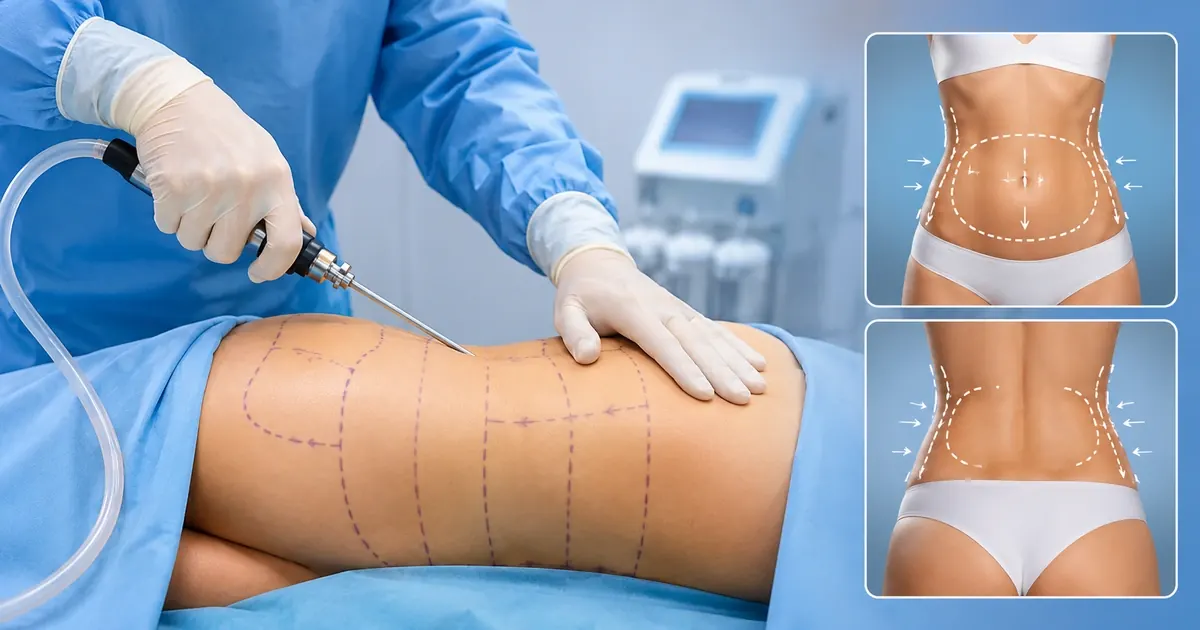
Lipo 360 — short for 360-degree liposuction — is a body-contouring procedure in which a surgeon removes excess subcutaneous fat from the entire circumference of the midsection in a single operative session. Rather than treating one localised area such as the abdomen alone, the surgeon repositions the patient to treat the flanks, love handles, and lower back at the same appointment and under the same anaesthetic.
The technique is standard liposuction — small cannulae inserted through tiny incisions to suction out fat — applied circumferentially. Lipo 360 is therefore a scope decision, not a new technology. It may use tumescent fluid, power-assistance, laser energy (SmartLipo), or ultrasound (VASER) depending on the surgeon's approach and the patient's fat volume.
Which Areas Are Treated?
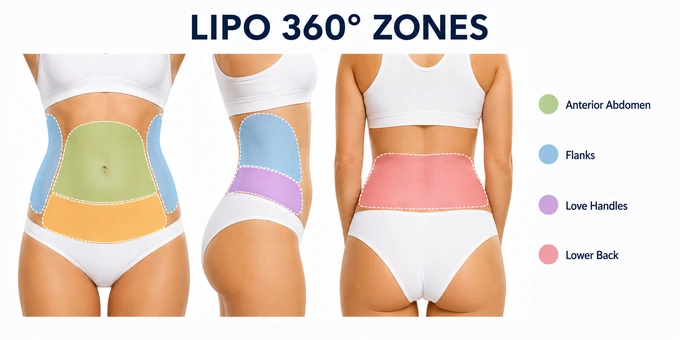
The standard Lipo 360 addresses all or most of the following zones:
- Anterior abdomen — upper and lower stomach including the subumbilical pouch
- Flanks — the side walls of the torso between the ribcage and hip
- Love handles — the soft fat rolls above the hip bone at the waist
- Lower back / lumbar rolls — the posterior band of fat above the buttocks
Some practices also include the upper back or bra-line rolls under their "360" definition. Confirm with your surgeon exactly which zones are covered in the quoted price.
Lipo 360 vs Standard Liposuction
The distinction is primarily one of scope and patient positioning, not a different technique. Standard liposuction addresses one or two discrete areas in one patient position; Lipo 360 requires multiple repositionings (supine → lateral → prone) to achieve circumferential coverage.
| Feature | Standard (Single-Zone) | Lipo 360 |
|---|---|---|
| Areas treated | 1–2 zones | Full midsection — front, sides, back |
| Patient repositioning | Usually one position | Supine + lateral/prone |
| Operative time | 1–2 hours | 2–4 hours |
| Fat volume removed | 0.5–2 litres typical | 2–5 litres typical |
| Recovery | 1–2 weeks | 2–3 weeks social; 6 weeks full |
| Goal | Localised reduction | Complete waist redefinition |
Lipo 360 With or Without a Tummy Tuck or BBL
Two of the most searched questions about Lipo 360 are whether it requires a Brazilian Butt Lift (BBL) or a tummy tuck (abdominoplasty). The short answer: neither is required, and both are entirely separate decisions.
Lipo 360 Without a BBL
A BBL uses fat harvested during liposuction — including Lipo 360 — and injects it into the buttocks to add volume. It is a separate procedure, not a component of Lipo 360. Many patients choose Lipo 360 alone because they want midsection contouring without buttock augmentation. You can combine Lipo 360 + BBL in one session if you are a suitable candidate and your surgeon has the skills for both — but it adds significant operative time, recovery complexity, and cost.
Lipo 360 Without a Tummy Tuck
A tummy tuck (abdominoplasty) addresses loose skin and separated abdominal muscles — problems that liposuction alone cannot fix. For patients with good skin elasticity, Lipo 360 alone produces excellent contour results. A tummy tuck is added only when significant skin laxity is present — typically after major weight loss or multiple pregnancies.
When the two are combined, the procedure is called lipoabdominoplasty. A prospective study of 360 patients comparing liposuction alone, lipoabdominoplasty, and traditional abdominoplasty found that the combination produces the best waist definition — but with a higher complication profile requiring rigorous patient selection and surgical experience.2
| Option | Best For | Added Consideration |
|---|---|---|
| Lipo 360 alone | Good skin elasticity, no skin excess | Simplest recovery; most common choice |
| Lipo 360 + BBL | Wants buttock volume added | Longer surgery; cannot sit for 6–8 weeks post-op |
| Lipo 360 + Tummy Tuck | Loose abdominal skin or diastasis recti | Higher complication risk; longer recovery |
| Lipo 360 + BBL + Tummy Tuck | Rarely recommended in one session | High-risk combination — requires specialist evaluation |
Who Is a Good Candidate for Lipo 360?
Lipo 360 is a body-contouring procedure, not a weight-loss treatment. The StatPearls clinical review on liposuction confirms that ideal candidates are adults at or near their target weight with localised, diet-resistant subcutaneous fat deposits.5
Surgeons generally require all of the following:
- BMI under 30 — some surgeons accept up to 35 in selected cases
- Stable weight for at least 6 months
- Good skin elasticity — the skin must retract after fat removal; significant laxity may require a tummy tuck instead
- Non-smoker, or willing to stop at least 4 weeks before surgery
- No active infection, bleeding disorder, or serious cardiac / pulmonary condition
- Realistic expectations — Lipo 360 reshapes the silhouette, it is not a guarantee of a particular clothing size
Patients whose midsection fat is primarily visceral — the hard, deep fat that cannot be pinched from outside — are not suitable candidates. Liposuction safely reaches only the subcutaneous layer.
Full candidacy guide: Am I a good candidate for liposuction? →The Procedure & Anaesthesia Options
Tumescent Fluid and Anaesthesia
Most Lipo 360 procedures use tumescent anaesthesia — large volumes of dilute lidocaine and epinephrine solution injected into the fat layer — either alone (with IV sedation) or before general anaesthesia. The epinephrine constricts small blood vessels and dramatically reduces blood loss. A national safety survey of tumescent liposuction across 66,000 procedures found the technique to be reliably safe in outpatient settings when performed by trained practitioners.3 Some surgeons also offer awake liposuction under local anaesthesia with light sedation for lower-volume cases.
Fat Removal and Patient Repositioning
The surgeon makes 3–4 mm incisions (hidden in natural skin folds) and passes thin cannulae in fanning motions to break up and suction out fat. For the 360° technique, the patient is repositioned — typically supine for the abdomen, lateral for the flanks, and prone for the lower back. This repositioning is what makes Lipo 360 an efficient single-operation solution rather than requiring two separate surgeries.
A published review of 1,000 consecutive circumferential liposuction cases found that close monitoring of fluid balance and haematocrit is the primary safety requirement when treating multiple zones and removing large fat volumes in one session.1
Closure
Incisions are closed with one or two dissolvable sutures. The compression garment is fitted in the operating room. Most Lipo 360 patients are discharged the same day.
Results: What's Realistic
Lipo 360 produces a measurably narrower waist circumference and improved silhouette visible from all angles. The main things to understand about results:
- It is not weight loss. The scale may barely move — the visual difference comes from redistribution of the body's proportions, not from significant mass removal.
- It does not treat visceral fat. Patients with significant visceral fat (hard abdominal protrusion that is not pinchable) will see limited improvement from liposuction alone. Read more in our what is liposuction guide.
- Skin quality matters. Patients with excellent skin elasticity see the cleanest results; patients with borderline laxity may see some surface irregularity or mild loose skin after fat removal.
- Maintenance is required. Removed fat cells do not return, but remaining fat cells throughout the body enlarge with weight gain. Maintaining weight within 5–10 lbs of your surgical weight preserves the result.
Recovery Timeline
Recovery from Lipo 360 is longer than single-zone liposuction because more tissue is treated. The compression garment covers the entire midsection and is worn continuously for the first 3 weeks, then part-time for a further 3 weeks.
| Timepoint | Typical Experience | Activity Level |
|---|---|---|
| Days 1–3 | Significant swelling, bruising, fluid drainage from incisions. Soreness managed with oral pain relief. | Rest; assisted walking only |
| Days 4–7 | Bruising peaks. Compression garment worn 24/7. Showering usually permitted after 48 hours. | Short gentle walks; no driving if on prescription pain relief |
| Week 2 | Most patients return to desk work. Swelling softening but still present. | Light activity; no lifting >5 kg |
| Weeks 3–4 | Bruising largely resolved. Fibrosis (firmness under skin) common — normal and temporary. | Light exercise: walking, stationary cycling |
| Week 6 | Compression discontinued. Swelling 70–80% resolved. Incision marks fading. | Full exercise including resistance training |
| Months 3–6 | Final contour visible. Skin retraction complete. Remaining swelling fully resolved. | Unrestricted |
A clinical study on activity restrictions after plastic surgery procedures found that the majority of liposuction patients return to non-strenuous work within 1–2 weeks and full physical activity by 6 weeks.4
Full Lipo 360 recovery guide — day by day →Risks & Side Effects
Lipo 360 carries the same risk profile as standard liposuction but with a slightly elevated overall profile because more tissue is treated and more anaesthetic time is needed.
Expected (not complications): bruising, swelling, temporary numbness, drainage from incisions.
Uncommon complications:
- Seroma — fluid collection under the skin; treated by drainage in clinic
- Contour irregularities — waviness or asymmetry from uneven fat removal
- Fibrosis — hard lumps from scar tissue; usually resolves with massage over 3–6 months
- Skin laxity — loose skin if elasticity was borderline pre-operatively
- Infection — rare in accredited facilities; treated with antibiotics
Rare but serious: deep vein thrombosis, pulmonary embolism (risk rises with longer operative time), fat embolism, lidocaine toxicity (tumescent technique at excessive volumes).
Choosing a board-certified plastic surgeon working in an accredited surgical facility — and verifying credentials independently — is the single most effective risk-reduction measure. See our surgeon credential checklist for what to verify before committing.
Full guide: liposuction risks, side effects and how to reduce them →How Much Does Lipo 360 Cost?
Lipo 360 costs more than single-zone liposuction because it requires longer operating time, higher anaesthetic use, and more post-operative garments. According to ASPS annual procedural data, the average US surgeon fee for liposuction is approximately $3,700 per area — and Lipo 360 typically spans three or more separate zones.6
| Country | Surgeon Fee | All-Inclusive Estimate |
|---|---|---|
| United States | $5,000 – $12,000 | $8,000 – $16,000 |
| United Kingdom | £4,500 – £9,000 | £6,000 – £12,000 |
| Australia | A$6,000 – A$14,000 | A$9,000 – A$18,000 |
| Turkey | $1,800 – $3,500 | $2,000 – $4,500 |
| Mexico | $2,500 – $5,000 | $3,500 – $7,000 |
| Poland | €2,000 – €4,500 | €3,000 – €6,000 |
Turkish all-inclusive packages typically cover: surgeon fee, anaesthesiologist, 1-night hospital stay, transfers, compression garment, post-operative medications, and 1–2 follow-up appointments. The price differential reflects local wage and operating costs — not a lower standard of care at JCI-accredited facilities. For a full breakdown, read our liposuction in Turkey guide.
Full Lipo 360 cost guide — what's included, Turkey packages, what to ask →Frequently Asked Questions
-
No. Lipo 360 and a BBL are completely separate procedures. Lipo 360 removes fat from the midsection; a BBL uses that fat to add volume to the buttocks. You can have Lipo 360 without a BBL — and most patients do. Combining them is possible but adds operative time, recovery complexity, and cost. Neither is a prerequisite for the other.
-
Yes — for most Lipo 360 patients, a tummy tuck is not needed. Lipo 360 alone is appropriate when skin elasticity is good and the concern is excess subcutaneous fat, not loose skin. A tummy tuck is added only when significant skin laxity is present — typically after major weight loss or multiple pregnancies. See the 360-patient prospective study for outcome comparisons.2
-
A standalone Lipo 360 procedure takes 2 to 4 hours under general or tumescent anaesthesia. Operating time increases when more fat volume is removed or the procedure is combined with a BBL or tummy tuck.
-
US surgeon fees typically run $5,000–$12,000 before facility and anaesthesia costs. Turkey all-inclusive packages average $2,000–$4,500 — covering surgeon, hospital, transfers, garment, and medications. The difference reflects local wage and operating costs, not a difference in surgical quality at accredited facilities. Source: ASPS 2023 Statistics Report.6
-
Initial contouring is visible at 2–4 weeks, but swelling persists for 3–6 months. Final results — skin fully retracted, swelling fully resolved — are typically visible at 6 months. Stable weight after surgery is essential to maintain the outcome.
-
The removed fat cells do not return. However, if you gain significant weight after surgery, remaining fat cells in the body enlarge — including in treated areas. Most surgeons recommend staying within 5–10 lbs of your surgical weight to maintain the result long-term.