
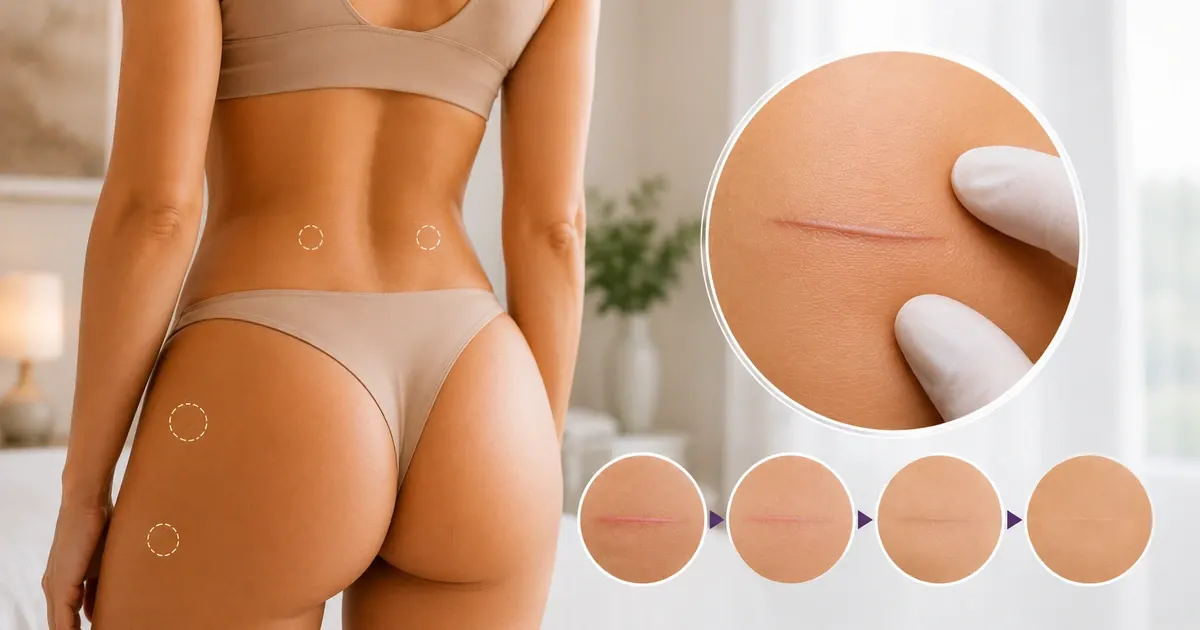
Does Liposuction Leave Scars?
Any procedure that breaks the skin produces some degree of scarring — liposuction is no exception. However, what distinguishes liposuction from most body-contouring surgeries is the remarkably small size of its incisions. Unlike abdominoplasty (which requires incisions spanning the entire lower abdomen) or body lifts (which leave long circumferential scars), liposuction requires only tiny port sites for cannula entry, as described in the StatPearls clinical review.1
In a nationwide analysis of 69,424 patients who underwent liposuction, visible scarring is uncommon as a reported complication.2 This low rate reflects both the small incision size and the strategic placement techniques modern surgeons employ. For related topics — including overall safety data and candidacy — browse our safety guides.
Why Liposuction Scars Are Minimal
Several factors work in favor of minimal scarring with liposuction. The cannula (a thin, hollow tube) requires only a small entry point — typically 3–5 mm. The incision is made through skin only, without needing to cut through underlying muscle or fascia. Additionally, the tumescent fluid injected before fat removal creates a cushioning effect that protects the incision edges from thermal damage and excessive manipulation.
How Lipo Scars Compare to Other Procedures
| Procedure | Typical Incision Length | Number of Incisions | Visibility at 12 Months |
|---|---|---|---|
| Liposuction (standard) | 3–5 mm | 2–4 per area | Minimal — often difficult to find |
| Liposuction (micro-cannula) | 1–2 mm | 3–6 per area | Near-invisible |
| Abdominoplasty (tummy tuck) | 25–60 cm | 1–2 | Visible but concealable under clothing |
| Body lift | 50–100+ cm | 1 circumferential | Clearly visible |
| Brachioplasty (arm lift) | 15–30 cm | 1 per arm | Visible along inner arm |
As this comparison shows, liposuction offers a significant advantage in scar burden. Most patients rank scarring as one of their lowest concerns after liposuction, whereas it remains a primary consideration for excisional procedures, as noted in imaging studies of liposuction outcomes.3
Where Incisions Are Placed (by Body Area)
Strategic incision placement is one of the most important skills a liposuction surgeon possesses. By positioning port sites in natural folds, creases, and areas typically concealed by clothing, surgeons ensure that even if a scar is visible up close, it remains hidden in everyday life.
Abdomen & Waist
For abdominal liposuction — the most commonly treated area — surgeons typically place incisions in the following locations:
- Navel (umbilicus): A small incision within or at the rim of the belly button, completely hidden by the natural contours
- Bikini line: Placed at or below the underwear line, concealed by any swimwear
- Lower abdominal crease: In the suprapubic fold, invisible even without clothing when standing
- Lateral hip creases: At natural love-handle folds, hidden when arms rest at sides
Thighs & Buttocks
For inner and outer thigh liposuction, incisions are strategically placed in:
- Gluteal crease: The natural fold where buttock meets thigh — excellent concealment
- Groin crease: For inner thigh work, hidden in the inguinal fold
- Knee crease: Behind or just above the knee for lower thigh contouring
- Outer hip: Positioned where underwear elastic typically sits
Arms & Upper Body
Arm liposuction incisions are placed in areas of natural concealment:
- Elbow crease (posterior): The small fold behind the elbow, barely visible
- Axillary fold: Within the armpit crease for upper arm and lateral chest work
- Bra line: Along the bra strap area for back fat or lateral chest treatment
Chin & Neck (Submental)
For double chin and neck liposuction, the most common placement is a single incision beneath the chin (submental crease) — typically 3–4 mm — which falls in a natural shadow and is virtually undetectable once healed. Some surgeons add small incisions behind the earlobes for lateral neck access.
| Body Area | Primary Incision Site | Secondary Sites | Typical Number |
|---|---|---|---|
| Abdomen | Navel rim, bikini line | Lateral hip creases | 3–4 |
| Flanks (love handles) | Posterior hip crease | Lower back midline | 2–3 |
| Inner thighs | Groin crease | Knee fold | 2–3 |
| Outer thighs | Gluteal crease | Lateral hip | 2–3 |
| Arms | Elbow crease | Axillary fold | 2 |
| Chin/neck | Submental crease | Behind earlobes | 1–3 |
| Back | Bra line fold | Posterior axillary line | 2–4 |
| Male chest | Areolar edge | Lateral chest fold | 2–3 |
How Big Are Liposuction Incisions?
The size of liposuction incisions depends primarily on the cannula diameter selected by the surgeon. Modern liposuction uses cannulas ranging from 1.5 mm to 6 mm in external diameter, with most body contouring performed using 3–4 mm cannulas per the StatPearls clinical review.1
Cannula Diameter vs. Incision Length
The skin incision must be slightly larger than the cannula to allow smooth passage without shearing the wound edges. As a general rule, the incision is approximately 1–2 mm longer than the cannula diameter:
| Cannula Diameter | Incision Length | Typical Use | Equivalent Size |
|---|---|---|---|
| 1.5–2.0 mm | 2–3 mm | Facial/submental, small areas | Smaller than a grain of rice |
| 2.5–3.0 mm | 3–4 mm | Arms, inner thighs, knees | Width of a pencil eraser |
| 3.5–4.0 mm | 4–5 mm | Abdomen, flanks, outer thighs | Slightly larger than a match head |
| 4.5–5.0 mm | 5–6 mm | Large-volume liposuction, back | Width of a standard pencil |
How Incisions Are Closed
Incision closure technique also affects final scar appearance. Common approaches include:
- Single absorbable suture: Dissolves in 7–14 days, no removal visit needed
- Adhesive strips (Steri-Strips): Hold edges together while a suture dissolves beneath
- Tissue adhesive (skin glue): Creates a waterproof seal with no suture marks
- Left open (intentional): Some surgeons leave one incision partially open for the first 24–48 hours to allow drainage of tumescent fluid, which reduces bruising — this incision is then closed or allowed to heal by secondary intention with no difference in final scar appearance
How Lipo Scars Heal Over Time
Scar maturation follows a predictable biological process. Understanding this timeline helps patients distinguish normal healing from concerning changes that require medical attention.
Weeks 1–3: Inflammatory Phase
Immediately after surgery, incision sites appear as small red or pink lines, often with slight surrounding bruising. Mild swelling at the port sites is normal. The body is actively delivering immune cells and growth factors to initiate repair. During this phase, scars may feel slightly firm and raised — this is a normal part of collagen deposition.
Weeks 3–12: Proliferative Phase
Collagen production ramps up significantly. Scars may appear slightly thicker or more raised than they will ultimately be. Color ranges from pink to reddish-purple, particularly in lighter skin tones. This is often when patients feel most concerned about their scars — but this is the most active phase of healing and does not represent the final outcome.
Months 3–18: Remodeling Phase
The longest phase involves collagen reorganization. Disorganized collagen fibers gradually align along tension lines, and excess collagen is broken down by enzymes. Scars progressively flatten, soften, and lighten. Most liposuction scars reach their final appearance between 12 and 18 months, though some continue improving for up to 2 years.
| Timeframe | Appearance | Texture | What's Normal | Action Required |
|---|---|---|---|---|
| Days 1–7 | Red, may have bruising | Slightly raised, tender | Minor oozing of tumescent fluid | Keep clean and dry per surgeon's instructions |
| Weeks 2–4 | Pink to red | Firm, may feel bumpy | Itching as healing progresses | Begin scar care once incision is fully closed |
| Months 1–3 | Red to purple (may be darker in deeper skin tones) | Slightly thickened | Scar appears worse before improving | Start silicone sheeting, strict sun protection |
| Months 3–6 | Fading pink, beginning to lighten | Softening, flattening | Gradual improvement | Continue sun protection, moisturize |
| Months 6–12 | Pale pink to skin-colored | Flat, soft | Scar blending with surrounding skin | Maintain sun protection |
| Months 12–18 | Near skin-colored or slightly lighter | Flat, barely palpable | Final result achieved | None — scar maturation complete |
Factors That Affect Scarring
While liposuction inherently produces small scars, several patient-specific and procedural factors influence whether those scars remain barely visible or become more prominent.
Skin Type & Ethnicity (Fitzpatrick Scale)
The Fitzpatrick skin classification system (Types I–VI) significantly predicts scarring outcomes. Individuals with darker skin (Types IV–VI) face higher rates of:
- Post-inflammatory hyperpigmentation (PIH): Dark marks at incision sites that may persist for 6–24 months
- Keloid formation: Raised, firm scars that extend beyond the original wound — more common in African, Asian, and Hispanic populations
- Hypertrophic scarring: Thickened scars that remain within wound boundaries but are more raised than typical
Conversely, very fair skin (Types I–II) may develop more visible redness during healing but typically achieves excellent long-term scar outcomes with less pigmentation risk, as reported in post-surgical imaging studies.3
Genetics & Age
Family history of keloids or hypertrophic scars is the strongest predictor of abnormal scarring. Patients should inform their surgeon if they have a personal or family history of raised scars. Age also plays a role — younger patients heal faster but may produce more collagen (potentially thicker initial scars), while older patients heal more slowly but often produce flatter, less visible scars.
Smoking & Nutrition
Smoking constricts blood vessels and reduces oxygen delivery to healing tissues. Studies consistently show that smokers experience:2
- Delayed wound healing (2–3× longer inflammatory phase)
- Higher rates of wound complications (infection, dehiscence)
- Wider, more visible final scars
- Increased risk of hypertrophic scarring
Most surgeons require patients to stop smoking at least 2–4 weeks before and after surgery. Nutritional factors — particularly adequate protein, vitamin C, and zinc — also support optimal wound healing.
Surgical Technique & Surgeon Experience
The surgeon's technique significantly impacts scarring through:
- Incision placement skill: Experienced surgeons choose sites with lower tension and natural concealment
- Port protectors: Silicone sleeves placed in the incision during surgery prevent thermal damage and mechanical abrasion from the cannula, reducing scar widening
- Gentle tissue handling: Minimizing trauma to wound edges during cannula insertion and removal
- Appropriate closure: Tension-free closure with proper suture technique
Scars by Technique: Traditional vs. VASER vs. Laser
Different liposuction technologies use similar-sized cannulas but vary in their energy delivery methods, which can affect surrounding tissue and scar outcomes.
Traditional Tumescent Liposuction (SAL)
Suction-assisted liposuction (SAL) uses mechanical force to dislodge and remove fat cells. Incisions are typically 3–5 mm. Because no thermal energy is applied, there is minimal risk of heat-related skin damage at port sites. SAL remains the gold standard with the longest safety track record per the StatPearls clinical review.1
VASER (Ultrasound-Assisted)
VASER liposuction uses ultrasonic energy to emulsify fat before removal. The ultrasound probe is slightly larger than a standard cannula, requiring incisions of 4–5 mm. A theoretical concern is thermal injury to incision edges, but modern VASER systems include pulsed energy delivery and temperature monitoring to minimize this risk. When port protectors are used consistently, scarring outcomes are comparable to SAL.
Laser-Assisted (SmartLipo, SlimLipo)
Laser liposuction uses fiber-optic laser energy to liquefy fat and stimulate collagen contraction. The laser fiber itself is very thin (1 mm), but the delivery cannula still requires a 2–4 mm incision. The primary scar concern with laser techniques is thermal damage — the laser generates significant heat at the cannula tip. If the tip lingers near the port site, it can cause a burn that widens the scar. Experienced practitioners use precise technique to avoid this.
Power-Assisted (PAL/MicroAire)
Power-assisted liposuction uses a vibrating or oscillating cannula tip to mechanically break up fat with less manual force. Incisions are 3–5 mm — similar to SAL. The vibration may reduce operative time, decreasing overall tissue trauma. Scar outcomes are comparable to traditional tumescent liposuction.
Technique Comparison for Scarring
| Technique | Incision Size | Thermal Risk | Port Protector Used | Scar Outcome |
|---|---|---|---|---|
| Traditional SAL | 3–5 mm | None | Recommended | Excellent — flat, barely visible |
| VASER (UAL) | 4–5 mm | Low–moderate | Required | Excellent with protectors |
| Laser-assisted | 2–4 mm | Moderate–high | Not always used | Good — slightly higher burn risk at port |
| Power-assisted (PAL) | 3–5 mm | None | Recommended | Excellent — comparable to SAL |
| Micro-cannula | 1–2 mm | None | Not needed | Superior — near-invisible |
Scar Care & Prevention
While you cannot prevent scars entirely, evidence-based interventions can significantly improve their final appearance. Beginning scar care at the right time — and maintaining consistency — produces the best outcomes.
Immediate Aftercare (Days 1–14)
During the initial healing period, the focus is on protecting the incision from infection and mechanical stress:
- Keep incisions clean and dry for the first 24–48 hours
- Follow your surgeon's specific wound care protocol (typically gentle cleaning with mild soap after 48 hours)
- Wear your compression garment as directed — this supports healing and reduces fluid accumulation near incision sites
- Avoid submerging incisions in water (no baths, pools, or hot tubs) until fully closed
- Do not apply creams, oils, or ointments to open wounds unless prescribed
Silicone-Based Scar Therapy
Silicone sheeting and silicone gel are the most well-studied scar treatments with Level I evidence supporting their use. They work by maintaining hydration at the scar surface, which regulates collagen production and reduces excessive scarring, as recommended by the American Society of Plastic Surgeons.4
- When to start: Once the incision is fully closed and any scabs have fallen off (usually 2–3 weeks post-op)
- Duration: 12–24 hours per day for a minimum of 8–12 weeks
- Evidence: Studies show 60% reduction in scar height and improvements in color, pliability, and overall appearance
Sun Protection
UV radiation stimulates melanocyte activity in healing scars, causing hyperpigmentation that may be permanent. Sun protection is arguably the single most important scar care intervention:
- Apply SPF 30+ broad-spectrum sunscreen to healed incisions whenever exposed
- Cover scars with clothing or medical tape when possible during the first 12 months
- Avoid tanning beds entirely during the healing period
- Even brief sun exposure can cause lasting pigment changes in immature scars
Scar Massage & Pressure Therapy
Gentle scar massage (beginning 3–4 weeks post-op, once incisions are fully healed) helps break up collagen adhesions, improves pliability, and reduces thickness. Recommended technique:
- Use firm circular motions over the scar for 5 minutes, 2–3 times daily
- Apply a silicone-based scar gel during massage for combined benefits
- Continue for 3–6 months or until the scar feels soft and flat
When a Scar Needs Medical Attention
While most liposuction scars heal uneventfully, certain signs warrant prompt evaluation by your surgeon:
- Signs of infection: Spreading redness, warmth, increasing pain, purulent discharge, or fever
- Keloid formation: Scar growing beyond original incision boundaries, becoming firm and nodular
- Hypertrophic scarring: Scar remaining raised and red beyond 6 months despite scar care
- Hard lumps: Firm nodules at or near incision sites that don't resolve with massage (may indicate suture granulomas or fat necrosis)
- Wound dehiscence: Incision edges separating after initial closure
Treatment options for problematic scars include intralesional corticosteroid injections (first line for keloids/hypertrophic scars), laser therapy (pulsed dye laser for redness, fractional CO2 for texture), pressure therapy, and in rare cases, surgical revision, as detailed in the imaging findings literature.3
Frequently Asked Questions
-
Yes, liposuction leaves small scars at each cannula entry point, typically 3–5 mm in length. However, surgeons strategically hide incisions in natural skin folds and creases, and most scars fade to near-invisible flat lines within 12–18 months. The scarring from liposuction is significantly less than that of excisional body-contouring procedures like tummy tucks or body lifts.
-
Standard liposuction incisions measure 3–5 mm (about the width of a pencil eraser). Power-assisted and tumescent techniques use similar port sizes. Micro-cannula techniques may use incisions as small as 1–2 mm. For perspective, a standard earring stud post is about 1 mm — most liposuction incisions are only 2–4 times that width.
-
Lipo scars progress through predictable phases: red/pink for 1–3 months, gradually lightening over 6–12 months, and reaching final maturity at 12–18 months. Darker skin types may experience hyperpigmentation that takes longer to resolve (up to 24 months). Consistent use of silicone sheeting and sun protection can accelerate this timeline.
-
Complete scar prevention is not possible since any incision produces some degree of scarring. However, proper wound care, silicone sheeting, sun protection, and choosing an experienced surgeon who uses hidden incision placement can make scars nearly undetectable. Many patients report being unable to locate their own scars after 12–18 months.
-
Darker skin types (Fitzpatrick IV–VI) have higher rates of post-inflammatory hyperpigmentation and keloid formation. With proper technique and postoperative care — including strict sun avoidance and early silicone therapy — outcomes are still excellent, though healing may take several additional months. Patients with known keloid tendency should discuss preventive steroid injections with their surgeon.
-
Contact your surgeon if a scar becomes raised, thickened, or painful beyond 8 weeks; develops spreading redness or warmth suggesting infection; produces discharge; or grows beyond the original incision boundaries (possible keloid). Also seek attention for firm lumps that don't respond to massage, as these may indicate suture granulomas or fat necrosis requiring treatment.