
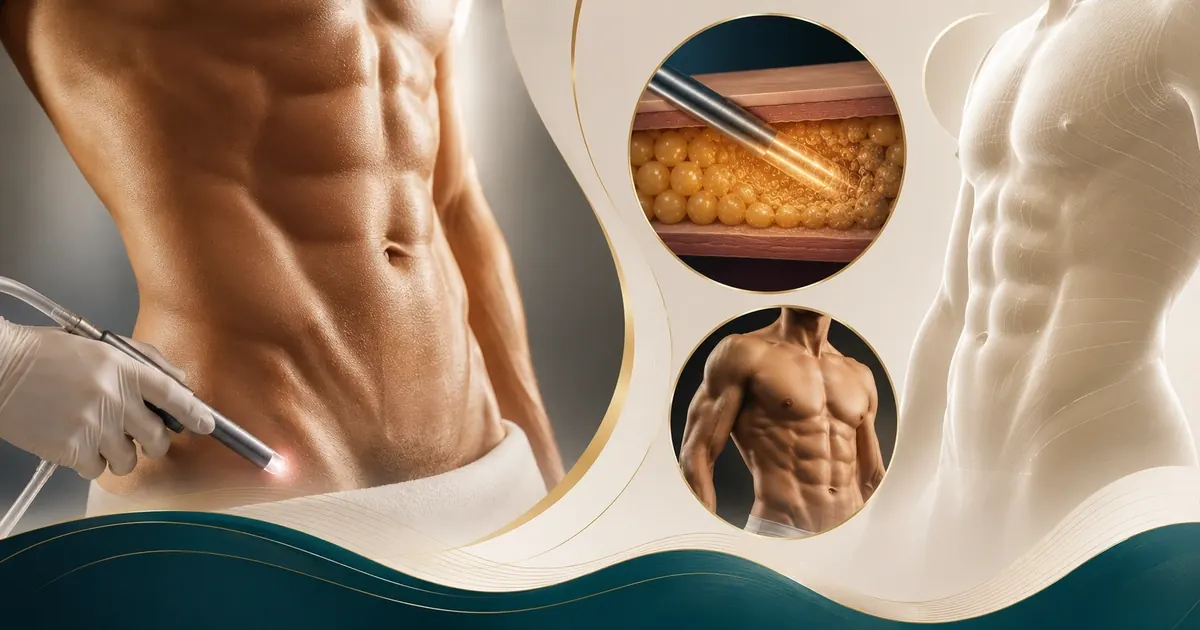
What Is HD Liposuction?
High-definition (HD) liposuction is an advanced body contouring technique that goes beyond standard fat reduction to create visible muscular definition. While standard liposuction aims to reduce volume and improve body proportions, HD lipo aims to sculpt an athletic appearance by selectively removing fat along anatomical muscle lines — creating shadows in the "valleys" between muscles and preserving fat over muscle bellies to create highlights.
The concept was pioneered by Dr. Alfredo Hoyos, who published the first clinical series on VASER-assisted high-definition lipoplasty — demonstrating that VASER ultrasound pre-treatment allowed safe removal of superficial fat to reveal underlying abdominal musculature.3
HD liposuction represents the intersection of surgery and artistic anatomy — the surgeon must understand muscular anatomy in three dimensions and sculpt fat accordingly. This is fundamentally different from standard liposuction, where the primary skill is uniform fat reduction. To understand how HD lipo relates to other approaches, visit our complete guide to liposuction methods.
HD vs Standard Liposuction
| Feature | Standard Liposuction | HD Liposuction |
|---|---|---|
| Primary goal | Volume reduction; proportion improvement | Muscular definition; athletic appearance |
| Fat layers treated | Deep fat primarily | Both superficial and deep fat |
| Artistic skill required | Moderate | Very high (anatomical sculpting) |
| Patient BMI range | Under 32–35 | Under 28 (ideally <26) |
| Underlying muscle needed | Not required | Essential (cannot create muscle) |
| Risk of irregularity | Low–moderate | Moderate–high (technique-dependent) |
| Surgeon pool | Large (most plastic surgeons) | Small (requires HD-specific training) |
| Cost multiplier | 1× (baseline) | 1.5–2.5× standard lipo pricing |
Levels of High-Definition
HD liposuction exists on a spectrum, often categorised as:
- Mid-Def (moderate definition): Subtle athletic appearance; natural-looking contour with hint of muscle lines. Suitable for patients wanting improvement without an obviously "worked-on" look.
- Hi-Def (high definition): Clear muscular lines visible; athletic six-pack appearance. The most common HD lipo goal.
- Ultra-HD: Extreme muscular definition — very lean, "fitness model" appearance. Pioneered in studies of Ultra-HD abdominal etching techniques showing dramatic muscular revelation is achievable in appropriately selected patients.2
Abdominal Etching Explained
Abdominal etching is the most requested HD liposuction procedure. It involves precisely sculpting the subcutaneous fat overlying the abdominal wall muscles to create visible "six-pack" lines — the linea alba (vertical midline), semilunar lines (lateral borders of rectus), and tendinous inscriptions (horizontal lines dividing the six-pack).
The Anatomy Behind Etching
The visible "six-pack" is created by natural fibrous structures in the abdominal wall that create depressions when subcutaneous fat is thin enough. In etching:
- Linea alba: Vertical midline groove — fat removed to the fascia in this narrow zone
- Semilunar lines: Lateral borders of the rectus abdominis — gentle depression sculpted here
- Tendinous inscriptions: Horizontal lines creating "packs" — fat minimised along these fibrous bands
- Oblique definition: V-lines at the lower abdomen; angular sculpting of the external oblique border
How Etching Is Performed
The surgeon first marks the anatomical lines with the patient standing and flexing. During surgery:
- Deep fat is reduced throughout the abdomen for overall slimming
- VASER emulsifies superficial fat along the marked anatomical lines
- Fat is selectively removed from the "valleys" (muscle borders) using fine cannulas
- Fat is preserved over muscle bellies (the "packs") to create convex highlights
- In some cases, fat is grafted over muscle bellies to enhance the highlight-shadow contrast
HD Lipo Technique & Technology
HD liposuction requires technology that enables safe, precise superficial fat removal. Working in the superficial fat layer (1–2 cm below the skin) carries higher risk of contour irregularities and skin damage than deep-layer work — making technology selection critical.
Why VASER Is the Gold Standard for HD
VASER ultrasound is the dominant technology for HD liposuction because:
- Tissue selectivity: Ultrasound energy preferentially disrupts fat while preserving fibrous septae — maintaining the structural "scaffolding" that prevents irregularities
- Safe superficial work: Pre-emulsification allows superficial fat removal with less mechanical trauma than traditional cannulas
- Smooth results: Preserved connective tissue acts as an internal scaffold for even skin retraction
- Fat transfer compatibility: VASER-harvested fat has good cell viability for grafting over muscle bellies
Other Technologies Used for HD
| Technology | HD Suitability | Advantage | Limitation |
|---|---|---|---|
| VASER (UAL) | Gold standard | Tissue-selective; safe superficial work | Equipment cost; training requirement |
| PAL (power-assisted) | Good | Precise; less surgeon fatigue | Less tissue-selective than VASER |
| Laser (LAL/SmartLipo) | Moderate | Skin tightening; coagulation | Risk of thermal injury superficially; less published HD evidence |
| Traditional SAL | Possible (expert only) | No equipment cost | Highest risk of irregularity superficially; most operator-dependent |
| Renuvion (J-Plasma) | Adjunct only | Skin tightening enhancement | Does not sculpt fat; used after lipo for retraction |
Ideal Candidates
HD liposuction is not appropriate for all liposuction patients. It is a body sculpting procedure for relatively fit individuals who want to enhance visible muscular definition — not a weight-loss or standard contouring procedure.
The Ideal HD Lipo Candidate
- BMI under 28 (ideally under 26) — the patient must already be relatively lean
- Regular strength training — underlying muscular development is essential (HD lipo reveals muscle, it cannot create it)
- Good skin elasticity — skin must retract smoothly over sculpted contours
- Thin-to-moderate subcutaneous fat that is obscuring existing definition
- Realistic expectations — understanding that results require maintenance through continued fitness
- Non-smoker — smoking impairs skin retraction and healing
- Commitment to maintenance — willing to maintain fitness and stable weight long-term
Who Should Choose Standard Lipo Instead
- BMI over 30: Standard liposuction for volume reduction is more appropriate; HD can be considered later after weight loss
- No muscular development: HD lipo cannot create muscle; there must be something to reveal
- Significant skin laxity: Loose skin will not retract properly over sculpted contours — may need abdominoplasty first
- Unwilling to maintain fitness: Weight gain quickly obscures HD results
- Unrealistic expectations: Expecting "bodybuilder" results without training or genetics to match
HD Lipo for Men vs Women
A systematic review of HD liposuction in males found that the procedure is particularly popular and well-suited to male anatomy — the masculine aesthetic of visible abdominal etching, pectoral definition, and V-taper back sculpting aligns well with what HD lipo can achieve.1 For women, HD lipo more commonly focuses on subtle "athletic" definition — gentle abdominal lines, defined waistline, and arm toning rather than aggressive six-pack etching.
Treatment Areas & Sculpting Goals
| Area | Male Goal | Female Goal | Technique |
|---|---|---|---|
| Abdomen | Six-pack etching; V-lines | Subtle vertical lines; flat with gentle definition | VASER + superficial sculpting + fat grafting |
| Chest | Pectoral definition; border sculpting | Under-breast definition (rare) | VASER emulsification + fine cannula sculpting |
| Arms | Bicep/tricep separation; deltoid definition | Toned appearance; reduced bulk with shape | Circumferential sculpting + superficial work |
| Back | V-taper; lat definition; erector spinae lines | Bra-roll elimination; hourglass enhancement | VASER (essential for fibrous back fat) |
| Flanks | Oblique definition; Adonis belt | Waist definition; hourglass silhouette | Deep reduction + superficial oblique sculpting |
The Multi-Area Approach
HD liposuction is almost always performed as a multi-area procedure. Sculpting the abdomen alone without addressing flanks, back, and chest creates an unnatural appearance — the body must look proportionally athletic from all angles. A comprehensive HD session typically treats the abdomen, flanks, and back as a minimum (Lipo 360 HD), with many patients adding chest and arms.
Results & Longevity
HD liposuction results develop gradually as swelling resolves and skin retracts over sculpted contours. The timeline for visible muscular definition is longer than standard liposuction because the superficial work causes more initial swelling.
Results Timeline
- Week 1–2: Significant swelling; results not visible; compression garment worn 24/7
- Week 3–4: Swelling beginning to subside; vague muscle lines may start appearing
- Month 2–3: 60–70% of final result visible; etching lines becoming clearer
- Month 4–6: Final result; skin fully retracted; maximum definition visible
- Month 6–12: Continued refinement; maintained by fitness and stable weight
Maintaining HD Results
Unlike standard liposuction where results are relatively stable with moderate weight fluctuation, HD results are more sensitive to body composition changes:
- Weight gain of 5–10 lbs: Slight blurring of definition; generally recoverable with diet
- Weight gain of 10–15 lbs: Significant definition loss; etching lines may become invisible
- Weight gain of 15+ lbs: Definition largely obscured; may require revision
- Losing muscle mass: Skin loses its contoured appearance over atrophied muscle
Patients who maintain regular strength training and stable body fat (under 18% for men, under 25% for women) can expect permanent, visible definition.
Risks & Complications
HD liposuction carries all the standard risks of liposuction plus additional risks related to superficial fat work. A review of complications in high-definition liposuction documented that while major complications remain rare, the overall complication rate is higher than standard liposuction — largely due to contour irregularities and seromas.4
HD-Specific Risks
| Complication | Approximate Incidence | Severity | Management |
|---|---|---|---|
| Contour irregularity | 5–15% | Minor–moderate | Often resolves with massage; may need revision |
| Seroma (fluid collection) | 3–8% | Minor | Aspiration; compression; usually self-limiting |
| Asymmetry | 3–7% | Minor–moderate | Touch-up procedure at 6+ months if persistent |
| Hyperpigmentation | 2–5% | Minor | Sun avoidance; usually fades over months |
| Over-resection (visible dents) | 1–3% | Moderate | Fat grafting correction |
| Skin necrosis | <1% | Serious | Wound care; may scar |
How to Minimise Risk
- Surgeon selection: Choose a board-certified plastic surgeon with documented HD-specific training and extensive before/after gallery
- Realistic expectations: "Ultra-HD" carries more risk than moderate definition
- Proper candidacy: BMI within range, good skin quality, existing muscle development
- Post-op compliance: Compression garment wear, lymphatic massage, activity restrictions
- Staged approach: Consider moderate definition first, with option to enhance later
A systematic review of HD liposuction efficacy confirmed that complication rates decrease significantly with surgeon experience — the learning curve is steep, and outcomes improve markedly after the first 50+ HD cases.5
For a broader overview of liposuction safety, see our Is Liposuction Safe? guide.
Cost
HD liposuction commands a significant premium over standard liposuction, reflecting the advanced technique, longer operative time (typically 3–5 hours for multi-area), specialist surgeon expertise, and the artistic skill required for sculpting results.
HD vs Standard Lipo Cost
| Procedure Scope | US (Total) | UK (Total) | Turkey (All-Inclusive) |
|---|---|---|---|
| Abdominal etching only | $6,000–$10,000 | £5,000–£9,000 | $3,500–$5,500 |
| Abdomen + flanks HD | $9,000–$14,000 | £7,500–£12,000 | $5,000–$7,500 |
| HD 360 (abdomen + flanks + back) | $12,000–$18,000 | £10,000–£16,000 | $6,000–$9,000 |
| Full-body HD (360 + chest + arms) | $16,000–$25,000+ | £14,000–£22,000 | $8,000–$12,000 |
| Standard lipo equivalent (comparison) | $6,000–$12,000 | £5,000–£10,000 | $3,000–$5,500 |
What Justifies the Premium
- Surgeon expertise: HD-trained surgeons have invested in extensive post-residency training (cadaver courses, mentorships, case volume building)
- Longer operative time: 3–5 hours vs 1–3 hours for standard lipo
- VASER equipment: Proprietary ultrasound system ($80,000–$150,000 investment)
- Artistic skill: HD results are uniquely dependent on the surgeon's ability to visualise and sculpt three-dimensional anatomy
- Revision risk: Higher touch-up rates mean surgeons build revision time into pricing
For detailed cost information across all liposuction techniques, see our comprehensive cost guide.
Frequently Asked Questions
-
HD (high-definition) liposuction is an advanced body sculpting technique that removes both deep and superficial fat to reveal underlying muscular anatomy — creating visible six-pack lines, pectoral definition, and athletic contours. It uses VASER ultrasound for precision and requires highly specialised surgeons. Unlike standard lipo which focuses on volume reduction, HD lipo creates an athletic, sculpted appearance.
-
Abdominal etching is an HD liposuction technique where fat is selectively removed along the natural lines of the abdominal muscles — the vertical midline (linea alba), lateral borders (semilunar lines), and horizontal lines (tendinous inscriptions). Fat is removed from these "valleys" while preserved over muscle bellies, creating the shadow-and-highlight effect of a defined six-pack. It requires existing underlying muscle development, as detailed in the ultra-high-definition abdominal etching technique paper.2
-
Ideal candidates have: BMI under 28 (ideally under 26), regular strength training with existing muscle development, good skin elasticity, a moderate fat layer obscuring existing definition, and commitment to maintaining fitness post-operatively. HD lipo reveals muscle — it cannot create it. Patients with BMI over 30, no exercise routine, or significant skin laxity should consider standard liposuction first.
-
HD liposuction costs significantly more than standard lipo due to advanced technique and specialist expertise. US costs: $6,000–$10,000 for abdominal etching alone; $12,000–$18,000 for HD 360 (abdomen + flanks + back); $16,000–$25,000+ for full-body HD. Turkey all-inclusive packages: $5,500–$9,000 for comprehensive HD sculpting. The premium reflects longer operative time, VASER equipment, and the artistic skill required.
-
HD liposuction carries a higher complication rate than standard liposuction — primarily contour irregularities (5–15%) and seromas (3–8%) due to superficial fat work.4 Major complications (skin necrosis, infection) remain rare (<1%). The risk is heavily dependent on surgeon experience — outcomes improve dramatically after 50+ cases. Choosing an HD-specialist surgeon with documented training and extensive before/after portfolio is the single most important safety factor.
-
HD lipo results are permanent in that removed fat cells do not regenerate. However, results are more sensitive to weight changes than standard lipo: gaining 10–15+ lbs can significantly obscure the sculpted definition. Maintaining results requires: staying within 5–10 lbs of procedure weight, continuing regular strength training, and maintaining low body fat. Patients who maintain fitness can expect visible definition permanently.