
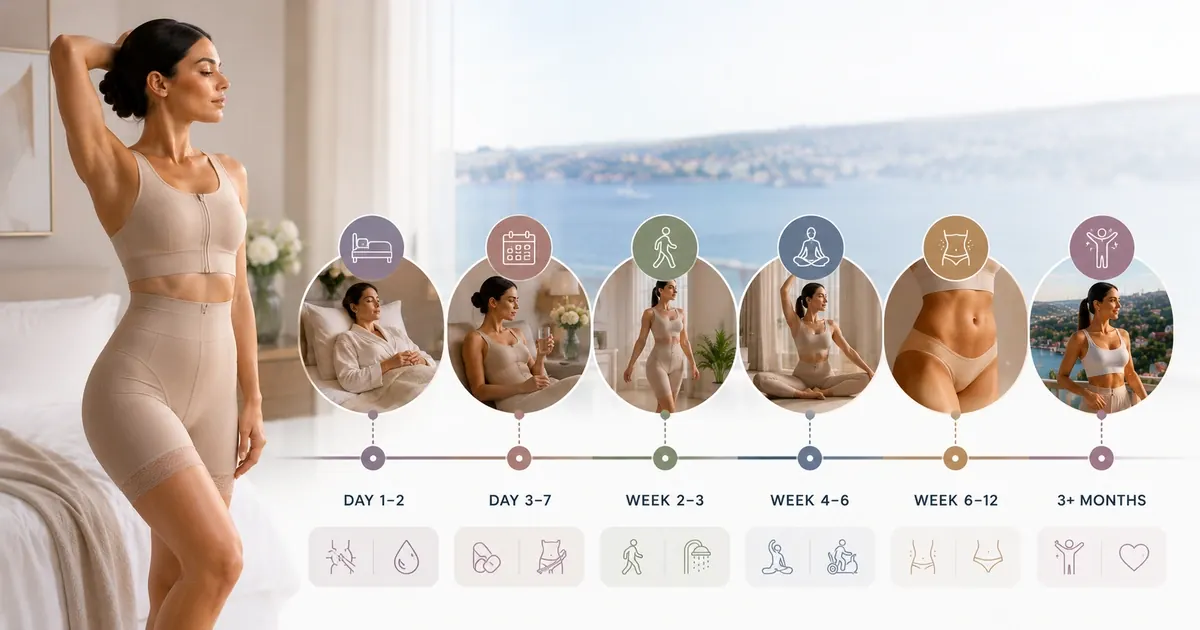
The First 72 Hours
The immediate post-operative period is the most uncomfortable phase of liposuction recovery. Understanding what is normal prevents unnecessary anxiety and ensures you seek help when something is genuinely wrong. This timeline is part of our recovery hub, where you can find companion guides on compression garments, swelling, fibrosis, and more.
- Day of surgery: You will be discharged with the compression garment fitted in the operating room. Pink-tinged fluid (tumescent solution mixed with blood) drains from the incision sites — this is expected and is not bleeding. Place absorbent padding under you when resting. Most patients feel sore, swollen, and tired. Have someone with you for the first 24 hours.
- Day 1–2: Swelling increases significantly — this is the peak swelling phase. Bruising is beginning to emerge (often more visible on day 2–3 than immediately after surgery). Short, gentle walks around the home are strongly encouraged to reduce venous thromboembolism (DVT) risk, in line with published VTE prevention guidance for plastic surgery patients.5 Do not remain immobile for extended periods.
- Day 2–3: Fluid drainage slows. Showering is usually permitted after 48 hours — follow your surgeon's specific instructions. Bruising may intensify and spread slightly downward from treated areas due to gravity. This is normal. Pain: manageable with paracetamol and/or ibuprofen in most cases; stronger prescription medication for the first 1–2 days if needed.
Week 1–2
Most surgeons recommend that liposuction patients return to non-strenuous (desk or remote) work within 1–2 weeks.
| Timepoint | Typical Experience | Activity Level |
|---|---|---|
| Days 1–3 | Peak swelling; bruising emerging; fluid drainage; soreness | Rest with gentle walking every 1–2 hours |
| Days 4–7 | Bruising peaks; swelling softening; drainage stopping | Short walks outside; light tasks; no driving if on opioids |
| Week 2 | Most bruising fading; swelling significant but softer; first improvement visible under garment | Desk work; light walking; no lifting >5 kg |
| Weeks 3–4 | Bruising largely resolved; swelling reducing; fibrosis developing (firmness under skin) | Light cardio (stationary bike, walking); no resistance training |
| Weeks 5–6 | Garment discontinued; swelling 60–70% resolved; contour emerging | Full cardio; light resistance training; swim |
| Months 2–3 | Swelling 80–90% resolved; fibrosis softening; contour progressively clearer | Full activity |
| Months 3–6 | Final result visible; all swelling resolved; skin fully retracted | Unrestricted |
Most surgeons recommend following structured activity guidance — particularly during weeks 1–4 — as this is associated with better outcomes and fewer complications than returning to activity at your own discretion.6
Weeks 3–6
This is the phase most patients find psychologically challenging — swelling is still present, the final result is not yet visible, and fibrosis (firmness under the skin) may make the treated area feel different from what was expected.
Fibrosis during weeks 3–6 is a normal healing response. Scar tissue forms in the disrupted fat layer, creating firmness, lumpiness, or a tight sensation under the skin. This is not a sign of a poor result — it is the tissue organising itself as it heals.7 Begin manual lymphatic drainage massage at 2–3 weeks as recommended by your surgeon.
The compression garment transitions from 24/7 wear to part-time (typically nights and several hours during the day) during weeks 4–6. Do not abandon the garment early — compression actively reduces fibrosis and seroma risk.
Light cardio — stationary cycling, brisk walking, gentle swimming — is permitted from weeks 3–4. Resistance training, heavy lifting, and high-impact exercise wait until week 6.
Months 2–6
The final stages of swelling resolution are often imperceptible week-to-week but clearly visible over months. At 2 months, most patients are 80–90% of their final result. At 3 months, 90–95%. Full skin retraction and complete swelling resolution occur at 3–6 months for standard procedures, and up to 6–9 months for large-volume or Lipo 360 procedures.
Fibrosis in months 2–6: Residual fibrosis — particularly in the lower abdomen and flanks — can persist. Continue lymphatic drainage massage if recommended. External therapeutic ultrasound therapy is used by some practitioners for persistent fibrosis. A clinical study of manual lymphatic drainage after liposuction confirmed it significantly accelerates post-surgical fluid clearance and subjective comfort during this phase.1
Scar maturation: The small cannula entry point marks continue fading during months 2–6. Silicone gel or sheet application may be used from 4–6 weeks onwards to optimise scar appearance.
Compression Garments: Why & How Long
The compression garment is one of the most important aspects of liposuction recovery. Research confirms it reduces swelling, bruising, seroma formation, fibrosis, and contour irregularity. A clinical study on post-liposuction compression garment use found that proper garment use significantly improved post-operative comfort and recovery speed.2
Standard protocol, consistent with the American Society of Plastic Surgeons' Practice Advisory on Liposuction:4
- Weeks 1–3: 24 hours/day (remove only to shower)
- Weeks 4–6: 12 hours/day (typically sleeping + several daytime hours)
- After week 6: Discontinued in most cases; some surgeons recommend additional part-time use for large procedures
Read our full compression garment guide for sizing, care, and what to do if the garment causes discomfort.
When to Call Your Surgeon
Most post-operative symptoms are expected and self-limiting. The following — drawn from the major serious-complication categories identified in a nationwide analysis of 69,424 liposuction patients3 — require prompt contact with your surgeon or emergency services:
- Chest pain or shortness of breath — possible pulmonary embolism: call emergency services immediately
- Fever above 38.5°C (101.3°F) — possible infection: contact surgeon same day
- Rapidly increasing pain or swelling in the treated area after the first 3 days
- Hard, red, hot swelling with skin changes — possible haematoma or deep infection
- Sudden leg pain, swelling, or warmth — possible DVT
- Incision site that will not stop bleeding after 20 minutes of firm pressure
- Foul-smelling drainage from incision sites after day 3
Frequently Asked Questions
-
Return to desk work: 1–2 weeks. Compression garment off: 6 weeks. Full exercise: 6 weeks. Final result visible: 3–6 months. Timelines are longer for large-volume or Lipo 360 procedures.
-
At 2 weeks, bruising is largely resolved or fading, swelling is significant but softer, and some early contouring is visible — especially under the compression garment. Without the garment, the area appears swollen. This is not the final result — swelling continues to resolve over months.
-
Gentle walking from day 1–2 (DVT prevention). Light cardio at week 3–4. Full exercise including resistance training at week 6. Most surgeons recommend following structured activity guidance, as this produces better outcomes than self-directed early return.
-
6 weeks total: 24/7 for the first 3 weeks, then part-time for 3 more weeks. Clinical evidence supports compression for reducing swelling, fibrosis, and seroma risk. Do not discontinue early without your surgeon's approval.
-
Yes — this is fibrosis, a normal healing response in which scar tissue forms in the disrupted fat layer. It typically peaks between weeks 3 and 8 and resolves with manual lymphatic drainage massage and compression by 3–6 months. It is not a sign of a poor result.