
What Is Tumescent Liposuction?
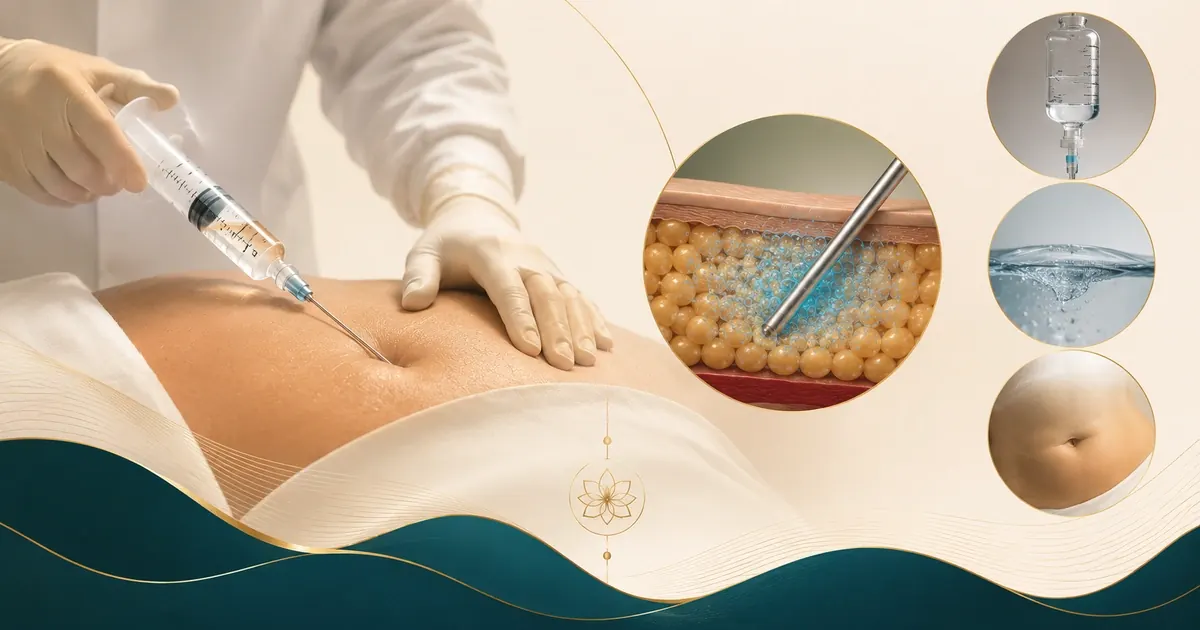
Tumescent liposuction is a technique in which large volumes of a very dilute solution of lidocaine (local anesthetic) and epinephrine (vasoconstrictor) are infiltrated into subcutaneous fat before suctioning begins. The word "tumescent" means "swollen and firm" — describing the state of the tissue after infiltration.
Developed by dermatologist Dr. Jeffrey Klein in the late 1980s, the tumescent technique revolutionised liposuction safety. Before tumescent, liposuction was performed either "dry" (no fluid) or with minimal "wet" infiltration — resulting in blood loss of 20–45% of aspirate volume, frequent need for blood transfusions, and significant complication rates including fatalities.
The tumescent technique reduced blood loss to less than 1% of aspirate volume, eliminated the need for transfusions, provided post-operative analgesia lasting 12–18 hours, and — most significantly — enabled liposuction to be performed safely under local anesthesia without general anesthesia or IV sedation.
Today, tumescent infiltration is not merely "a type" of liposuction — it is the foundation of all modern liposuction. When a patient has "VASER liposuction" or "laser liposuction," the first step is always tumescent infiltration. The tumescent solution is what makes modern liposuction safe regardless of which aspiration technology is subsequently used. To see how tumescent SAL fits alongside newer technologies, explore our full guide to liposuction types.
The Tumescent Solution
The tumescent solution is a precisely formulated mixture:
- Normal saline (0.9% NaCl): The carrier fluid — typically 1,000 ml bags
- Lidocaine (0.05–0.1%): Local anesthetic providing complete numbness for 12–18 hours
- Epinephrine (1:1,000,000): Vasoconstrictor that minimises bleeding
- Sodium bicarbonate (optional): Buffers the pH to reduce infiltration discomfort
The solution is infiltrated in a ratio of approximately 2–3 ml of solution per 1 ml of planned fat removal (superwet technique) or up to 3–4 ml per 1 ml (full tumescent technique). This volume creates the "tumescent" state — distended, blanched tissue that is easy to aspirate smoothly.
How the Tumescent Technique Works
The tumescent liposuction procedure follows a precise sequence that accounts for its superior safety and efficacy compared to older techniques.
Step-by-Step Procedure
- Marking: Target areas are marked with the patient standing to identify contour goals
- Access incisions: Tiny (2–4 mm) incisions are placed in natural creases or hidden locations
- Infiltration: Tumescent solution is delivered through blunt infiltration cannulas; the area becomes firm and blanched
- Waiting period: 15–30 minutes for epinephrine vasoconstriction to reach full effect
- Aspiration: Fat is suctioned through cannulas (3–5 mm) using negative pressure; the surgeon uses a cross-hatching pattern for smooth results
- Assessment: Contour is assessed by palpation and visual inspection; additional passes if needed
- Closure: Incisions are left open or loosely closed to allow fluid drainage (reduces swelling)
- Compression: Garment applied immediately
Why the Technique Works So Well
The tumescent approach provides multiple simultaneous benefits:
| Component | Mechanism | Clinical Benefit |
|---|---|---|
| High-volume saline | Hydrodissects fat from surrounding tissue | Easier, less traumatic aspiration |
| Tissue distension | Creates larger working space for cannula | Smoother contour results |
| Dilute lidocaine | Blocks nerve conduction throughout fat layer | Complete local anesthesia; 12–18hr post-op analgesia |
| Dilute epinephrine | Constricts capillaries and small vessels | Blood loss <1% of aspirate; no transfusions needed |
| Alkalinisation (bicarb) | Raises pH toward physiologic | Reduces infiltration discomfort |
| Open incisions post-op | Allows residual tumescent fluid to drain | Less swelling, faster recovery |
Safety Record & Evidence
The tumescent technique has the strongest safety evidence base of any liposuction approach. Three landmark studies established its exceptional safety profile:
The foundational study — a review of 15,336 tumescent liposuction procedures performed under local anesthesia — reported zero fatalities, zero hospitalizations, and no cases of pulmonary embolism, fat embolism, or hypovolemic shock.1 This safety record is unmatched by any other liposuction technique studied at comparable scale.
A subsequent series of 3,240 consecutive tumescent liposuction cases confirmed these findings, reporting no major complications requiring hospital admission and a minor complication rate (haematoma, infection) of less than 0.5%.2
The largest recent series — 4,380 tumescent liposuction patients — demonstrated comparable safety across multiple body areas, with no systemic lidocaine toxicity events despite large total infiltration volumes, confirming that the slow absorption kinetics of tumescent lidocaine provide a wide safety margin.3
Why Tumescent Is Safer Than Older Methods
| Safety Metric | Pre-Tumescent ("Dry/Wet") | Tumescent |
|---|---|---|
| Blood loss (% of aspirate) | 20–45% | <1% |
| Transfusion needed | Common for large volumes | Essentially never |
| General anesthesia required | Yes (always) | No (optional) |
| Mortality rate (reported) | 1 in 5,000–10,000 | 0 in 15,336 (local only) |
| Hospital admission rate | Common (inpatient procedure) | Outpatient; 0% admission in key studies |
| Post-op pain | Significant (immediate) | Delayed 12–18 hours (lidocaine analgesia) |
The Local Anesthesia Advantage
One of the most significant clinical advantages of tumescent liposuction is that it can be performed entirely under local anesthesia — eliminating the risks, cost, and recovery burden of general anesthesia. The tumescent solution delivers lidocaine directly into the fat layer at concentrations sufficient for complete surgical anesthesia.
Lidocaine Pharmacology in Tumescent Use
Traditional teaching limits lidocaine dosing to 4.5–7 mg/kg (with epinephrine). In tumescent liposuction, doses of 35–55 mg/kg are safely used because:
- Slow absorption: Fat tissue has poor blood supply; lidocaine absorbs very slowly from tumescent fat
- Epinephrine effect: Further delays absorption by constricting local vasculature
- Peak blood levels: Occur 8–12 hours after infiltration (not immediately)
- Removal with fat: A significant proportion of infiltrated lidocaine is removed with the aspirated fat
This pharmacokinetic profile means that blood lidocaine levels remain well below toxic thresholds despite the large total doses used — a principle confirmed across multiple large patient series without a single case of lidocaine toxicity.
Awake vs Sedated Tumescent Liposuction
While tumescent liposuction can be performed with the patient completely awake (local only), many patients and surgeons prefer adding light sedation for comfort. Options include:
- Local only: Oral anxiolytic (diazepam) + tumescent. Patient fully alert. Lowest risk, fastest recovery.
- Oral sedation: Stronger oral sedatives. Patient drowsy but arousable. No monitoring equipment needed beyond pulse oximetry.
- IV sedation (MAC): Propofol or midazolam by anaesthesiologist. Patient deeply sedated but breathing independently. Most common approach in surgical centres.
- General anesthesia: Full intubation. Necessary for very large-volume cases or when combined with other procedures (abdominoplasty).
The safety advantage of tumescent is strongest when performed under local or light sedation — avoiding the risks of general anesthesia. For more on this topic, see our guide to awake liposuction.
Comparison to Other Techniques
It is important to understand that tumescent is not "competing" with VASER or laser liposuction — it is the foundation upon which those technologies are built. When we say "tumescent liposuction" as a standalone technique, we mean tumescent infiltration followed by mechanical aspiration using standard cannulas (suction-assisted lipoplasty, or SAL).
| Feature | Tumescent SAL (Standard) | Tumescent + VASER | Tumescent + Laser | Tumescent + PAL |
|---|---|---|---|---|
| Fat disruption | Manual cannula | Ultrasound + cannula | Laser + cannula | Powered vibrating cannula |
| Equipment cost | Lowest | Highest | High | Moderate |
| HD sculpting ability | Limited | Excellent | Moderate | Good |
| Skin tightening claim | Via retraction only | Mild thermal effect | Collagen stimulation | Via retraction only |
| Surgeon fatigue | Higher (manual work) | Lower (pre-emulsified) | Moderate | Lowest (power-assisted) |
| Best for | General contouring; cost-conscious | HD definition; fibrous areas | Small areas; skin tightening | Large volumes; multiple areas |
For a comprehensive side-by-side analysis of all liposuction techniques, see our liposuction technique comparison guide.
When Standard Tumescent SAL Is the Best Choice
Standard tumescent liposuction (without VASER, laser, or PAL) remains the best choice when:
- The treatment area has soft, non-fibrous fat (abdomen in women, thighs)
- Standard contouring is the goal (not high-definition sculpting)
- Cost is a primary consideration
- The surgeon is highly experienced with manual techniques
- The patient wants to avoid general anesthesia (pure tumescent under local)
Candidates & Treatment Areas
Tumescent liposuction is suitable for virtually all liposuction candidates. As the baseline technique, it has no specific contraindications beyond those for liposuction in general:
- Adults within 30% of ideal body weight
- Localised subcutaneous fat deposits resistant to diet and exercise
- Good skin elasticity (or willingness to accept some laxity)
- No active infections, bleeding disorders, or uncontrolled medical conditions
- Non-smoker or willing to cease 4+ weeks before and after
Treatable Areas
All standard liposuction areas are treatable with tumescent technique: abdomen, flanks, thighs (inner and outer), arms, back, chin/neck, male chest, knees, calves, and ankles. The technique is particularly well-suited to areas with softer fat that responds readily to mechanical cannula aspiration — including the female abdomen, thighs, and arms.
For fibrous areas (male chest, upper back) or when high-definition sculpting is desired, tumescent infiltration is still used as the first step — but VASER or another technology may be added to the aspiration phase. Read about VASER liposuction for more on this approach.
Volume Limits and Safety
Professional guidelines recommend a maximum aspirate volume of 5,000 ml (5 litres) per session for outpatient liposuction. When tumescent liposuction is performed under local anesthesia alone, practical volume limits are typically lower (2,000–3,000 ml) because the procedure duration must remain manageable for a conscious patient. Higher volumes typically require IV sedation or general anesthesia and overnight monitoring.
Recovery Timeline
Recovery from tumescent liposuction follows a predictable course. A unique feature is the continued drainage of tumescent fluid from incision sites for 24–48 hours post-operatively — this is intentional (incisions are left open or loosely approximated) and significantly reduces post-operative swelling compared to techniques where incisions are closed immediately.
| Timeframe | What to Expect | Activity Level |
|---|---|---|
| Day 0 (procedure day) | Numbness persists 12–18 hours (tumescent lidocaine); drainage from incisions | Rest; walking within hours |
| Days 1–3 | Drainage slowing; mild soreness as lidocaine wears off; swelling building | Light home activities; gentle walks |
| Days 4–7 | Drainage stopped; swelling peaks; bruising developing; moderate soreness | Desk work possible for most; driving after 3–5 days |
| Weeks 2–3 | Swelling beginning to resolve; bruising fading; stiffness normal | Most normal activities; light walking/cycling |
| Weeks 4–6 | Major swelling resolved; contour visible; numbness improving | Return to exercise; compression garment weaning |
| Months 2–6 | Final result emerging; skin retraction complete; residual firmness resolving | Full activity; final assessment |
For a more detailed recovery guide with tips for optimising healing, see our liposuction recovery timeline.
Post-Operative Drainage: Normal and Beneficial
Patients are often alarmed by the volume of fluid drainage in the first 24–48 hours after tumescent liposuction. This is expected and beneficial: the draining fluid is residual tumescent solution (blood-tinged saline), not blood. Allowing it to exit through open incisions means less fluid trapped in tissues, which translates to less swelling, less bruising, and faster resolution of discomfort. Absorbent pads under clothing and waterproof mattress protection are recommended for the first 1–2 nights.
Cost
Tumescent liposuction is typically the most affordable form of liposuction because it requires no specialized technology beyond standard cannulas and a suction device. When performed under local anesthesia in an office-based surgical suite, costs are further reduced by eliminating operating room and anesthesiologist fees.
Cost Breakdown
- Surgeon's fee: $1,500–$5,000 per area (varies by region and experience)
- Facility fee: $500–$2,000 (or included if office-based)
- Anesthesia: $0 (local only) to $1,500 (IV sedation/MAC) to $2,500+ (general)
- Compression garment: $50–$200
- Post-op medications: $50–$150
- Total US range: $2,500–$7,500 per area
Turkey all-inclusive tumescent liposuction packages average $1,800–$4,000, covering surgeon, clinic, anesthesia, garment, medications, hotel, and transfers. See our liposuction cost guide for detailed country-by-country pricing.
Frequently Asked Questions
-
"Tumescent" means swollen and firm. In tumescent liposuction, large volumes of a dilute anesthetic solution (lidocaine + epinephrine in saline) are injected into the fat layer before suctioning. This causes the tissue to become distended and firm — making fat easier to remove, reducing blood loss to less than 1% of aspirate volume, and providing local anesthesia lasting 12–18 hours post-operatively.
-
Yes — tumescent liposuction under local anesthesia has the strongest safety record of any liposuction approach. A study of 15,336 patients reported zero fatalities and zero hospitalizations.1 The safety advantage comes from near-zero blood loss (due to epinephrine vasoconstriction) and avoidance of general anesthesia risks. All modern liposuction variants (VASER, laser) build upon tumescent infiltration as their safety foundation.
-
Yes — this is one of its defining advantages. The tumescent solution itself provides complete local anesthesia to the entire treatment area. Many patients have the procedure with only oral sedation or light IV sedation. Pure local anesthesia is most practical for 1–3 areas; larger multi-area cases often use IV sedation or general anesthesia for patient comfort and operative efficiency.
-
Most patients return to desk work within 2–5 days and resume exercise at 2–4 weeks. Residual tumescent fluid drains from incisions for 24–48 hours (this is normal and reduces swelling). Compression garments are worn for 3–6 weeks. Final results appear at 3–6 months as swelling fully resolves and skin retracts. The prolonged lidocaine analgesia (12–18 hours) means the first day post-op is relatively comfortable.
-
Tumescent SAL is the most affordable liposuction technique because it needs no proprietary equipment. US total costs range from $2,500 to $7,500 per area. Under local anesthesia in an office suite, costs can be at the lower end. Turkey all-inclusive packages (surgeon, clinic, hotel, transfers) average $1,800–$4,000. It costs 15–35% less than VASER or laser variants for the same treatment areas.
-
Virtually any area with subcutaneous fat: abdomen, flanks (love handles), thighs (inner and outer), arms, back, chin and neck, male chest, knees, calves, and ankles. It works especially well in areas with softer fat. For fibrous areas (male chest, upper back) or HD sculpting, VASER ultrasound may be added after tumescent infiltration for better results in those specific zones.