
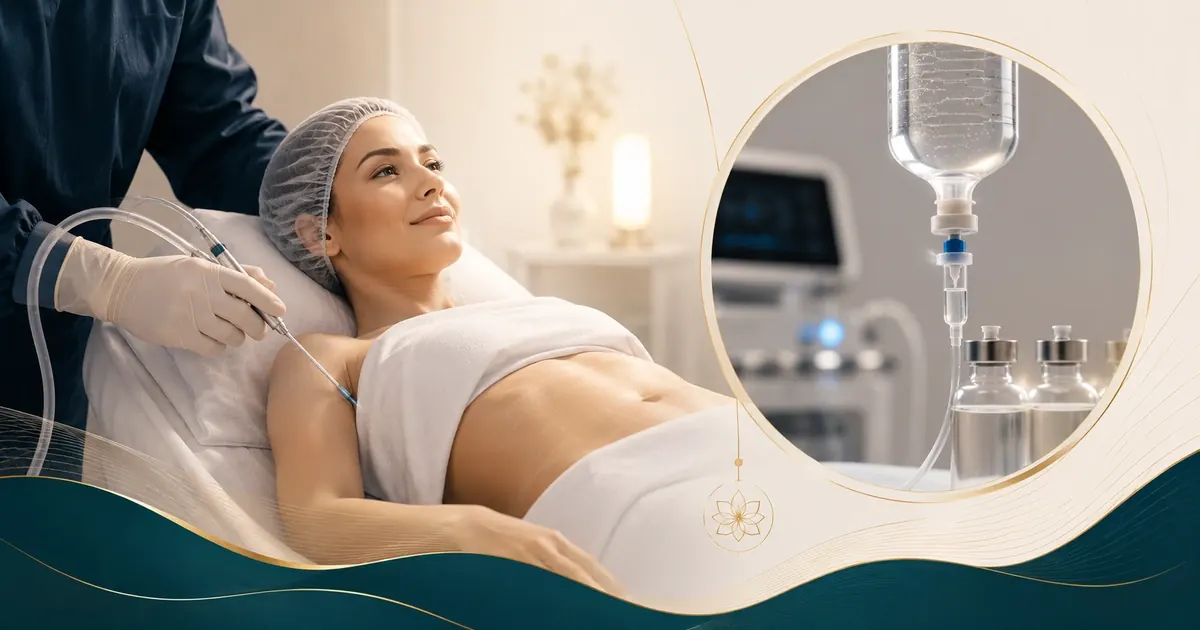
What Is Awake Liposuction?
Awake liposuction refers to liposuction performed while the patient is conscious — using tumescent local anesthesia to completely numb the treatment areas. The patient may take an oral anxiolytic (like diazepam) for relaxation, or light IV sedation may be added — but they are breathing independently and can communicate throughout the procedure.
The concept is made possible by the tumescent technique: large volumes of dilute lidocaine solution are infiltrated into the fat layer, providing complete surgical anesthesia to the treatment area without any systemic (whole-body) anesthesia. The patient feels no sharp pain in the treated zones — only pressure, movement, and vibration.
Awake liposuction is not a different type of liposuction — it is a different anesthesia approach. The actual fat removal can use any technique: standard cannulas, VASER, SmartLipo, or power-assisted liposuction. The distinguishing factor is that the patient is not under general anesthesia. For a broader look at all the methods available, see our liposuction types overview.
The Sedation Spectrum
"Awake" exists on a spectrum — from fully alert to deeply sedated but still breathing independently:
- Pure local: Tumescent anesthesia only + perhaps an oral anxiolytic. Patient fully alert and conversational.
- Oral sedation: Tumescent + oral sedatives (benzodiazepines). Patient drowsy but easily arousable.
- IV sedation / MAC: Tumescent + IV propofol or midazolam administered by an anesthesiologist. Patient deeply relaxed, may drift in and out of awareness, but breathing independently.
- General anesthesia: Full intubation, mechanical ventilation, unconscious. (This is NOT awake lipo.)
How Awake Lipo Feels
One of the most common questions about awake liposuction is whether it is painful or scary. Clinical experience consistently shows high patient satisfaction with awake approaches when proper tumescent technique and appropriate anxiolysis are used — the same landmark safety series of 15,336 tumescent procedures demonstrated that patients tolerate awake liposuction well under local anesthesia alone.1
Phase-by-Phase Experience
| Phase | Sensation | Discomfort Level | Duration |
|---|---|---|---|
| Initial needle entry | Brief sting (like a blood draw) | 2–3/10 | Seconds per entry point |
| Tumescent infiltration | Pressure, fullness, mild burning as fluid expands tissue | 3–5/10 (most uncomfortable phase) | 10–20 min per area |
| Waiting period | Numbness developing; treated area feels heavy and firm | 0–1/10 | 15–30 min |
| Liposuction aspiration | Pressure, pushing/pulling, vibration; no sharp pain | 1–2/10 | 20–60 min per area |
| Breakthrough areas | Occasional mild discomfort in insufficiently numb spots | 3–4/10 (brief; surgeon adds more solution) | Brief moments |
| Post-procedure | Numbness persists 12–18 hours; then gradual soreness | 0/10 initially; builds to 3–5/10 next day | Hours to days |
Real Patient Perspective
Most patients report that the tumescent infiltration phase is the most uncomfortable part — the feeling of fluid expanding tissue is described as "weird pressure" or "mild burning" lasting 10–20 minutes per area. Once numbness is established, the actual liposuction is described as feeling "someone pushing on you through a thick blanket" — no sharp pain, just movement and pressure. The procedure is well-tolerated with proper technique and anxiolysis.
Anesthesia Options Explained
Understanding the available anesthesia options helps patients make informed decisions about their comfort level and the trade-offs involved.
| Option | Patient Awareness | Who Administers | Setting | Volume Practical Limit | Additional Cost |
|---|---|---|---|---|---|
| Local only (pure awake) | Fully alert | Surgeon | Office or clinic | ~2,000–3,000 ml | $0 |
| Local + oral sedation | Drowsy, conversational | Surgeon | Office or clinic | ~2,500–3,500 ml | $50–$200 |
| IV sedation / MAC | Deeply relaxed; intermittent awareness | Anesthesiologist/CRNA | Accredited surgical center | Up to 5,000 ml | $800–$2,500 |
| General anesthesia | Unconscious; intubated | Anesthesiologist | Hospital/accredited center | Up to 5,000 ml | $1,500–$3,500 |
MAC (Monitored Anesthesia Care) — The Middle Ground
MAC sedation — often called "twilight anesthesia" — is the most common compromise between fully awake and general anesthesia. A review of monitored anesthesia care describes how MAC maintains patient safety (spontaneous breathing, intact airway reflexes) while providing significant anxiolysis and comfort — principles directly applicable to liposuction procedures.2
Under MAC, patients typically:
- Drift in and out of light sleep
- May not remember parts of the procedure (anterograde amnesia from midazolam)
- Can respond to requests ("turn onto your side, please")
- Breathe independently — no intubation needed
- Are monitored by an anesthesia provider throughout
Twilight Sedation vs General Anesthesia
Consensus guidelines on postoperative nausea and vomiting (PONV) confirm that avoiding general anesthesia is one of the most effective strategies for reducing PONV — patients under sedation or local anesthesia experience significantly less nausea than those under GA, supporting the use of MAC/twilight sedation for liposuction when patient comfort allows.3
Safety: Awake vs General Anesthesia
The safety advantage of awake liposuction is its strongest selling point. The landmark study of 15,336 tumescent liposuction procedures under local anesthesia reported zero fatalities and zero hospitalizations — a safety record unmatched by any study using general anesthesia.1
Risks Eliminated by Avoiding General Anesthesia
- Adverse anesthetic reactions: Allergies, malignant hyperthermia (rare but potentially fatal)
- Airway complications: Failed intubation, aspiration, laryngeal injury
- Respiratory depression: Over-sedation, post-operative breathing problems
- Post-operative nausea/vomiting: Affects 30–50% of GA patients; very rare with local
- Cognitive effects: Post-operative confusion, delayed reaction time (hours after GA)
- Prolonged recovery: GA requires hours of post-anesthetic monitoring
Safety Data Comparison
| Safety Metric | Local / Awake | MAC / Twilight | General Anesthesia |
|---|---|---|---|
| Mortality rate (literature) | 0 in 15,336 (local only) | Very low; limited separate data | ~1 in 50,000–100,000 |
| Hospitalization rate | 0% (outpatient) | <1% | 1–3% (large volume cases) |
| Nausea/vomiting | <5% | 10–20% | 30–50% |
| Over-sedation risk | None | Low (monitored) | Not applicable (intentional unconsciousness) |
| Time to discharge | 30–60 min post-op | 1–2 hours post-op | 2–4 hours post-op |
| DVT/PE risk factor | Lowest (early ambulation) | Low | Higher (longer immobility) |
Pros & Cons of Awake Liposuction
Advantages
- Superior safety profile: Eliminates all general anesthesia risks
- Faster recovery: No GA grogginess; patients walk out and often drive home (with escort)
- Lower cost: No anesthesiologist fee; can be performed in office setting (no hospital fees)
- Less nausea: Post-operative nausea extremely rare without GA agents
- Patient positioning: Patient can stand for contour assessment mid-procedure
- Immediate feedback: Patient can report any discomfort or concerns in real-time
- Post-op analgesia: Tumescent lidocaine provides 12–18 hours of numbness after surgery
- Earlier ambulation: Reduces DVT risk; accelerates lymphatic drainage
Disadvantages
- Patient anxiety: Some patients find being awake during surgery psychologically difficult
- Volume limitations: Practical limits lower than GA (2,000–3,500 ml vs 5,000 ml)
- Procedure duration: Patient comfort limits how long the procedure can last (typically <3 hours)
- Position changes: Difficult for 360-degree procedures (back + front) in fully awake patients
- Not suitable for: Very large-volume cases, procedures combined with other surgeries (tummy tuck), or highly anxious patients
- Infiltration discomfort: The tumescent phase is uncomfortable (3–5/10) and cannot be eliminated under pure local
Candidacy & Volume Limits
Ideal Candidates for Awake Liposuction
- Treating 1–3 areas with small-to-moderate fat deposits
- Patients who want to avoid general anesthesia (anxiety about "going under," prior bad reactions)
- Medical conditions that increase GA risk (obesity-related respiratory issues, cardiac conditions, difficult airway)
- Cost-conscious patients — saving $1,500–$3,500 on anesthesia fees
- Patients who value faster recovery — no GA grogginess, earlier return to activities
- Those comfortable with mild discomfort during the procedure in exchange for safety and recovery benefits
Volume Considerations
| Anesthesia Level | Practical Volume Limit | Typical Areas | Procedure Duration |
|---|---|---|---|
| Pure local (oral anxiolytic only) | 1,500–2,500 ml | 1–2 areas (chin, arms, small abdomen) | 1–2 hours |
| Local + oral sedation | 2,000–3,500 ml | 2–3 areas (abdomen + flanks) | 1.5–3 hours |
| Local + IV sedation (MAC) | 3,000–5,000 ml | 3–5 areas (lipo 360) | 2–4 hours |
| General anesthesia (comparison) | Up to 5,000 ml | Any number of areas | 2–5+ hours |
When General Anesthesia Is Preferred
- Large-volume liposuction: 4,000+ ml requiring extensive multi-area treatment
- Combined procedures: Liposuction + tummy tuck, or liposuction + breast surgery
- Highly anxious patients: Those who cannot tolerate being aware during surgery despite sedation
- Prone positioning: Extended back work is uncomfortable for awake patients
- HD sculpting: Multi-area VASER HD requires position changes and extended time that challenge patient tolerance
Recovery Differences
Recovery from the liposuction itself is identical regardless of anesthesia type — swelling, bruising, and contouring timelines are the same. The difference is in the immediate post-operative period — the first few hours after the procedure.
Immediate Post-Op: Awake vs GA
- Awake: Patient walks to recovery room immediately. Alert within minutes. Discharged 30–60 minutes post-procedure. No nausea. Can eat/drink immediately. Driven home by companion.
- General anesthesia: Patient transferred unconscious to PACU. Wakes over 30–60 minutes. Often nauseous. Monitored 2–4 hours. Groggy for 12–24 hours. Cannot make decisions or drive for 24 hours.
The tumescent lidocaine provides 12–18 hours of post-operative numbness — meaning awake lipo patients often report a very comfortable first day followed by gradual onset of soreness as the local anesthesia wears off. GA patients wake to immediate discomfort as the general wears off before the tumescent fully absorbs.
For detailed recovery information regardless of anesthesia type, see our liposuction recovery timeline.
Cost Comparison
Awake liposuction can be significantly less expensive than the same procedure under general anesthesia because it eliminates two major cost centres: the anesthesiologist and the operating room (when performed in an office-based suite).
| Cost Component | Awake (Office-Based) | MAC (Surgical Center) | General (Hospital/ASC) |
|---|---|---|---|
| Surgeon's fee | Same | Same | Same |
| Anesthesia provider | $0 | $800–$1,500 | $1,500–$3,500 |
| Facility / OR fee | $300–$800 (office) | $800–$2,000 | $1,500–$3,500 |
| Typical total savings | Reference (lowest) | +$1,000–$2,500 | +$2,500–$5,000 |
| Typical total cost (2 areas) | $3,000–$6,000 | $5,000–$9,000 | $6,000–$11,000 |
Turkey all-inclusive packages typically include anesthesia (usually MAC or GA) in the price, so the cost advantage of awake lipo is less significant for medical tourism patients. However, some patients still prefer awake procedures for safety and recovery reasons regardless of cost. See our liposuction cost guide for detailed pricing.
Frequently Asked Questions
-
Awake liposuction is liposuction performed under tumescent local anesthesia — the patient remains conscious and breathing independently. The tumescent solution (dilute lidocaine + epinephrine in saline) completely numbs the treatment area. Patients may take an oral sedative for relaxation or receive light IV sedation, but they are not under general anesthesia. The actual fat removal technique can be standard, VASER, laser, or power-assisted.
-
The tumescent infiltration phase (injecting numbing solution) is the most uncomfortable part — patients describe it as pressure and mild burning (3–5/10) lasting 10–20 minutes per area. Once numb, the actual liposuction is largely painless — patients feel pressure, pushing/pulling, and vibration but not sharp pain (1–2/10). Occasional "breakthrough" areas may cause brief mild discomfort before additional solution is added. Most patients say it was much less unpleasant than expected.
-
Yes — awake liposuction eliminates all risks specific to general anesthesia: adverse drug reactions, airway complications, respiratory depression, and post-anesthetic nausea. A landmark study of 15,336 patients under tumescent local anesthesia reported zero fatalities and zero hospitalizations.1 While modern general anesthesia is also very safe, the addition of GA necessarily introduces risks that local anesthesia does not carry.
-
Practical limits for fully awake procedures (local ± oral sedation) are 2,000–3,500 ml — limited by patient comfort over 2–3 hours rather than medical safety. With IV sedation (MAC), volumes up to the standard 5,000 ml safety limit are achievable. For most patients wanting 1–3 areas treated (chin, arms, small-to-moderate abdomen), awake volumes are perfectly adequate.
-
Good candidates include: patients treating 1–3 areas with moderate fat volumes; those wanting to avoid GA (anxiety, prior adverse reactions, or medical conditions increasing GA risk); cost-conscious patients (saving $1,500–$3,500 on anesthesia); and those valuing faster same-day recovery. Not ideal for: very large-volume removal (>4 L), highly anxious patients who cannot tolerate awareness, or procedures combined with other surgeries (tummy tuck).
-
Awake lipo (local only) means the patient takes an oral anxiolytic but remains fully alert and conversational. Twilight sedation (MAC) adds IV drugs (propofol, midazolam) administered by an anesthesiologist — the patient is deeply relaxed, may not remember the procedure, but still breathes independently. Both avoid general anesthesia intubation. Twilight is a common middle ground for multi-area procedures where full wakefulness isn't practical but GA isn't needed, as outlined in monitored anesthesia care guidelines.2