
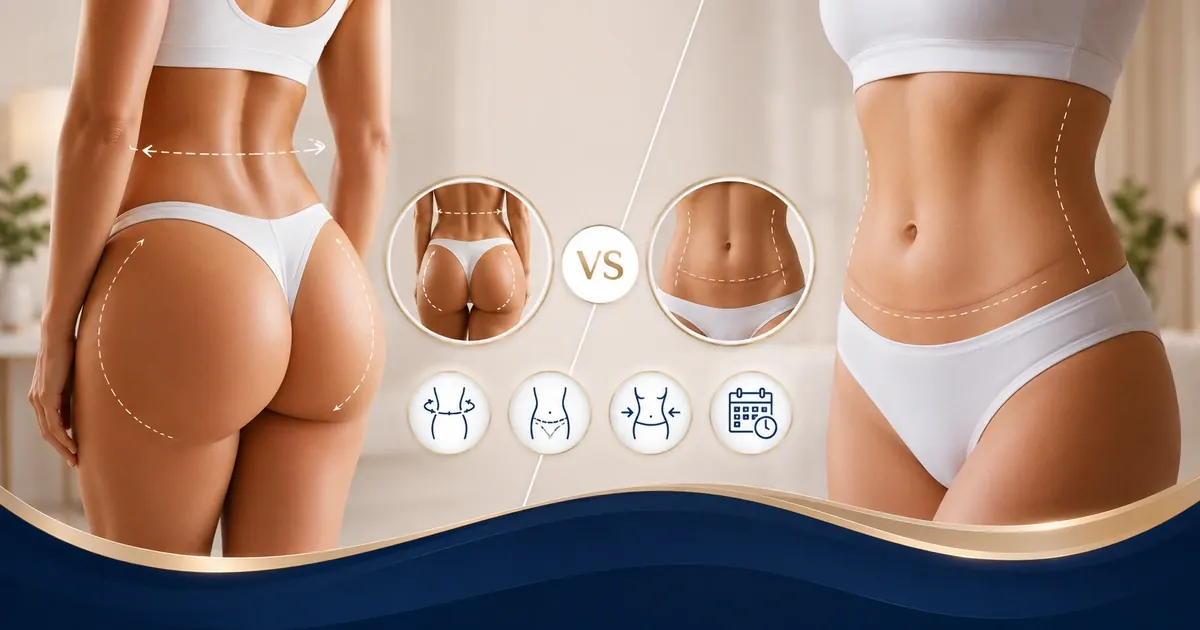
What Lipo 360 and Tummy Tuck Each Address
Lipo 360 and tummy tuck are two of the most commonly confused body-contouring procedures — partly because both target the midsection and partly because they are regularly combined. But they solve fundamentally different anatomical problems, and choosing the wrong one (or assuming one can substitute for the other) is one of the most common sources of dissatisfaction in body contouring. Understanding exactly what each addresses is the first step to knowing which you need.
What Lipo 360 treats: subcutaneous fat across the circumferential trunk
Lipo 360 is circumferential liposuction of the midsection — meaning it treats fat in every zone around the trunk in a single session: the anterior abdomen, lateral flanks, love handles, and lower back. A thin cannula is introduced through tiny incisions (typically 3–5 mm) and used to aspirate subcutaneous fat — the layer of fat that lies between the skin and the abdominal muscle fascia.
The procedure reshapes the visible waist contour from all angles. Because fat is removed all the way around rather than only from the front, surgeons can create an hourglass definition that anterior-only liposuction cannot replicate. Natural skin retraction — driven by dermal collagen remodelling — occurs over 3–6 months after fat removal, provided the skin has adequate baseline elasticity. This retraction is what gives the skin its snug appearance after Lipo 360 in good candidates.
What Lipo 360 cannot do is equally important: it cannot remove skin, it cannot tighten skin that has lost its structural elasticity, and it cannot repair the abdominal wall muscles. It also cannot address visceral fat — the deep fat that surrounds the internal organs. Only subcutaneous fat is accessible to a cannula.
What a tummy tuck treats: loose skin, excess skin, diastasis recti, and lower overhang
A tummy tuck (abdominoplasty) is a different category of procedure. It involves a horizontal incision along the lower abdomen (typically placed at or just above the bikini line), through which a section of skin and fat between the navel and the pubic area is surgically excised. The remaining skin is pulled downward, tensioned, and re-sutured, leaving a flat lower abdominal contour. The umbilicus is repositioned through a new opening in the redraped skin.
In a full abdominoplasty, the surgeon also plicates (sutures together) the two columns of the rectus abdominis muscle where they have separated — a condition called diastasis recti. This plication can dramatically flatten a midline bulge that no amount of fat removal would resolve. A mini tummy tuck (limited to the skin below the navel, without muscle repair) is an option when skin excess is confined to the lower zone and there is no significant diastasis.
The trade-off is a permanent horizontal scar — typically 20–30 cm wide in a full abdominoplasty, though placed low enough to be concealed under most underwear and swimwear. The procedure also has a longer, more demanding recovery than Lipo 360 alone, carries a higher risk profile, and is substantially more expensive.
The fundamental difference: fat vs skin vs muscle
The clearest way to understand the distinction is to assign each problem to its correct tool. Excess subcutaneous fat is a Lipo 360 problem. Excess or loose skin is a tummy tuck problem. Separated abdominal muscles (diastasis recti) are a tummy tuck problem. Many patients have a combination of all three — which is exactly why the combined lipoabdominoplasty procedure exists. But starting from first principles — what is the primary anatomical problem? — is the correct way to approach the decision, not starting from which procedure sounds less invasive.
What neither procedure addresses: visceral fat and weight loss
Both Lipo 360 and tummy tuck are body-contouring procedures, not weight-loss interventions. Neither procedure removes the visceral fat that sits inside the abdominal cavity around the organs — the fat responsible for a hard, protruding belly and the primary driver of metabolic health risk. Visceral fat is only reduced through sustained caloric deficit, exercise, and, where indicated, medical management. A patient with significant visceral fat will not achieve a flat abdomen from either procedure, because the internal fat volume continues to push the abdominal wall outward regardless of what has been done to the outer layers.
Surgeons typically require patients to be at or near their stable goal weight before proceeding with either procedure. Significant weight fluctuation after surgery can distort results, cause skin to re-loosen, and compromise the durability of a tummy tuck repair. Lipo 360 is best thought of as a refining tool for patients who have already achieved their weight goals through lifestyle means — not a shortcut to weight loss.
Full Lipo 360 guide: what it covers, candidacy, and recovery →
The Single Deciding Factor: Skin Elasticity
If you had to reduce the Lipo 360 vs tummy tuck decision to a single question, it would be: what is your skin's elasticity? This one variable — more than weight, age, or the amount of fat present — determines whether Lipo 360 alone will produce a good result or whether skin excision is required. Understanding how to think about elasticity, and how surgeons assess it, is the most useful preparation you can do before a consultation.
What the skin pinch and snap test reveals
The informal skin snap test involves pinching a fold of abdominal skin between the thumb and forefinger, pulling it gently away from the body, and releasing it. Skin with good elasticity snaps back firmly and quickly — within less than a second — with no residual fold or draping. Skin with poor elasticity releases slowly, returns partially, or remains in a draped position. This reflects the underlying collagen and elastin fibre network: both proteins degrade with age, sun exposure, significant weight fluctuation, and pregnancy-related stretching.
In clinical practice, surgeons assess far more than a simple snap. They evaluate skin thickness, the presence of stretch marks (which indicate the dermis has torn and been replaced by inelastic scar tissue), the degree of any existing skin overhang, and how the skin behaves when the patient is examined standing, sitting, and lying down. The snap test is a useful starting heuristic, but it is not a substitute for an in-person examination.
How to assess your own skin elasticity informally
Stand in front of a mirror and look at your lower abdomen from the front and the side. If you see a fold of skin hanging over the waistband, or if when you bend forward the skin gathers in draped folds rather than remaining taut, elasticity is likely compromised. Run a fingernail lightly across the abdomen: if you see a network of fine white or silvery lines (mature stretch marks), the dermis in those areas has undergone irreversible structural change and will not retract fully after fat removal.
Now try the snap test on multiple areas — the central abdomen, the lower abdomen above the pubis, and the flanks. The lower central abdomen is often the zone with the poorest elasticity, especially in post-pregnancy patients, and this is the zone where loose skin most commonly becomes a problem after Lipo 360 in patients who were not ideal candidates. If the snap test shows significant delay in multiple zones, this is a strong signal to discuss skin management — including the possibility of a tummy tuck — with your surgeon before proceeding.
Why diastasis recti always requires a tummy tuck
Diastasis recti — the separation of the two rectus abdominis muscles along the midline linea alba — is a structural problem that cannot be addressed by any form of liposuction. The midline bulge it causes is not a fat bulge; it is the abdominal organs pressing forward through a weakened fascial gap. No amount of fat removal changes this. In fact, removing the subcutaneous fat layer without addressing the underlying diastasis can make the midline bulge more visible, because the fat that was softening the contour of the protrusion has been removed.
Diastasis recti is particularly common after pregnancy — estimates suggest it affects up to 60% of women at 6 weeks postpartum, with a significant proportion persisting long-term — and after significant abdominal weight gain and loss. Any patient with confirmed or suspected diastasis who is seeking abdominal contouring must have this assessed and discussed before deciding between Lipo 360 and a tummy tuck. If diastasis is present and is contributing to the abdominal contour, a tummy tuck with muscle plication is the only surgical procedure that will address it.2
The post-pregnancy anatomy consideration
Post-pregnancy patients deserve particular attention because they commonly have a combination of all three problems: residual fat, skin laxity, and diastasis recti. The specific combination — and its severity — determines the appropriate procedure. A woman who regained her pre-pregnancy weight, has maintained good skin tone, and does not have significant diastasis may be an excellent Lipo 360 candidate. A woman with loose lower abdominal skin, stretch marks across the lower abdomen, and a palpable midline gap is almost certainly a tummy tuck candidate, with or without concurrent Lipo 360 for the flanks and lateral areas.
A useful rule of thumb for post-pregnancy patients: if you can pinch more than approximately 3–4 cm of skin fold at the lower abdomen while standing, or if you have a visible skin overhang when wearing form-fitting clothing, a tummy tuck consultation is warranted before committing to Lipo 360 alone. This is a general guide only — individual anatomy varies widely, and a surgeon's assessment is the only reliable arbiter.
| Patient profile | Skin elasticity | Diastasis recti? | Recommended procedure |
|---|---|---|---|
| Near ideal weight, no significant pregnancy history, fat as primary concern | Good — snaps back quickly | None / not suspected | Lipo 360 alone |
| Good weight, mild skin laxity, some residual fat after pregnancy | Moderate — some delay | Mild / none | Lipo 360 alone (with informed discussion of retraction limits) |
| Significant weight loss, excess lower abdominal skin, no diastasis | Poor — skin drapes | None | Tummy tuck (skin excision priority) |
| Post-pregnancy, loose skin, midline bulge | Poor — stretch marks, slow retraction | Confirmed / likely | Tummy tuck + muscle plication |
| Post-pregnancy or weight loss, loose skin, excess fat on flanks and back | Poor anteriorly | Confirmed / likely | Combined Lipo 360 + tummy tuck (lipoabdominoplasty) |
When Lipo 360 Alone Is the Right Choice
For the right patient, Lipo 360 alone produces transformative results with a fraction of the recovery, scarring, and cost of a tummy tuck. Understanding the specific characteristics that make a patient an ideal Lipo 360 candidate — and the results it can realistically achieve — sets accurate expectations and prevents the frustration of undergoing a procedure that cannot address the underlying anatomy.
Near-ideal weight with good skin tone
The classic Lipo 360 candidate is at or close to their stable goal weight (typically BMI under 30, though this is not a hard cutoff), has good overall physical health, and has not experienced extreme weight fluctuation. The key anatomical characteristic is subcutaneous fat as the primary concern — fat that can be felt as a soft, compressible layer beneath the skin — in the context of skin that has retained its structural integrity.
Good skin tone at this weight class means the skin will retract over the 3–6 months following the procedure, following the new, reduced fat volume. The end result is a smoother, slimmer midsection contour with waist definition visible from every angle — the defining goal of the 360-degree approach. Because the fat is removed from the flanks and lower back as well as the front, the circumferential improvement in waist definition is something anterior-only liposuction cannot replicate.
No overhanging skin fold
The presence or absence of a skin overhang is one of the clearest clinical indicators for or against Lipo 360 alone. A patient who can lift the lower abdominal skin with their hand and see a fold that hangs over the waistband — especially one that has its own underlying fat content and is prone to friction or moisture issues — is not an ideal Lipo 360 candidate. That fold is excess skin, not excess fat, and liposuction does not remove it.
Performing Lipo 360 on such a patient removes the fat that was plumping the fold, leaving the skin itself behind. The result is often a flatter central abdomen above the fold paired with a more deflated and potentially more visible fold below — the opposite of what the patient hoped to achieve. If no overhang is present and the abdominal contour is primarily determined by subcutaneous fat, Lipo 360 alone is appropriate.
No diastasis recti (confirmed or low suspicion)
In patients without diastasis recti, the abdominal wall is structurally intact and the midline is not contributing to the abdominal protrusion. Fat removal will produce a flat, defined result. In these patients, the absence of diastasis is confirmed either through physical examination (a trained surgeon or physiotherapist palpating the midline gap) or through imaging if there is clinical ambiguity. For most patients who have not been through multiple pregnancies and have not had a history of significant abdominal strain or rapid weight change, diastasis is not a major concern — but it should be evaluated at consultation before a final plan is made.
Results Lipo 360 achieves without a tummy tuck
In the right candidate, Lipo 360 achieves a significant and durable reduction in midsection fat volume, improved waist-to-hip ratio visible from all angles, softened love handles and flank fat, a flatter lower back, and a more defined silhouette in clothing. Over the weeks and months following surgery, as swelling resolves and skin retracts, the contour improvement becomes increasingly apparent. The result is permanent as long as weight is maintained — liposuction permanently removes fat cells from treated areas, and those cells do not regenerate. Significant weight gain after the procedure, however, will distribute new fat to remaining cells across the body, including in treated areas.
The key realistic expectation is that Lipo 360 improves contour — it does not dramatically tighten skin, smooth out all surface irregularities (some waviness or minor contour irregularity is possible), or change the underlying muscle definition. The aesthetic improvement is in reduction and reshaping, not in the kind of tight, sculpted result that requires both fat removal and skin tightening.3
Lipo 360 recovery timeline: week-by-week expectations →When a Tummy Tuck Is the Right Choice
A tummy tuck is a more invasive procedure with a longer recovery, a permanent scar, and a higher cost — but for the right patient, it achieves results that are simply not possible with liposuction alone. There are three primary indications, and they apply regardless of whether the patient also has excess fat to address.
Significant loose abdominal skin after weight loss or pregnancy
After bariatric surgery or significant lifestyle-driven weight loss, the skin that was stretched to accommodate the larger body volume does not fully retract. The degree of retraction depends on individual collagen quality, the rate of weight loss, age, and the total amount of weight lost — but in general, losses of more than 45–50 kg (100 lb) almost invariably leave significant skin excess. This skin excess, particularly in the lower abdominal zone, cannot be addressed by any non-surgical method and is a primary indication for abdominoplasty.
Post-pregnancy patients with loose lower abdominal skin face the same issue: the skin was stretched to accommodate a growing uterus, and — especially after multiple pregnancies — it does not fully retract. Many post-pregnancy patients have reached or returned to their goal weight but are left with a lower abdominal contour that no amount of dieting or exercise will change, because the limiting factor is skin, not fat or muscle tone. For these patients, a tummy tuck addresses the anatomical root cause.
Lower abdominal pannus or overhang
A pannus — the medical term for a hanging fold of abdominal skin and fat — represents excess tissue that cannot be corrected by fat removal. Pannuses vary in severity from a small fold that sits above the pubic area to a large apron that extends down the thighs. In addition to the cosmetic concern, a pannus can cause practical problems: skin-on-skin friction, moisture accumulation, skin infections (intertrigo), difficulty with hygiene, and interference with clothing fit and mobility.
A tummy tuck — specifically a full abdominoplasty or, in more severe cases, a panniculectomy (skin excision without the full tummy tuck components) — directly addresses the pannus by surgically removing the excess tissue. Lipo 360 alone not only cannot remove this tissue but, as noted above, can worsen the appearance of a pannus by removing the fat inside the fold while leaving the empty skin behind.
Diastasis recti causing abdominal bulge
Diastasis recti is a structural problem of the abdominal wall, and its correction requires a structural solution. Muscle plication — the suturing together of the separated rectus abdominis muscles during an abdominoplasty — physically narrows the interrectus gap, tightens the linea alba, and flattens the midline bulge. This cannot be achieved by any external device, physiotherapy programme, or body-contouring procedure other than surgery. Physiotherapy can improve function and stability, and can prevent diastasis from worsening, but cannot close a significant fascial gap that has caused visible midline protrusion.
For patients whose primary complaint is a rounded, protruding abdomen that persists regardless of weight or fitness level — particularly those with a palpable midline ridge when tensing the abdomen — diastasis recti is the likely culprit, and a tummy tuck with muscle plication is the appropriate procedure. This is one of the most satisfying categories of tummy tuck outcome because the improvement in flatness is structural rather than superficial.
Why adding Lipo 360 to a tummy tuck is often the default combination
A standard full abdominoplasty addresses the anterior abdomen — primarily the skin and muscle between the navel and pubis. It does not routinely address the flanks, love handles, or lower back. A patient who undergoes a tummy tuck alone may achieve a flat front but retain disproportionate flank fullness that the tummy tuck scar frames rather than eliminates. For this reason, surgeons commonly recommend adding lateral and posterior Lipo 360 to a tummy tuck — treating the full midsection comprehensively and achieving the most balanced circumferential result. This combination is addressed in detail in the next section.
Combined Lipo 360 + Tummy Tuck: When Both Are Needed
For patients who have both excess fat across the circumferential midsection and skin excess or diastasis anteriorly, combining Lipo 360 with a tummy tuck in a single operative session — the lipoabdominoplasty — is the most efficient and increasingly well-evidenced approach. It addresses the complete range of anatomical problems in one anaesthetic, avoids the additional risk and cost of two separate procedures, and typically produces a superior overall body-contouring result compared to either procedure performed in isolation for the same patient.
What the combination achieves
The combined procedure provides circumferential fat reduction across the full midsection (flanks, love handles, lower back, and anterior abdomen), surgical excision of the excess lower abdominal skin, repositioning of the umbilicus, and — in a full abdominoplasty component — repair of diastasis recti. The result is a simultaneously flatter, tighter, and narrower midsection from every angle. The tummy tuck component handles the anterior skin tightening and structural repair that Lipo 360 cannot provide; the Lipo 360 component handles the circumferential fat and lateral contouring that a standard tummy tuck alone would leave unaddressed.
The combined approach requires careful surgical planning, particularly regarding blood supply to the abdominal skin flap. Earlier concerns about vascular compromise from combining aggressive liposuction with abdominoplasty have been substantially allayed by the selective and anatomically aware liposuction technique described by Saldanha and others, which preserves the key perforating vessels that supply the flap while still achieving effective fat removal.1
Evidence for combined safety: 1,000 consecutive cases
The safety of combining Lipo 360 with abdominoplasty is well-supported in the peer-reviewed literature. Saldanha et al. published a review of 1,000 consecutive cases of abdominoplasty with circumferential liposuction, demonstrating the procedure's safety and reporting high patient satisfaction rates when patient selection criteria were carefully applied (PMID 29979368).1 An earlier prospective study by Matarasso et al. of 360 patients treated with liposuction, lipoabdominoplasty, or abdominoplasty further delineated the appropriate patient for each approach and confirmed that lipoabdominoplasty produces superior global results in patients who have both fat and skin excess compared to either procedure alone (PMID 22183499).2
Both studies underscore the importance of patient selection. The combined procedure is not appropriate for every patient — those with limited skin excess and good elasticity do better with Lipo 360 alone, avoiding unnecessary scarring and recovery burden. But for appropriately selected candidates, the evidence consistently supports both the safety and the superior outcomes of the combination approach.
Operative time and recovery versus separate procedures
A combined Lipo 360 plus tummy tuck typically takes 4–6 hours under general anaesthesia, compared to 2–4 hours for Lipo 360 alone and 2–4 hours for a tummy tuck alone. The longer operative time does modestly increase anaesthetic risk and the risk of venous thromboembolism (VTE) — a potentially serious complication that is managed through appropriate mechanical compression and pharmacological prophylaxis. Well-managed surgical centres performing high volumes of combined procedures have well-established protocols for this.
The recovery from the combined procedure essentially follows the tummy tuck timeline — the more demanding of the two. Patients should plan for 3–4 weeks before returning to desk-based work, approximately 2 weeks of limited mobility and bent-forward posture as the skin flap settles, abdominal binding for 6–8 weeks, and full resumption of exercise at 10–12 weeks. The Lipo 360 component adds some additional bruising and swelling to the flanks and back, but does not independently prolong the recovery beyond the tummy tuck baseline. The advantage of combining is clear: achieving in one recovery period what would otherwise require two separate recoveries months apart.
Cost of combined versus individual procedures
The combined procedure costs more than either procedure alone, but significantly less than the two performed separately. The reason is shared fixed costs: operating room time, anaesthesia fees, and nursing staff are all shared across a single session rather than duplicated. In the US, a combined lipoabdominoplasty all-in typically costs $12,000–$25,000, compared to $7,000–$18,000 for Lipo 360 alone and $8,000–$20,000 for a tummy tuck alone. In Turkey, all-inclusive combined packages typically range from $4,000–$8,500, with significant variation by clinic tier and extent of the procedure. Detailed cost data is in the cost section below.
Recovery Comparison
Recovery is one of the most significant practical differences between Lipo 360 and a tummy tuck, and it is frequently underestimated — particularly for the tummy tuck. Patients who have undergone one procedure and then later undergo the other consistently describe the tummy tuck recovery as substantially more demanding in terms of both duration and restriction. Understanding what each recovery actually involves helps in planning time off work, arranging support at home, and setting accurate expectations about when you will feel like yourself again.
Lipo 360 recovery timeline
Lipo 360 recovery is manageable for most patients. The first 48–72 hours involve the most acute discomfort: bruising, swelling, soreness, and fluid drainage through the small incision sites are all normal. Most patients take 5–7 days off work for sedentary roles and up to 2 weeks for physically demanding jobs. Compression garments are worn continuously for the first 4–6 weeks to support the treated tissue and minimise swelling.
By weeks 2–3, most patients feel well enough to resume light activity. Swelling — the primary variable in how results look during recovery — continues to resolve over 3–6 months, with the majority of the final result visible at the 3-month mark. Full exercise, including abdominal training, is typically cleared at 6 weeks. The small puncture incisions from Lipo 360 do not leave visible scarring in most patients and do not require the same wound care attention as a tummy tuck incision.
Tummy tuck recovery timeline
Tummy tuck recovery is more demanding and more prolonged. In the first 1–2 weeks, patients often cannot stand fully upright due to tension on the abdominal repair and skin closure — a bent-forward posture is normal and should not be forced. Drains are typically in place for 1–2 weeks to manage fluid accumulation beneath the flap. Patients returning to desk-based work typically require 3–4 weeks minimum; some return at 2–3 weeks if commuting and sitting is manageable, while others with physically demanding roles may need 6 weeks or more.
The abdominal binder or compression garment is worn for 6–8 weeks. Most patients experience significant swelling, particularly in the lower abdomen and around the navel, which takes 3–6 months to fully resolve. Full exercise — including any abdominal exercises or heavy lifting — is typically not cleared until 8–12 weeks post-operatively, to allow the muscle plication sutures to consolidate fully. The horizontal scar, initially red and raised, matures to a flat, pale line over 12–18 months and is placed to be concealed under standard swimwear.
Combined procedure recovery
The combined Lipo 360 plus tummy tuck recovery follows the tummy tuck timeline, with additional swelling and bruising in the flanks and back from the liposuction component. The upright posture restriction, drain management, and return-to-work timeline are determined by the tummy tuck rather than the liposuction. Most patients find that the liposuction swelling in the lateral areas resolves somewhat faster than the anterior tummy tuck swelling, and the full result — with all swelling resolved and the scar well-matured — is typically assessed at 6–12 months post-operatively.
| Recovery stage | Lipo 360 alone | Tummy tuck alone | Combined Lipo 360 + tummy tuck |
|---|---|---|---|
| Drains removed | None typically | 1–2 weeks | 1–2 weeks |
| Stand fully upright | Day 1–2 | 1–2 weeks | 1–2 weeks |
| Return to desk work | 1–2 weeks | 3–4 weeks | 3–4 weeks |
| Compression garment worn | 4–6 weeks | 6–8 weeks | 6–8 weeks |
| Light walking / gentle movement | Week 1–2 | Week 2–3 | Week 2–3 |
| Return to exercise (light) | 3–4 weeks | 6–8 weeks | 6–8 weeks |
| Full exercise / heavy lifting | 6 weeks | 8–12 weeks | 10–12 weeks |
| Majority of swelling resolved | 6–10 weeks | 3–6 months | 4–6 months |
| Final result visible | 3–6 months | 6–12 months | 6–12 months |
Cost Comparison
Cost is one of the most frequently cited factors in the Lipo 360 vs tummy tuck decision. Lipo 360 is consistently less expensive than a tummy tuck in every market — reflecting the shorter operative time, smaller incision, and less involved recovery support. However, the cost differential between markets (particularly the US vs Turkey) is substantial, and for many patients the ability to access high-quality combined procedures in lower-cost markets changes the equation significantly.
Lipo 360 cost range: US, UK, and Turkey
In the United States, Lipo 360 all-inclusive (surgeon fee, anaesthesia, facility, garments, standard post-op visits) typically ranges from $7,000 to $18,000, with the wide range reflecting geography, surgeon experience, the number of zones treated, and whether enhanced techniques such as VASER or laser-assisted liposuction are used. Major metropolitan areas (New York, Los Angeles, Miami) are at the upper end of this range.
In the United Kingdom, Lipo 360 all-in typically costs £5,000–£12,000, with London-based clinics at the top of the range. In Turkey — a major destination for medical tourism from the UK, Europe, and increasingly North America — all-inclusive Lipo 360 packages (clinic accommodation, surgery, transfers, garments, standard aftercare) typically range from $2,000 to $4,500. The price differential reflects lower labour costs and operational overheads rather than lower-quality surgery; many Turkish surgeons performing these procedures are fellowship-trained and operate at JCI-accredited facilities.
Tummy tuck cost range: US, UK, and Turkey
A full abdominoplasty in the United States all-in typically ranges from $8,000 to $20,000. The higher end of the range reflects complex cases (revision procedures, simultaneous muscle repair and skin excision with significant technical demand), high-overhead practices, and major cities. Mini tummy tuck — a less extensive variant — is typically at the lower end of the full abdominoplasty range or slightly below.
In the UK, a full tummy tuck all-in typically ranges from £6,000 to £14,000. Turkey all-inclusive tummy tuck packages typically range from $3,000 to $6,500, with full lipoabdominoplasty (tummy tuck with concurrent liposuction of multiple areas) ranging from $4,000 to $8,500. As with Lipo 360, the all-inclusive nature of Turkish packages — which typically include pre-operative testing, hospital stay, transfers, accommodation, garments, and follow-up — makes direct cost comparison with itemised US or UK quotes complex.4
Combined procedure cost: not simply additive
A key point for patients considering both procedures: the combined lipoabdominoplasty does not cost as much as Lipo 360 plus a tummy tuck performed as two separate sessions. The largest cost components in any surgical procedure are operating room time and anaesthesia — and these are shared (not duplicated) when both procedures are performed in a single session. The combined procedure therefore typically costs 30–50% less than the two procedures priced and performed separately, making it a financially rational choice for patients who genuinely need both.
| Procedure | US all-in (USD) | UK all-in (GBP) | Turkey all-inclusive (USD) |
|---|---|---|---|
| Lipo 360 alone | $7,000–$18,000 | £5,000–£12,000 | $2,000–$4,500 |
| Mini tummy tuck | $6,000–$12,000 | £4,500–£9,000 | $2,500–$4,500 |
| Full tummy tuck (abdominoplasty) | $8,000–$20,000 | £6,000–£14,000 | $3,000–$6,500 |
| Combined Lipo 360 + tummy tuck | $12,000–$25,000 | £9,000–£18,000 | $4,000–$8,500 |
| Two separate procedures (estimate) | $15,000–$38,000 | £11,000–£26,000 | $5,000–$11,000 |
Costs are approximate ranges based on published market data and clinic package pricing as of 2026. Individual quotes vary by surgeon, facility tier, procedure extent, and whether revision or enhanced techniques are required. Turkey figures reflect all-inclusive packages (accommodation, transfers, aftercare, garments). US and UK figures reflect standard all-in pricing excluding travel.
| Feature | Lipo 360 alone | Tummy tuck alone | Combined Lipo 360 + tummy tuck |
|---|---|---|---|
| Removes subcutaneous fat (full midsection) | Yes | Anterior only | Yes — full midsection |
| Removes excess abdominal skin | No | Yes | Yes |
| Repairs diastasis recti | No | Yes (full abdominoplasty) | Yes (full abdominoplasty component) |
| Repositions navel | No | Yes | Yes |
| Visible scar | Tiny punctures only | Horizontal bikini-line scar | Horizontal bikini-line scar |
| General anaesthesia required | Usually sedation or GA | General anaesthesia | General anaesthesia |
| Treats visceral fat | No | No | No |
| Useful for weight loss | No — contouring only | No — contouring only | No — contouring only |
Frequently Asked Questions
-
The deciding factor is skin laxity and whether diastasis recti is present. If you have excess subcutaneous fat with good skin elasticity — the skin snaps back firmly when pinched — Lipo 360 alone is typically appropriate. If you have loose or overhanging abdominal skin, or separated abdominal muscles (diastasis recti), a tummy tuck is needed because Lipo 360 cannot address skin excess or muscle separation. A surgeon's physical assessment is the only reliable way to determine which applies to you.
-
Not surgically. As fat is removed, the overlying skin retracts naturally over 3–6 months — provided baseline elasticity is good. This is natural skin contraction driven by dermal collagen remodelling, not surgical tightening. Patients with poor elasticity, significant stretch marks, or post-pregnancy skin laxity will not achieve the same degree of retraction. A tummy tuck is the only surgical procedure that physically removes and tightens excess abdominal skin.
-
Yes. Combining Lipo 360 with abdominoplasty in one session — termed lipoabdominoplasty — is well-established. A review of 1,000 consecutive cases confirmed the combination is safe and produces superior midsection contouring in appropriately selected patients.1 The combined procedure adds operative time, recovery time, and cost compared to Lipo 360 alone, but achieves circumferential fat removal, skin tightening, and muscle repair in a single anaesthetic episode.
-
Lipo 360 is typically less expensive. In the US, Lipo 360 all-in costs approximately $7,000–$18,000 versus $8,000–$20,000 for a full tummy tuck. In Turkey, all-inclusive Lipo 360 packages average $2,000–$4,500 versus $3,000–$6,500 for a tummy tuck. A combined Lipo 360 plus tummy tuck is more expensive than either alone, but costs substantially less than the two procedures performed as separate sessions — shared operating room time and anaesthesia account for the saving.
-
A basic self-check: lie on your back with knees bent, place fingertips horizontally at your navel, and slowly lift only your head and shoulders. If you feel a gap between the two muscle columns wider than about 2 finger-widths, diastasis recti is likely. A bulge or vertical ridge down the midline when tensing the abdomen is another common sign. Formal diagnosis requires ultrasound or physical examination by a surgeon or physiotherapist. Confirmed diastasis is one of the clearest indications for a tummy tuck rather than Lipo 360 alone.
-
It can in patients who are not good candidates. When fat is removed from skin that lacks the elasticity to retract, the skin can appear more lax, crepe-like, or rippled after the procedure than before — because the fat that was filling the skin envelope is no longer present. Performing Lipo 360 on a patient who needed a tummy tuck can worsen their cosmetic outcome. This is why thorough pre-operative candidacy assessment is essential before proceeding with Lipo 360.