
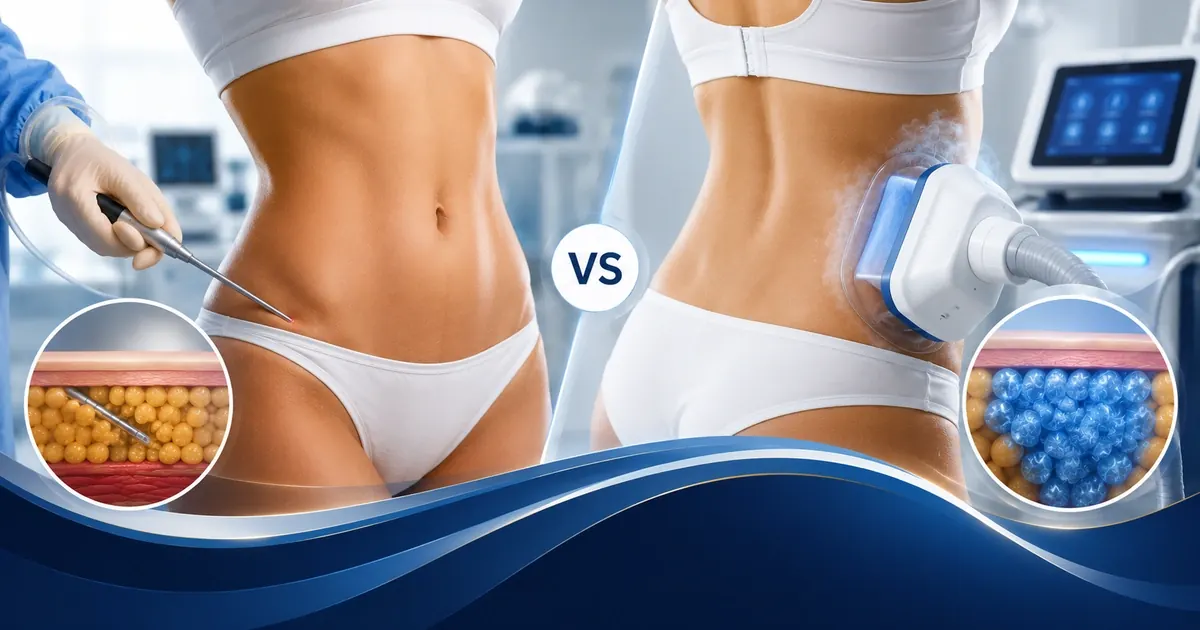
How Each Procedure Works
Liposuction and CoolSculpting are both used to reduce unwanted fat deposits, but their mechanisms are entirely different — one is a surgical procedure, the other is a non-invasive device treatment. Understanding how each works at a physiological level is the foundation for understanding every difference in results, timelines, risks, and costs.
Liposuction: Tumescent Infiltration and Mechanical Fat Removal
Modern liposuction uses the tumescent technique as its standard foundation. A large volume of tumescent fluid — a dilute solution of saline, lidocaine (local anaesthetic), and epinephrine (vasoconstrictor) — is injected into the subcutaneous fat layer before any fat is removed. The lidocaine anaesthetises the area; the epinephrine constricts blood vessels to minimise bleeding. The fluid also expands the fat compartment, making it easier to manoeuvre the cannula and reducing trauma to surrounding tissue.4
Once tumescent fluid is injected, a thin hollow tube called a cannula — typically 2–4 mm in diameter — is inserted through tiny incisions (2–4 mm). The surgeon moves the cannula back and forth in a controlled fanning motion through the fat layer, physically disrupting and suctioning out fat cells. The fat is simultaneously broken up and vacuumed into a collection canister. The volume removed is measurable in the canister at the end of the procedure. The entire process is immediate — when the cannula is withdrawn, the fat is gone.
Variant techniques add energy to the cannula — laser energy (SmartLipo), ultrasound energy (VASER), or radiofrequency — to liquefy fat before suction. These are modifications of the same fundamental mechanism: mechanical removal of fat cells through suction. The fat cells removed do not regenerate.
CoolSculpting (Cryolipolysis): Controlled Cooling Triggers Adipocyte Apoptosis
CoolSculpting works on the principle that fat cells are more sensitive to cold temperatures than the overlying skin. An applicator is placed on the skin surface and draws the tissue into a vacuum cup, then cools the drawn-in tissue to approximately −5°C to −10°C for 35–60 minutes depending on the applicator model.
At this temperature, the fat cells undergo cryolipolysis — controlled cold injury that triggers apoptosis, a programmed cell death pathway. The fat cells do not die immediately on the table. Instead, they begin a biological process of self-destruction that unfolds over weeks to months. The cellular debris from apoptotic fat cells is cleared by the body's immune system — specifically by macrophages that phagocytose (engulf and digest) the dead cells and their lipid contents. This clearance process takes 2–4 months to complete.
No incisions are made. No anaesthesia is required. The patient typically feels intense cold and pressure during the treatment, followed by temporary numbness. After the applicator is removed, a brief manual massage of the treated area is performed to break up the crystallised fat tissue and improve efficacy.
The Key Mechanistic Difference: Surgical Removal vs Biological Cell Death Over Weeks
The mechanistic difference between these two procedures produces every practical difference a patient experiences:
- Immediacy: Liposuction removes fat in the procedure. CoolSculpting initiates a biological process that unfolds over months.
- Volume: Liposuction removes fat in litres. CoolSculpting reduces the treated layer by a percentage — modest in absolute terms.
- Controllability: Liposuction allows the surgeon to sculpt and contour in real time. CoolSculpting applies a fixed cooling profile to a fixed applicator footprint — the result is determined by the biology, not the operator's skill in the moment.
- Repeatability: With each CoolSculpting cycle, the remaining fat layer is thinner — and each subsequent cycle achieves progressively smaller absolute reduction. This is why stacking cycles yields diminishing returns.
How Much Fat Each Can Remove
The difference in fat removal volume between these two procedures is one of the most important practical distinctions — and one that is often underplayed in non-surgical marketing.
Liposuction Removes Fat Immediately and in Measurable Volume
Liposuction removes fat in a volume that is measured directly in the collection canister. A typical single-area treatment removes 500 mL to 2 litres of fat. Multi-area sessions can safely remove up to 5 litres of fat in a single operative session in healthy patients, though most surgeons cap single-session removal at 3–4 litres for safety, with higher volumes requiring hospitalisation.4 A 2025 nationwide analysis of 69,424 liposuction patients confirmed that higher-volume cases carry incrementally greater risk, reinforcing why volume limits exist.2
The volume removed is visible and measurable. The patient wakes from the procedure with less fat in the treated area — the shape change is real, immediate, and confirmed at the time of surgery. Swelling and bruising temporarily obscure the final contour for 4–6 weeks, but the fat has already been removed.
CoolSculpting Reduces the Treated Fat Layer by 20–25% Per Cycle
Published clinical studies consistently show that CoolSculpting reduces the fat layer thickness in the treated area by approximately 20–25% per cycle. This is a percentage reduction of the existing fat layer — not an absolute volume figure. If the treated fat layer is 15 mm thick, one cycle produces roughly 3–4 mm of thickness reduction. That is a meaningful improvement for a patient with a thin, isolated fat deposit, but modest for a patient with a thicker layer.
Crucially, each subsequent cycle applies a 20–25% reduction to the remaining (now thinner) fat layer. A second cycle on the same area achieves less absolute reduction than the first. A third cycle achieves less still. The law of diminishing returns applies biologically — CoolSculpting results do not scale linearly with the number of cycles.
Real-World Comparison: One Lipo Session vs a Full CoolSculpting Course
For context, the following table compares a single abdominal liposuction session against a CoolSculpting treatment of the same area:
| Metric | Liposuction (1 session) | CoolSculpting (per cycle) | CoolSculpting (full course, 3 cycles) |
|---|---|---|---|
| Fat layer reduction | Large volume removed directly | ~20–25% of treated layer | ~50–60% cumulative (diminishing returns) |
| Absolute volume removed | 500 mL – 2+ L per area | Low (percentage of thin layer) | Low–moderate (still fraction of lipo) |
| Time to visible result | 4–6 weeks (swelling clears) | 2–4 months | 6–12 months (staggered cycles) |
| Areas treated simultaneously | Multiple in one session | One applicator position per cycle | Multiple positions, but sequential |
| Result certainty | High — volume confirmed in canister | Variable — biology-dependent | Variable — diminishing returns |
Results Timeline and Permanence
Both procedures permanently reduce fat cells in the treated areas — but the timelines to see those results are dramatically different, and the waiting period has meaningful implications for cost, planning, and patient satisfaction.
Liposuction Results: Shape Visible at 4–6 Weeks, Final at 3–6 Months
After liposuction, swelling develops immediately as the body responds to the surgical trauma. In the first 1–2 weeks, swelling is substantial and the treated area may look larger or lumpy rather than smaller. At around 4–6 weeks, the bulk of the acute swelling has resolved and the new shape becomes visible. Most patients are satisfied and consider their result "revealed" by this point.
The final result continues to refine over 3–6 months as residual deep swelling clears, the skin redrapes over the new contour, and any fibrosis (internal scar tissue formation) softens. Some patients take up to 6 months to see the absolute final result, particularly in areas treated aggressively or with ultrasound/laser energy adjuncts. The complete timeline from surgery to final result is therefore 3–6 months — but the direction of change is clear much sooner.
CoolSculpting Results: Gradual Over 2–4 Months Per Cycle
CoolSculpting results develop as the body clears apoptotic fat cells through macrophage activity. This biological process takes 2–4 months per cycle to produce maximum visible reduction. Some patients notice improvement within 4–6 weeks, but the peak change typically occurs around 3–4 months post-treatment.
For patients undergoing multiple cycles — which is the standard recommendation for most areas — the timeline compounds. If three cycles are spaced 4–6 weeks apart, the final assessment cannot meaningfully occur until 4–5 months after the last cycle. A realistic timeline from first treatment to final result for a multi-cycle CoolSculpting course is 6–12 months. Patients who start CoolSculpting expecting rapid improvement often find the extended waiting period a significant frustration.
Permanence: Both Procedures Permanently Reduce Fat Cells in Treated Areas
Both liposuction and CoolSculpting permanently remove or destroy fat cells in the treated areas. Adult humans have a fixed number of fat cells — they can expand (hypertrophy) or shrink (atrophy) in response to weight change, but new fat cells are not generated in meaningful numbers after late adolescence. When fat cells are physically removed (lipo) or undergo apoptosis (CoolSculpting), the cells are gone permanently.
This does not mean the results are immune to weight gain. If a patient gains significant weight after either procedure, the remaining fat cells in the treated area will expand, and fat may redistribute to untreated areas — sometimes in a pattern the patient finds unexpected. The treated area generally remains relatively slimmer compared to untreated areas, but dramatic weight gain will compromise any result. Neither procedure is a substitute for weight management. Both procedures are best viewed as body-contouring tools for patients who are at or near their goal weight.
Downtime, Risk and Side Effects
This section compares what recovery and risk look like honestly for each procedure — including CoolSculpting's rarely discussed but serious complication.
Liposuction: Surgical Risks, 1–2 Weeks Social Downtime, Anaesthesia
Liposuction is a surgical procedure and carries surgical risks. A 2024 systematic review of liposuction risks and complications (PMID 38563572) identified the primary categories of adverse events.3 Common minor complications include bruising, swelling, temporary numbness, and contour irregularities. Serious but less common complications include haematoma (blood pooling under the skin), seroma (fluid accumulation), infection, skin necrosis in areas of aggressive treatment, and — very rarely — systemic complications from lidocaine toxicity or fat embolism.
The nationwide 69,424-patient analysis confirmed that serious complication rates in board-certified surgical settings are low, with haematoma being the most commonly reported major complication.2 Risk increases with volume removed, number of areas treated simultaneously, and patient comorbidities.
Social downtime — the period during which most patients are not comfortable in public, returning to work, or resuming normal activity — is typically 1–2 weeks for desk-based work and light activity. Compression garments are worn for 4–6 weeks. Full exercise is generally cleared at 6 weeks. Patients undergoing large-volume or multi-area liposuction may have longer recovery demands.
CoolSculpting: No Anaesthesia, No Incisions, but Paradoxical Adipose Hyperplasia Risk
CoolSculpting's appeal is its non-surgical profile. No anaesthesia is required, no incisions are made, and patients typically return to normal activity immediately. From a procedural standpoint, it is lower risk than surgery. However, it carries one specific complication that is categorically different from typical non-invasive treatment risks: paradoxical adipose hyperplasia (PAH).
PAH occurs when the fat in the treated area grows larger instead of smaller after CoolSculpting. It is discussed in detail in its own section below. This complication requires surgical correction — liposuction or abdominoplasty — to address. It is rare, but it is not trivially rare, and it represents a significant outcome for those affected: a non-surgical treatment that ends up requiring surgery to fix.
Common CoolSculpting Side Effects: Temporary Numbness, Erythema, Bruising
The typical post-treatment experience with CoolSculpting includes:
- Temporary numbness: The treated area is numb immediately after the applicator is removed. Sensation usually returns within 30–60 minutes but partial numbness can persist for days to weeks.
- Erythema (redness): The skin in the treated zone is typically red and flushed immediately post-treatment, fading within hours.
- Bruising: Minor bruising can occur in the treated area, resolving within 1–2 weeks.
- Swelling and tenderness: The treated area may be tender, swollen, and firm for 1–4 weeks post-treatment.
- Delayed pain: Some patients experience an intense aching or pain in the treated area that develops 3–5 days after treatment and resolves within 2 weeks. This is thought to be related to nerve regeneration.
| Factor | Liposuction | CoolSculpting |
|---|---|---|
| Anaesthesia required | Yes (local ± sedation or general) | No |
| Incisions | 2–4 mm punctures (tiny) | None |
| Immediate downtime | 1–2 weeks social downtime | None — return to normal immediately |
| Compression garment | 4–6 weeks | None required |
| Full exercise return | 6 weeks | Immediately (typically) |
| Common side effects | Bruising, swelling, numbness, soreness | Numbness, redness, bruising, firmness, delayed pain |
| Serious complication risk | Haematoma, seroma, infection, contour irregularity, anaesthesia risk | Paradoxical adipose hyperplasia (PAH) |
| PAH risk | Not applicable | 0.0051%–0.39% depending on applicator |
Sessions Required and Total Cost
One of the most common misconceptions about CoolSculpting is that it is significantly cheaper than liposuction. When the full cost of an adequate treatment course is calculated — across multiple cycles, multiple applicator positions, and potentially multiple sessions — the cost comparison often favours liposuction.
Liposuction: Usually One Session Per Treatment Zone
Liposuction is typically performed in a single session per treatment zone. Multiple adjacent areas (such as abdomen plus flanks, or inner and outer thighs) can often be treated in the same operative session. The "one and done" nature of liposuction is a significant practical and financial advantage: the patient pays once, recovers once, and the result is permanent.
Revision liposuction — a second procedure to address residual or uneven areas — is occasionally needed, but is not the norm for patients treated by experienced surgeons. ASPS statistics for liposuction procedures document hundreds of thousands of annual procedures performed across the US, with liposuction consistently ranking among the top cosmetic surgical procedures performed each year.1
CoolSculpting: Multiple Cycles Per Area, Commonly 2–3 Sessions for Adequate Result
CoolSculpting providers typically recommend 2–3 cycles per area to achieve a satisfactory result. For areas with multiple distinct fat deposit zones — such as the abdomen, which often has both upper and lower regions — multiple applicator positions are used per session, and multiple sessions are typically recommended. A full abdominal CoolSculpting course might involve 6–8 applicator placements across 2–3 visits.
Each applicator cycle is priced separately, typically at $600–$1,500 per cycle depending on the provider and applicator size. Patients are not always given clear upfront communication about how many total cycles will likely be needed for their goals — which can lead to sticker shock as the treatment progresses.
Total Cost Comparison Per Area
| Area | Lipo all-in (US) | CoolSculpting per cycle | CoolSculpting adequate course total | Long-term value winner |
|---|---|---|---|---|
| Abdomen | $4,500–$8,000 | $800–$1,200 per placement | $4,000–$8,000+ (6–8 placements) | Roughly equal or lipo cheaper |
| Flanks (love handles) | $3,000–$5,000 | $700–$1,000 per side | $3,000–$6,000 (2–3 rounds each side) | Roughly equal or lipo cheaper |
| Inner thighs | $3,500–$6,000 | $700–$1,000 per side | $3,500–$6,000 (2–3 rounds each side) | Roughly equal |
| Double chin / submental | $1,500–$3,500 | $700–$900 per cycle | $1,500–$2,700 (2–3 cycles) | CoolSculpting can be competitive |
| Upper arms | $3,000–$5,500 | $700–$900 per cycle per arm | $4,000–$7,200 (2–3 rounds per arm) | Liposuction cheaper and more effective |
| Multiple areas combined | $8,000–$15,000 | $700–$1,200 per cycle | $12,000–$25,000+ | Liposuction significantly cheaper |
The cost advantage of CoolSculpting over liposuction is real only in specific scenarios: a single small, isolated fat deposit requiring just one or two cycles, in a patient for whom surgery is not appropriate. In most other scenarios, the full CoolSculpting course cost meets or exceeds the all-in liposuction cost — for a lesser result.
Full liposuction cost guide by area →
Which Is Right for You?
The honest answer is that the decision depends on three variables: how much fat you want removed, how many areas you want treated, and whether surgery is an option for you.
CoolSculpting May Suit: Small Isolated Areas, Truly Mild Fat, Surgical Contraindication
CoolSculpting is a reasonable option in a limited set of circumstances:
- Small, isolated fat deposit: A single area of mild, focal fat — such as a small submental (chin) deposit, or a minor flank bulge — where 1–2 cycles are likely to achieve the desired result. In this scenario, CoolSculpting's non-surgical profile and competitive cost make it attractive.
- Truly mild fat: The procedure works best on thin fat layers. Patients with thicker deposits often find the 20–25% reduction underwhelming or insufficient.
- Surgical contraindication: Patients who cannot undergo surgery due to medical conditions (cardiovascular disease, coagulation disorders, anaesthesia risk) may find CoolSculpting the only viable option for any fat reduction, despite its limitations.
- Personal preference for non-surgical: Some patients have a strong preference against surgery regardless of practical considerations. For these patients, CoolSculpting at least offers measurable improvement, with the understanding that results will be more modest.
Liposuction Is Better For: Moderate to Significant Fat, Multiple Areas, Definitive Results
Liposuction is the superior choice in the majority of body-contouring scenarios:
- Moderate to significant fat deposits: Any area where a meaningful volume reduction is desired — rather than a 20–25% layer thinning — requires liposuction to achieve the patient's goal.
- Multiple areas: Treating the abdomen, flanks, and inner thighs in a single session under liposuction is standard practice and highly cost-effective. The equivalent CoolSculpting course would require many more visits, far more cycles, and substantially more expense.
- Wanting a definitive, single-session result: Patients who want to be "done" — one recovery, one set of instructions, one outcome to wait for — benefit from liposuction's single-session finality.
- Body sculpting beyond mild reduction: Procedures such as Lipo 360 or high-definition liposuction, which reshape the entire torso or create athletic muscle definition, are simply not possible with CoolSculpting.
The "Try CoolSculpting First" Debate: Cost Logic Examined
A common suggestion from some providers is to "try CoolSculpting first and upgrade to liposuction if needed." The cost logic underpinning this recommendation is questionable. If a patient ultimately needs liposuction, any money spent on CoolSculpting cycles that didn't achieve the goal is wasted. The total expenditure becomes: CoolSculpting course cost + liposuction cost — more than liposuction would have cost alone.
There are scenarios where this approach is reasonable: when it is genuinely unclear whether mild fat will respond well to CoolSculpting and the patient wants to try the non-surgical route before committing to surgery. But for patients where the anatomy clearly indicates that liposuction is the appropriate procedure, the "try CoolSculpting first" path usually results in delayed outcomes and higher total cost.
| Patient Scenario | Better Option | Reasoning |
|---|---|---|
| Small submental fat deposit, fit patient | Either (CoolSculpting competitive) | 1–2 cycles may suffice; cost comparable; non-surgical preferred by many |
| Moderate abdominal fat, good skin elasticity | Liposuction | Greater fat removal, likely lower total cost, single recovery |
| Multiple areas (abdomen + flanks + thighs) | Liposuction | CoolSculpting course would cost 2–3× liposuction; far more sessions |
| Medical contraindication to surgery | CoolSculpting | Surgery not an option; CoolSculpting is the only viable route |
| Significant fat, wanting maximum change | Liposuction | CoolSculpting cannot produce equivalent fat reduction regardless of cycles |
| Previously had lipo, mild residual pocket | Revision lipo (preferred) or CoolSculpting | Revision lipo more targeted; CoolSculpting possible if tissue allows |
CoolSculpting's Rare but Significant Risk: Paradoxical Adipose Hyperplasia
Paradoxical adipose hyperplasia (PAH) is the complication of CoolSculpting that receives the least attention in marketing materials and the most attention in medical literature. Patients considering CoolSculpting should understand it clearly before proceeding.
What PAH Is: Fat Grows Instead of Shrinking
In PAH, the fat in the treated area does not shrink — it enlarges. Instead of triggering apoptosis and cell death, the cryolipolysis appears to stimulate abnormal fat cell proliferation in the treated zone. The result is a firm, painless, well-defined mass of enlarged fat tissue that takes the shape of the CoolSculpting applicator — a rectangular or curved bulge that corresponds exactly to the footprint of the device. The mass typically develops gradually, becoming noticeable 2–3 months after treatment — the same timeframe when normal CoolSculpting results would be expected. This means patients initially assume the swelling is normal post-treatment tissue response and only later recognise something has gone wrong.
PAH is not subtle when it occurs. The enlarged fat mass is harder, denser, and more defined than normal subcutaneous fat. It is clearly visible and does not shrink over time — it is permanent unless surgically treated. The paradoxical nature of the complication (a fat-reduction treatment causing fat growth) makes it particularly distressing for patients.
Incidence Estimates: 0.0051%–0.39% Range Depending on Applicator and Study
Incidence estimates for PAH vary considerably across studies and are influenced by which applicator was used, how cases were identified (passive reporting vs active follow-up), and what time period is studied.4 The manufacturer's original published incidence estimate was very low (approximately 0.0051%). However, studies with more systematic patient follow-up have found substantially higher rates — up to approximately 0.39%. Some single-centre retrospective analyses have found PAH rates in specific applicator types that approach 1%.
The discrepancy likely reflects significant under-reporting in passive surveillance systems. Patients who develop PAH may not connect it to the CoolSculpting treatment, may not report it to the provider, or may seek evaluation elsewhere. Studies that actively follow patients to outcome produce higher rates than those relying on voluntary adverse event reporting.
Who Appears to Be at Higher Risk
The exact mechanism of PAH is not fully understood, but patterns in reported cases suggest certain risk factors:
- Male sex: PAH is disproportionately reported in male patients compared to the female-majority CoolSculpting patient population. The reason is unclear.
- Specific applicators: Certain applicator types (particularly earlier flat-panel models) appear associated with higher PAH rates compared to newer curved applicators. The specific cooling profile and applicator geometry may influence the biological response.
- Abdominal treatment: PAH appears to be more common in abdominal treatment than in other areas, possibly related to the fat characteristics or anatomy of the region.
- Multiple treatments: Some evidence suggests that repeated treatment of the same area may elevate risk, though data is limited.
Treatment: Liposuction or Abdominoplasty Required to Correct
There is no non-surgical treatment for PAH. The paradoxically enlarged fat tissue is denser and more fibrous than normal subcutaneous fat and does not respond to additional CoolSculpting cycles, external massage, or dietary intervention. Surgical removal — liposuction or, in cases of significant abdominal PAH, abdominoplasty — is the only effective treatment.
PAH tissue is technically more challenging to remove by liposuction than normal fat due to its increased density and fibrous character. Multiple liposuction sessions may be required for complete correction, and results of surgical correction may not be as smooth as treatment of untreated fat. Some patients require ultrasound-assisted liposuction (VASER) or other energy-assisted techniques to adequately address the fibrous PAH tissue.
The total cost of correcting PAH — evaluation, surgical correction, potential revision — can significantly exceed the original cost of the CoolSculpting treatment. Patients considering CoolSculpting should discuss PAH risk explicitly with their provider and ensure they understand both the incidence range and the surgical requirements for correction if it occurs.
Frequently Asked Questions
-
No. CoolSculpting reduces the treated fat layer by approximately 20–25% per cycle through gradual apoptosis. Liposuction physically removes fat in measurable volume — typically 1–5 litres per session — in a single procedure. For patients with moderate to significant fat deposits, liposuction produces substantially greater and more immediate volume reduction than any CoolSculpting course. CoolSculpting can produce meaningful improvement in small, isolated areas of mild fat, but it is not equivalent to liposuction in overall fat reduction capacity.
-
For most body areas, liposuction is cheaper long-term despite a higher upfront cost. A single liposuction session treats the area definitively. CoolSculpting requires multiple cycles per area — typically 2–3 sessions for an adequate result — and each cycle costs $600–$1,500. For the abdomen, a complete CoolSculpting course covering multiple applicator positions can exceed $4,000–$8,000, often matching or surpassing the cost of liposuction for the same area. For a single very small fat deposit requiring only one or two cycles, CoolSculpting may be cheaper. For any area requiring broad coverage or multiple sessions, liposuction typically offers better long-term value.
-
Liposuction removes substantially more fat. A single liposuction session can remove 1–5 litres of fat per area (up to a safe maximum). CoolSculpting reduces the treated fat layer by 20–25% per cycle — a modest volumetric reduction that improves gradually over 2–4 months. Even a full multi-cycle CoolSculpting course across an area achieves a fraction of the volume reduction possible with one liposuction session. The difference is not marginal — it is the difference between surgical fat removal and a percentage reduction in a thin layer.
-
CoolSculpting avoids surgical risks — no anaesthesia, no incisions, no cannula-related complications. However, it carries its own specific risk: paradoxical adipose hyperplasia (PAH), where fat in the treated area grows larger instead of shrinking. PAH incidence estimates range from 0.0051% to 0.39% and correction requires liposuction or abdominoplasty. Liposuction carries standard surgical risks including haematoma, seroma, infection, and anaesthesia risk. Neither procedure is categorically "safer" — the risk profiles are different. For patients with surgical contraindications, CoolSculpting may be the more appropriate option.
-
For most patients and most areas, CoolSculpting cannot match liposuction results regardless of how many sessions are done. Each CoolSculpting cycle reduces the fat layer by 20–25% of the remaining layer — the absolute volume removed diminishes with each cycle (diminishing returns). Liposuction's single-session removal is typically many times the total volume achievable with a multi-cycle CoolSculpting course. Patients with moderate to significant fat deposits who attempt to replicate liposuction outcomes with CoolSculpting generally end up spending more money over a longer timeline for a lesser result.
-
In general, CoolSculpting after liposuction is possible but results are less predictable. Post-liposuction areas may have altered tissue texture, internal fibrosis, and reduced fat layer thickness — all of which affect how the CoolSculpting applicator adheres and how the tissue responds to controlled cooling. Most providers recommend waiting at least 6 months after liposuction before attempting CoolSculpting in the same area. More practically, if the liposuction achieved a good result, additional treatment of the same area is rarely needed. If residual fat remains, revision liposuction is typically more targeted and effective than CoolSculpting.