
Where Healing Stands at Two Weeks
The two-week post-operative checkpoint is often the first time patients assess their recovery outside the immediate post-surgical haze — and it is common to feel uncertain about what the body should look and feel like at this stage. Understanding where the healing process actually stands helps separate normal findings from genuine causes for concern.
The Inflammatory Phase Winding Down
In the first 72 hours after liposuction, the body launches a full acute inflammatory response to surgical trauma: blood vessels dilate, fluid rushes into the treated tissue, and immune cells flood the area to begin clearing debris and initiating repair. This produces the heat, firmness, and swelling of the first days. By week two, this acute inflammatory phase is winding down — cytokine levels are falling, the acute oedema is beginning to be reabsorbed, and the body is transitioning into the proliferative (repair) phase in which new connective tissue is laid down. The practical effect is that patients at two weeks feel meaningfully better than they did at days 3–5, but they are not yet feeling well — the underlying tissue is still healing and still contains residual oedema. This is expected and does not indicate that recovery is delayed.
Bruising at Two Weeks: The Yellow-Green Stage
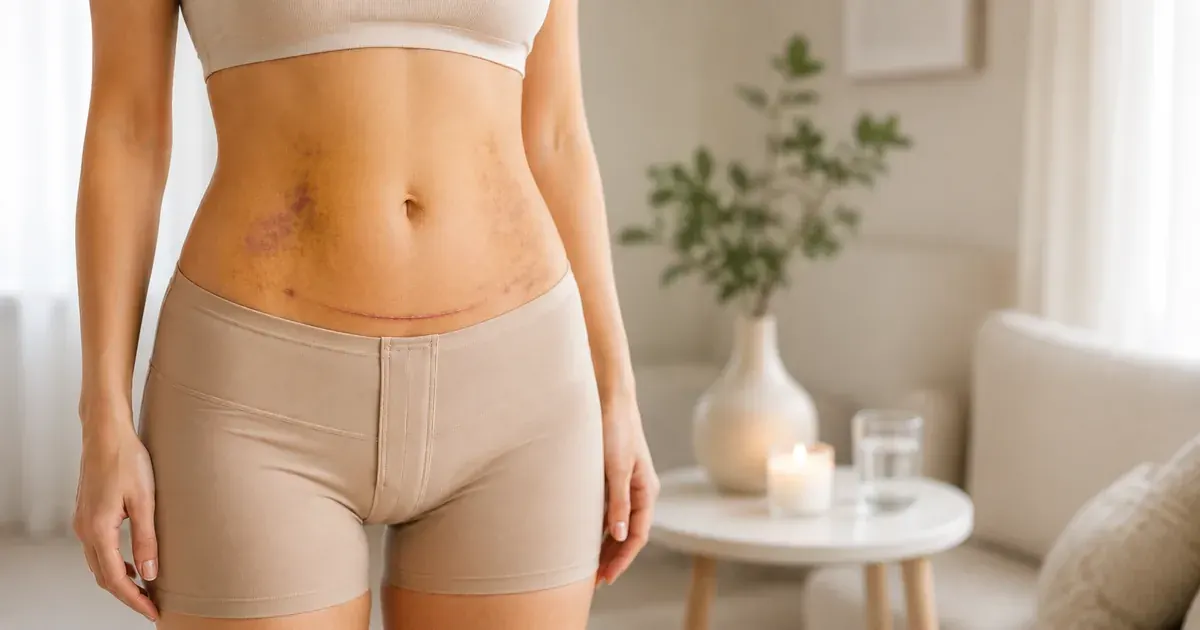
Bruising follows a predictable colour progression as haemoglobin is broken down by the body. Fresh bruising in the first 24–72 hours is dark red or purple. By days 5–7 it typically turns dark green or blue; by days 10–14 it fades to yellow or yellow-green as biliverdin is further metabolised. At two weeks, most patients are at or approaching the yellow-green stage — the bruising is fading rather than intensifying, and it should continue to clear over the following week or two.
The distribution of bruising depends on where fat was removed and how the tumescent fluid and blood tracked through tissue. With abdominal liposuction, bruising may still be present across the entire lower abdomen and flanks at two weeks. With inner thigh or arm liposuction, bruising typically clears faster because the treatment areas are smaller. Importantly, bruising that is worsening at two weeks — becoming darker, more swollen, and more painful — is not normal and should prompt a call to your surgeon.
Swelling: The Two-Week Level vs What Is Still to Come
Swelling is the most significant source of anxiety and misjudgement at two weeks. Many patients expect to see a dramatic change in body shape by this point; most do not, and this is entirely normal. The reason is that post-liposuction swelling operates on two timescales: an acute fluid-driven swelling from the first days, and a slower, more persistent oedema driven by disrupted lymphatic drainage and the ongoing inflammatory and repair processes in the tissue. At two weeks, the acute swelling has begun to subside, but the persistent swelling remains very much present — most patients retain roughly 60–80% of their peak swelling at this stage.
Additionally, at two weeks patients typically begin increasing their activity compared with the first week. Even gentle increases in movement — walking more, returning to a desk job, doing light household tasks — can cause a temporary increase in swelling, particularly by the end of the day. This fluctuation is normal: tissues that have just emerged from acute inflammation are reactive, and dependent areas (lower abdomen, inner thighs, knees) accumulate fluid when upright. Wearing the compression garment consistently and elevating treated areas when resting will help manage this. Do not interpret end-of-day swelling increases as a regression in healing.
Incision Appearance at Two Weeks
Liposuction incisions are small — typically 3–5 mm — but their appearance at two weeks is a useful indicator of healing progress. By week two, all incision sites should be closed: the skin has re-epithelialised over the entry point, and there should be no open wound, weeping, or crust indicating an unhealed break. The incisions themselves will appear pinkish or faintly red, slightly raised or at the skin surface, and may be mildly itchy — all of which are normal signs of active scar formation. Significant scarring, the kind visible from a normal social distance, is not yet apparent at two weeks and is unlikely to develop from properly made liposuction incisions. The final appearance of the incision marks will not be assessable until 12–18 months post-surgery.
If any incision site is still open, draining pus, hot to the touch, or surrounded by spreading redness, contact your surgeon promptly — this combination suggests wound breakdown or a superficial infection.
What Looks and Feels Normal at Two Weeks
Several findings at two weeks alarm patients who were not warned to expect them. The following are all within the expected range of normal recovery.
Firmness and Lumpiness Under the Skin: Early Fibrosis Starting
One of the most common concerns at two weeks is discovering firm, hard patches or cord-like lumps in the treated area that were not present — or were less noticeable — in the first week. This is early fibrosis: the body's response to the widespread connective tissue disruption caused by the cannula's repeated passes during fat removal. As the acute fluid-driven swelling begins to subside, the underlying tissue firmness — caused by collagen-rich scar matrix being deposited by fibroblasts — becomes palpable for the first time. Patients who had large-volume liposuction, or procedures involving multiple areas (Lipo 360, combined abdomen and flanks), typically notice more pronounced firmness than patients with smaller, single-area procedures.
Normal fibrosis at two weeks feels dense and solid — like a firm area of tissue under otherwise normal skin. It is not soft, not fluctuant, and not acutely tender when lightly pressed. It does not pulsate or feel warm. It will feel more prominent in some positions than others (lying flat vs standing) and may be more noticeable first thing in the morning before swelling accumulates. This firmness is expected to peak over the next 2–4 weeks before gradually softening.
Asymmetric Swelling: Common and Usually Self-Resolving
The body does not swell and heal symmetrically. Even when a procedure is performed identically on both sides, the left and right sides of the body frequently swell to different degrees and resolve at different rates. At two weeks, it is normal for one flank to look more swollen than the other, for one thigh to appear larger, or for one arm to feel tighter. This asymmetry is driven by subtle differences in lymphatic drainage efficiency, the exact volume of tumescent fluid infiltrated on each side, the patient's sleeping position (dependent swelling is greater on the side they lie on), and natural individual variation in inflammatory response. In the vast majority of patients, the asymmetry self-resolves over weeks 3–8 as swelling subsides symmetrically. Contact your surgeon only if the asymmetric swelling is also accompanied by pain, warmth, or other localised symptoms — isolated asymmetric swelling without these features does not require urgent attention at two weeks.
Skin Sensitivity, Numbness, and Hypersensitivity
Altered skin sensation is a near-universal finding after liposuction and should be expected at two weeks. The fine network of cutaneous nerves that runs through the subcutaneous fat layer is disrupted by the cannula during fat removal. Some nerves are compressed by swelling; others sustain minor trauma that temporarily disrupts their signalling. The result is a variable mix of sensations in the treated skin: patches of complete numbness (no sensation when touched), reduced sensitivity, or conversely, areas of hypersensitivity where light touch or pressure feels exaggerated or uncomfortable. Some patients describe a "burning" or "electric" quality to the hypersensitive zones. All of these presentations are normal at two weeks. Sensation typically returns progressively over 6–12 weeks; in a small number of patients, mild altered sensation may persist for 6–12 months before full resolution. Permanent sensory changes after liposuction are possible but uncommon.
Residual Drainage: When Does It Typically Stop?
After tumescent liposuction — the most commonly used technique — a large volume of tumescent fluid (saline, local anaesthetic, and adrenaline) is infiltrated into the treatment area before fat is removed. The incisions are left open or loosely closed in the immediate post-operative period to allow this fluid to drain, which reduces bruising and swelling. Most drainage occurs in the first 24–48 hours, tapering off over days 2–4. By week one, the majority of patients have no active drainage from incision sites. At two weeks, any ongoing drainage is typically minimal — a small amount of serous (clear-yellow) fluid from one or two incision sites is not unusual, particularly if the patient has been more active. Drainage that is increasing at two weeks, has become cloudy or frankly purulent, or is accompanied by pain and redness around the site warrants contact with your surgeon.
Activity and Returning to Work
Activity restrictions after liposuction are graded and specific — what is appropriate for a sedentary office worker differs substantially from what is appropriate for a manual labourer or a regular gym-goer. Two weeks is a natural checkpoint at which many patients are wondering what they can safely resume.
Desk Work vs Physical Work: Different Return Timelines
For entirely sedentary work — sitting at a desk, working from home, light computer tasks — most patients can return within 1–2 weeks, provided they can manage the commute comfortably, can sit or stand as required without significant pain, and can wear their compression garment throughout the working day. A study on post-operative work restrictions after outpatient plastic surgery supports these timelines.1 If the procedure was abdominal or flank liposuction, sitting for extended periods can be uncomfortable at two weeks, and some patients benefit from a phased return (starting with a few hours a day and building up) rather than returning full-time immediately.
Physical work — any role involving lifting, manual handling, prolonged standing, or bending — typically requires 3–6 weeks off, depending on the volume of liposuction and the nature of the work demands. Published activity restriction guidelines confirm this range.2 Returning to physical work too early elevates intra-abdominal pressure, increases swelling, raises the risk of seroma formation in abdominal procedures, and may disrupt healing connective tissue.
Driving: When It Is Safe After Abdominal Lipo
Driving requires the ability to perform an emergency stop — a sharp, forceful brake — without hesitation. After abdominal or flank liposuction, this movement involves rapid tensing of the core musculature, which is painful and may be mechanically limited at two weeks. Most surgeons recommend avoiding driving for 2 weeks minimum after abdominal liposuction, and for longer (up to 3–4 weeks) after larger procedures. Patients who have had liposuction of areas that do not involve the core — arms, neck, inner knees — may be cleared to drive sooner, as the limiting factor is primarily pain-free emergency braking ability, not just general comfort while seated. Confirm with your surgeon before returning to driving — if you are unsure whether you can perform a rapid, forceful foot-brake manoeuvre without bracing, you are not ready.
Exercise at Two Weeks: What Is and Is Not Allowed
At two weeks, light walking is the only form of exercise consistently appropriate for all patients. Short, flat walks at a comfortable pace — 15–30 minutes, 2–3 times daily — support lymphatic circulation, reduce the risk of DVT, and keep joints mobile without stressing healing tissue, as a study on activity restrictions after liposuction confirms.2 Everything beyond this should be discussed with your surgeon before restarting.
Activities to avoid at two weeks include any form of cardiovascular exercise that elevates heart rate significantly (running, cycling, swimming, aerobics), resistance training, yoga involving core engagement or inversions, Pilates, and any sport. These activities increase intra-abdominal and intra-thoracic pressure, drive up inflammation, and significantly increase the risk of seroma formation in the treated areas. The standard staged return — light cardio at weeks 4–6, full exercise at weeks 6–8 — exists because the tissue is genuinely not ready for that stress until those timepoints.
| Activity Type | Status at 2 Weeks | When Typically Cleared |
|---|---|---|
| Short, gentle walking (15–30 min) | Permitted — encouraged | Day 1 post-op onward |
| Desk / sedentary work | Permitted for most patients | Weeks 1–2 (with compression) |
| Driving (abdominal / flank lipo) | Usually not yet permitted | Weeks 2–4 (surgeon clearance required) |
| Light physical work (standing, slow-paced) | Not recommended | Weeks 3–4 (depending on volume) |
| Low-impact cardio (stationary bike, elliptical) | Not permitted | Weeks 4–6 (surgeon clearance) |
| Swimming / open water | Not permitted (infection risk) | Week 6 minimum (incisions fully healed) |
| Resistance training / weights | Not permitted | Weeks 6–8 (graduated return) |
| High-intensity exercise, contact sports | Not permitted | Week 8+ (surgeon approval required) |
| Heavy manual work / lifting | Not permitted | Weeks 4–6 (varies by volume and area) |

The Swelling Journey: What's Still Ahead
Two weeks is not the halfway point of swelling resolution — it is closer to the beginning. Understanding the full timeline helps patients avoid the frustration and anxiety of expecting results before the body has had time to deliver them.
Weeks 3–6: Still Significant Swelling, Clothes Still Tight
During weeks 3–6, swelling continues to fluctuate rather than steadily decline. Many patients are surprised to find that clothing still feels tight at this stage — sometimes tighter in the morning (lymphatic fluid pools overnight) and slightly better in the evening after movement encourages fluid redistribution. Activity increases at this stage, which can drive temporary swelling spikes. The compression garment remains critical during this period. It is also during weeks 3–6 that fibrosis is typically at its peak: the treated areas feel firmest and lumpiest, and the skin may appear uneven or corrugated in texture. This is not a sign that something went wrong — it is the normal peak of the body's repair response, and it will improve.
Months 2–3: Notable Visible Improvement Begins
For most patients, months 2–3 are when recovery feels like it is finally progressing in a visible, meaningful way. The bulk of acute swelling has resolved, fibrosis is softening, and the early contour of the result begins to emerge. Clothing fits better, and the treated area is noticeably different from the pre-operative state. However, the result at months 2–3 is not the final result — residual swelling persists in many patients, particularly around the lower abdomen and inner thighs, and fibrosis continues to soften through month 6. Do not make judgements about asymmetry, contour irregularities, or whether the result met your expectations at this stage.
Months 3–6: Final Result Becomes Visible
Between months 3 and 6, the residual swelling resolves, fibrosis softens to its final state, and the skin begins to retract and conform to the new underlying contour. For most patients, the final result is assessable at 6 months post-surgery. Some patients — particularly those who had large-volume liposuction, Lipo 360, or high-definition procedures — may continue to see improvement through months 9–12. The 6-month mark is typically when surgeons will consider assessing whether any revision or touch-up is warranted, because before this point it is impossible to distinguish residual healing from a genuine contour irregularity.
| Post-Op Period | Typical Swelling Level | Result Clarity |
|---|---|---|
| Days 1–7 | Peak acute swelling — 80–100% of maximum | No result visible; bruising dominant |
| Week 2 | Still substantial — 60–80% of peak | Not assessable; fibrosis emerging |
| Weeks 3–6 | Gradually declining but fluctuating — 40–70% | Early silhouette visible; fibrosis at peak |
| Months 2–3 | Moderate residual — 20–40% | Meaningful improvement visible; not final |
| Months 3–6 | Minimal residual — 5–20% | Near-final; irregularities may still be resolving |
| Month 6+ | Fully resolved in most patients | Final result assessable |
Early Fibrosis and Lumps: Normal vs Concerning
Lumps and firmness in the weeks after liposuction are one of the most common sources of patient anxiety. The vast majority are normal fibrosis — but knowing how to distinguish normal fibrosis from a complication can help you decide when to call your surgeon and when to wait, as a randomised clinical study on post-liposuction recovery discusses.4
What Fibrosis Feels Like at Two Weeks
Post-liposuction fibrosis at two weeks typically presents as areas of dense, firm tissue beneath the skin surface. On palpation — pressing gently with fingertips — it feels like solid, compressible firmness rather than normal soft tissue. In some areas, patients can feel distinct cord-like bands running under the skin, particularly along cannula paths. These are collagen-rich fibrous strands deposited by fibroblasts as part of the repair matrix. The overlying skin feels normal in temperature — not warm. When lightly pressed, there may be mild discomfort (the area is still healing) but not acute tenderness, throbbing, or shooting pain. The firmness is present across a broad area of the treated zone rather than isolated to a single, sharply defined nodule. It is generally bilateral if bilateral areas were treated, though not necessarily symmetrical in degree.
When to Start Lymphatic Drainage Massage
Manual lymphatic drainage (MLD) is typically introduced between days 7 and 14 post-surgery, once the incision sites are sufficiently healed to tolerate skin movement and the acute inflammatory phase has begun to settle. The rationale is primarily fluid management: MLD stimulates superficial lymphatic vessels to clear the protein-rich interstitial fluid that accumulates in the surgical dead space after fat removal. This fluid is the primary stimulus for fibroblast activation — by clearing it promptly, MLD reduces the intensity of fibrosis that forms. A 2014 randomised clinical study demonstrated significantly reduced post-operative oedema in patients receiving MLD compared with controls.4
If you have not yet started MLD at two weeks, this is typically the right time to begin — confirm clearance with your surgeon first. A course of 4–8 sessions with a certified therapist (Vodder-trained or LANA-certified) over weeks 2–6 is the standard recommendation. Do not begin self-massage until week 3–4 at the earliest, and only after your surgeon has cleared it.
Distinguishing Normal Fibrosis from Seroma and Infection
Three types of post-liposuction lumps require different responses. The table below summarises the key distinguishing features.
| Lump Type | How It Feels | Tender? | Recommended Action |
|---|---|---|---|
| Fibrosis (normal) | Firm, dense, solid; cord-like in places; spread across treated area; normal temperature | Mildly uncomfortable at most; not acutely tender | No urgent action. Continue compression; start MLD if not already. Reassess if no softening by month 3–4. |
| Seroma (fluid collection) | Soft, fluctuant; wave-like or sloshing quality when pressed; distinctly localised; can develop days–weeks post-op as initial swelling settles | Variable — often mild; no fever typically in early seroma | Contact your surgeon. Seromas require aspiration (needle drainage) and do not resolve on their own. Do not delay — untreated seromas worsen fibrosis. |
| Haematoma (blood collection) | Firm to fluctuant; bruised skin overlying; may feel tense; typically develops in first 72 hours | Yes — often acutely tender; skin may be discoloured | Contact your surgeon immediately. Small haematomas may be monitored; larger ones require drainage. Do not apply heat. |
| Infection (cellulitis / abscess) | Variable — may be firm (early cellulitis) or fluctuant (abscess); surrounding skin red and warm | Yes — increasing tenderness; often accompanied by fever and systemic malaise | Seek medical attention the same day. Post-liposuction infection can progress rapidly. Do not wait for a scheduled appointment. |
Compression Garment at Week Two
The compression garment is not merely a comfort measure — it is one of the primary interventions that shapes how healing proceeds in the weeks after liposuction, as Klein's research on tumescent liposuction garments established. At two weeks, patients are typically either continuing their Stage 1 garment or transitioning to a Stage 2 garment, but discontinuation is not appropriate at this stage.3
How Many More Weeks to Wear It
The standard prescription for compression garment wear after liposuction is 4–6 weeks total, with many surgeons extending this to 8 weeks for large-volume procedures or for patients developing significant fibrosis. At two weeks, most patients have 2–4 more weeks of full-time garment wear ahead of them. "Full-time" means 23 hours per day — the one hour off is for showering and garment washing. Some surgeons transition to part-time wear (daytime only) at weeks 4–6, but this varies by practice and procedure volume. Always follow your specific surgeon's garment protocol — there is meaningful variation between practices, and the prescription you received is calibrated to your procedure.
Transitioning from Stage 1 to Stage 2 Garment
Stage 1 compression garments are designed for the immediate post-operative period: they are typically firmer, provide higher levels of compression (measured in mmHg), and are often made from a material that tolerates drainage. Stage 2 garments are introduced once initial swelling has reduced sufficiently that the original garment has become loose — typically between weeks 2 and 4. Stage 2 garments are generally more comfortable for extended wear, come in a wider range of styles, and are specifically designed for the ongoing compression needed during the remodelling phase. The transition point is when the Stage 1 garment no longer fits snugly — if you can pinch significant fabric or if the garment shifts position with movement, it is no longer providing adequate compression. Your surgical team will advise on when to transition and what garment specification to use; if you are uncertain, err on the side of continuing Stage 1 wear until you can ask at your follow-up.
What Happens If You Stop Wearing It Too Early
Stopping the compression garment prematurely — before 4–6 weeks — has well-documented negative consequences. The garment provides the even, sustained pressure that closes the dead space between the removed-fat layer and the overlying skin. Without it, this dead space fills with interstitial fluid, which drives two problems: increased swelling that can become self-perpetuating, and a more intense fibrotic response as the persistent fluid activates fibroblasts to deposit more collagen. Research on compression garments after tumescent liposuction demonstrates that consistent compression garment use is integral to post-operative care and contributes significantly to outcome quality.3 There is also an increased risk of seroma formation — the classic late-presenting fluid collection — when compression is discontinued before the tissue has sufficiently adhered. If your garment is uncomfortable, has become loose, or is causing skin irritation, contact your surgeon's team to discuss garment adjustment options — do not simply stop wearing it.
Warning Signs That Warrant a Call to Your Surgeon
Most discomfort and visual changes at two weeks fall within the normal range of recovery. The following signs, however, should prompt you to contact your surgeon or seek medical advice promptly — in some cases the same day.
| Symptom | Timing Context | Urgency | Recommended Action |
|---|---|---|---|
| Fever 38°C / 100.4°F or above | Any time in the first 6 weeks | Same day | Contact your surgeon immediately. Post-operative fever can indicate infection, DVT, or pulmonary embolism. Do not take paracetamol/ibuprofen to mask it and wait. |
| Skin redness spreading from incision or treated area; warmth; increasing local pain | Any time post-op; especially weeks 1–4 | Same day | Contact your surgeon. These are classic signs of cellulitis (skin infection). Post-liposuction infections can progress rapidly and require prompt antibiotic treatment. |
| Swelling, pain, and redness in one calf or leg; calf pain on dorsiflexion (pulling toes up) | Any time in the first 6 weeks | Emergency — same day | Seek emergency medical care. These are symptoms of deep vein thrombosis (DVT). Do not massage the area. If combined with chest pain or breathlessness, call emergency services immediately (possible pulmonary embolism). |
| Sudden chest pain, breathlessness, or unexplained rapid heart rate | Any time post-op | Emergency — call 999 / 911 immediately | These symptoms may indicate pulmonary embolism. Do not wait for your surgeon. Call emergency services immediately. |
| Soft, fluctuant swelling that is new or enlarging; wave-like quality on pressing | Typically days 7–21; can appear later | Contact within 24 hours | Likely seroma (fluid collection). Requires aspiration by your surgeon. Do not ignore — an untreated seroma increases fibrosis risk and does not resolve on its own. |
| Tense, painful, dark swelling that appeared or enlarged in first 72 hours | Days 1–3 most commonly | Same day | Possible haematoma (blood collection). Small haematomas can be monitored, but your surgeon needs to assess the size and decide whether drainage is required. |
| Increasing pain at 2 weeks (rather than gradual improvement) | Week 2 onward | Contact within 24 hours | Pain should be on a slow improving trend at two weeks. Worsening pain — particularly if localised — warrants assessment to exclude haematoma, seroma, or infection. |
| Incision site open, draining pus, or not healing | Week 2+ | Same day | All incision sites should be closed by week two. An open or purulent wound requires assessment and likely topical or systemic treatment. |
When in doubt, contact your surgeon. A brief call or message to your surgical team is always the right response to uncertainty — most post-liposuction complications are far more manageable when caught early.
Liposuction risks and complications: a complete guide →Frequently Asked Questions
-
Yes — significant swelling at two weeks is entirely normal and expected. Most patients retain 60–80% of their peak post-operative swelling at this stage. The inflammatory phase is winding down but the tissue is still actively healing. Swelling will continue to fluctuate — and may temporarily worsen when you increase activity — throughout weeks 3–6 before beginning a more sustained decline. Do not judge your results at this stage.
-
A meaningful improvement in contour typically becomes visible between months 2 and 3, once the majority of acute swelling has subsided. The final result — with residual swelling, fibrosis, and skin retraction all fully resolved — is usually assessable at 6 months post-surgery. Some patients with large-volume procedures continue to see improvement up to 12 months. Do not make judgements about your results in the first 6–8 weeks.
-
At two weeks, only very light activity is appropriate — short walks at a gentle pace. Most surgeons permit a graduated return to low-impact cardio (cycling, light elliptical) at weeks 4–6, and a return to resistance training and high-intensity exercise at 6–8 weeks, subject to your individual recovery and surgeon guidance. Published activity restriction recommendations support this staged approach.2 Returning to the gym too early increases inflammation, worsens swelling, and raises the risk of seroma formation. Follow your surgeon's specific timeline, not general internet averages.
-
Yes. Firm, hard areas and cord-like lumps beneath the skin at two weeks are a normal early sign of fibrosis — the body's wound-repair response. These are caused by collagen-rich scar tissue being deposited in the space where fat was removed. Normal fibrosis lumps are non-tender (or only mildly uncomfortable) and have a solid, dense quality — they are not soft or fluctuant. They will feel most prominent over weeks 2–6, then gradually soften over 2–4 months. If a lump is warm, acutely tender, growing, or accompanied by fever, contact your surgeon — that combination suggests seroma, haematoma, or infection rather than simple fibrosis.
-
No. Two weeks is too early to discontinue compression. Most surgeons prescribe full-time compression garment wear for at least 4–6 weeks total, transitioning from a Stage 1 to a Stage 2 garment around weeks 2–3, as research on post-liposuction compression protocols recommends.3 Stopping compression at two weeks increases the risk of worsened swelling, seroma formation, and more significant fibrosis. If your garment is uncomfortable, has become loose, or is causing skin problems, discuss adjustments with your surgeon's team — do not simply stop wearing it.
-
Significant swelling at two weeks is completely normal and is not a cause for concern on its own. Two weeks is still early in the healing process — the body is still actively managing the inflammatory and repair responses to surgical trauma. Do not compare your appearance to pre-operative photos or to other patients' social media posts; swelling timelines vary considerably between individuals and procedures. Contact your surgeon if swelling is accompanied by fever, increasing pain, skin warmth or redness, or if you notice a distinct soft fluid-filled swelling developing in a treated area (which could indicate a seroma). Swelling alone at two weeks requires patience, not concern.