
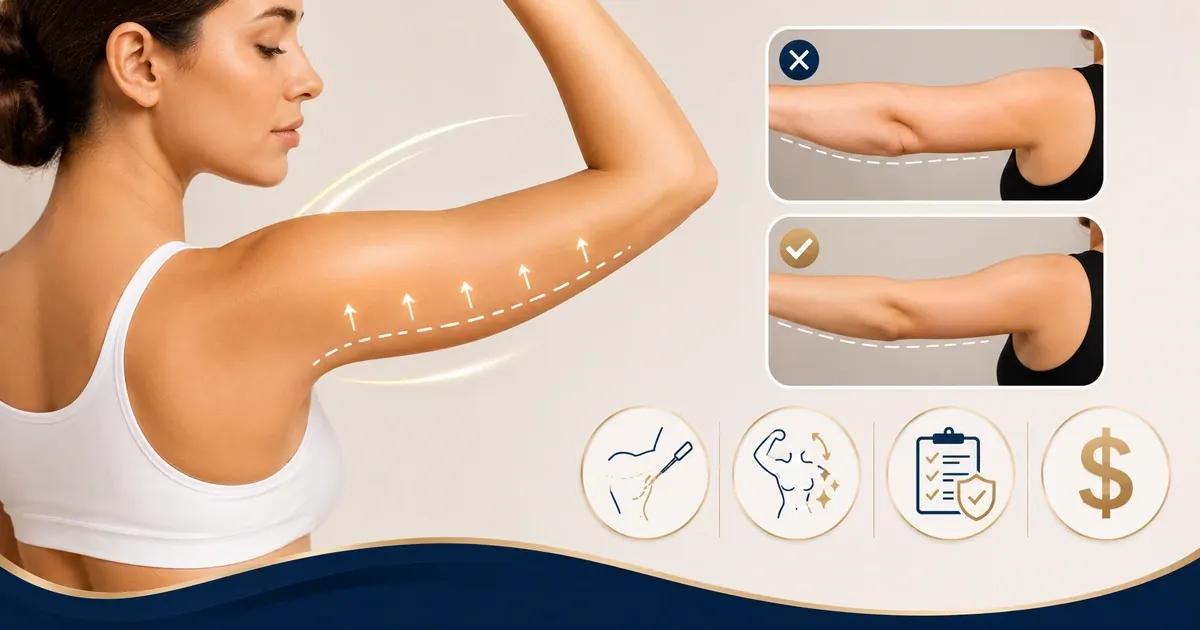
What Arm Liposuction Treats
Arm liposuction targets the subcutaneous fat of the upper arm — the soft, jiggly tissue on the inner and back surface that many people find resistant to diet and exercise. This area is sometimes called the "bat wing" region, referring to the appearance when arms are raised.
The procedure removes fat from the posterior and medial upper arm using small cannulas inserted through 2–4 mm incisions, typically hidden in the armpit fold or at the elbow crease. Some surgeons also treat the deltoid (shoulder cap) area or lateral arm depending on patient anatomy.
Arm liposuction does not treat:
- Loose or excess skin — liposuction cannot remove or tighten skin
- Muscle tone — building arm muscle requires exercise, not liposuction
- The forearm — this area is rarely treated due to the proximity of important neurovascular structures
Candidacy: Fat vs Skin Laxity
The single most important candidacy factor for arm liposuction is the ratio of fat to skin laxity. This distinction determines whether liposuction alone will achieve a good result, or whether an arm lift is needed.
Fat Deposits vs Skin Laxity: The Critical Difference
When a surgeon assesses your arms, they are evaluating two distinct tissue problems that can look similar but require fundamentally different solutions. Excess fat is subcutaneous tissue that accumulates beneath skin that retains its own structural integrity — the skin is full, perhaps rounded, but it holds its shape. Skin laxity is a loss of elastin and collagen in the dermis itself, leaving skin that droops, creases, and hangs independently of how much fat lies beneath it. These two conditions frequently coexist, but they are not the same problem.
A simple self-assessment: stand with your arm raised at shoulder height and extended to the side. If the underarm area hangs or droops without any fat bulging outward when you shake your arm, skin laxity is likely the dominant issue. If the underarm has fullness — volume that fills the space — fat is the dominant issue. Many patients have a combination, which is why an in-person consultation is essential. A surgeon will perform a pinch test and assess skin snap-back time to determine whether the skin has sufficient elasticity to redrape after fat removal.
Age, significant weight fluctuations, pregnancy, and genetics all affect skin elasticity. Patients who have lost large amounts of weight (40 lb / 18 kg or more) almost always have some degree of skin laxity regardless of how much fat remains. Sun damage also degrades dermal collagen over time, which is why two patients of identical age and weight can have very different arm skin quality. The table below outlines the most common patient profiles and what procedure best serves each:
| Patient profile | Recommended procedure |
|---|---|
| Excess arm fat, good skin elasticity (skin snaps back when pinched) | Arm liposuction alone |
| Modest fat with mild skin laxity — early looseness | Arm liposuction (possible residual mild laxity — discuss expectations) |
| Significant loose skin with or without fat — classic "bat wing" droop | Arm lift (brachioplasty) — liposuction alone will worsen appearance |
| Post-massive-weight-loss with hanging skin apron | Arm lift; liposuction may be used as an adjunct |
When Brachioplasty Is the Right Choice
A brachioplasty — commonly called an arm lift — does something arm liposuction fundamentally cannot: it physically removes excess skin. The procedure involves an incision running from the axilla (armpit) to near the elbow along the inner arm, excising a segment of redundant skin and the underlying fat, then suturing the remaining skin tighter against the arm. The result is a firmer, smoother arm contour. The trade-off is a visible linear scar on the inner upper arm — one that, while it typically fades over 12–18 months, does not disappear entirely. For patients with significant skin laxity, this is almost always an acceptable trade-off because the alternative — loose, drooping skin after liposuction — can be cosmetically worse than the original problem.
Brachioplasty is the appropriate choice when the primary complaint is skin that hangs or sags regardless of arm position, when a pinch test reveals excess skin beyond what fat alone would explain, or when the patient's history includes massive weight loss. A surgeon may also recommend a minimal-incision arm lift (sometimes called a mini-brachioplasty), which uses a shorter scar confined closer to the axilla to address mild-to-moderate laxity with a less invasive approach. In some cases, liposuction is used alongside brachioplasty to reduce fat volume before skin excision — this combination can produce a more refined result than either procedure alone.
Arm Liposuction vs Arm Lift (Brachioplasty)
An arm lift (brachioplasty) excises excess skin and fat from the inner upper arm, leaving a linear scar running from the armpit to the elbow. It is a more invasive procedure than liposuction with a longer scar and longer recovery, but it is the only option that can address significant skin laxity.
Some surgeons combine liposuction with a limited arm lift, removing fat while also excising a small ellipse of skin — this is called a minimal-incision arm lift or mini-brachioplasty. The scar is shorter but the skin-tightening is less dramatic.
The American Society of Plastic Surgeons notes that brachioplasty is indicated specifically when skin redundancy is the primary concern, and liposuction when fat reduction with skin retraction is the goal.1 A surgeon will assess both during your consultation by pinching the skin and evaluating how much excess skin vs fat is present.
The Procedure & Anaesthesia
Arm liposuction is most commonly performed as an outpatient procedure under local tumescent anaesthesia with optional light sedation. General anaesthesia is used when larger volumes are planned or when combined with other procedures.
Typical steps:
- Tumescent fluid injected into the upper arm to anaesthetise the area, minimise bleeding, and facilitate fat removal
- Small incisions (2–4 mm) made in inconspicuous locations — axilla, medial elbow crease
- Thin cannula passed through the upper arm fat layer in controlled strokes; fat aspirated
- Incisions closed with a single absorbable suture or tape
- Compression sleeve applied
Total operative time for both arms is typically 1–2 hours. Patients go home the same day. The procedure can be combined with liposuction of other areas in the same session — a common combination is arm + flanks or arm + abdomen.
A nationwide analysis of liposuction outcomes in 69,424 patients confirmed that liposuction performed by board-certified surgeons in accredited facilities has a favourable safety profile across all body areas.2

Results: Before, After & Realistic Expectations
A successful arm liposuction produces a slimmer upper arm profile with reduced soft tissue fullness. The improvement is typically significant for patients with good skin elasticity and moderate fat deposits.
What results depend on:
- Skin elasticity: The primary predictor. Good elasticity means the skin contracts smoothly around the reduced fat volume. Poor elasticity means some looseness remains.
- Volume of fat removed: The extent of improvement correlates with how much fat was there preoperatively and how much is safely removed.
- Stable post-operative weight: Remaining fat cells in the arms can enlarge with weight gain.
- Patient age: Younger patients generally have better skin retraction. This is a tendency, not a rule — many patients over 50 achieve excellent results.
Initial improvement is visible within 1–2 weeks as bruising resolves, but swelling persists for 6–8 weeks. Final results — with the arm fully settled — are typically seen at 2–3 months.
Results are permanent in the sense that the removed fat cells do not return. Significant weight gain after surgery will cause remaining cells to enlarge.
Recovery & Compression Sleeves
Arm liposuction has a relatively short recovery compared to larger procedures like Lipo 360, because the treatment area is smaller and local anaesthesia allows patients to avoid the grogginess of general anaesthesia.
| Timeframe | What to expect |
|---|---|
| Day 1–3 | Arms sore, bruised, and swollen. Compression sleeves worn. Light arm use only. |
| Days 3–7 | Bruising visible. Most patients return to desk work. No heavy lifting. |
| Week 2 | Bruising fading. Swelling improving. Most daily activities comfortable. |
| Weeks 3–4 | Garment often transitioned to daytime only or removed (per surgeon). Light exercise resumes. |
| Weeks 4–6 | Return to full exercise including weights and swimming. |
| Month 2–3 | Final results visible; residual swelling fully resolved. |
Compression Garment for Arms
An arm compression sleeve is worn continuously for the first 2–3 weeks after surgery, then transitioned to daytime-only wear for a further 1–2 weeks, for a total garment period of approximately 3–4 weeks. Compression serves two purposes in arm liposuction recovery: it reduces post-operative swelling by limiting fluid accumulation in the treated tissue, and it encourages the skin to adhere smoothly to the underlying contour as swelling resolves. Inadequate compression is one of the factors associated with uneven or lumpy final results, so consistent garment use during the initial healing phase matters more than most patients expect.
Arm sleeves present some practical challenges that midsection garments do not. They are visible beneath short sleeves and cannot easily be concealed in warmer weather. The axillary (armpit) area can become uncomfortable if the sleeve band sits too high or rolls. Sweat accumulation in the crease can cause skin irritation, particularly in the first week when drainage from incision sites is still active. Most surgeons provide a medical-grade compression sleeve as part of the post-operative package; if you need to purchase one independently, a compression class of 20–30 mmHg is typical. Avoid non-medical "slimming sleeves" sold online — these rarely provide sufficient uniform compression. Your surgeon or nurse will show you how to put the sleeve on correctly, as an improperly applied sleeve can create pressure bands that cause indentation rather than smooth compression.
Avoid swimming and activities that submerge the incision sites until they are fully healed (typically 3–4 weeks).
Risks Specific to Arm Liposuction
Arm liposuction shares the general risks of any liposuction procedure — infection, haematoma, seroma, anaesthetic reaction — but the arm's anatomy creates some area-specific considerations that patients should understand before proceeding.
Contour Irregularity
The upper arm has a relatively thin fat compartment compared to areas like the abdomen or thighs. This means that any unevenness in cannula passes — taking slightly more fat in one pass than another — translates almost directly into a visible surface irregularity: a ripple, divot, or step in the arm contour. In thicker fat areas, small inconsistencies self-correct as the tissue redistributes. In the arm, they do not. This is why arm liposuction requires a surgeon with specific experience in thin-compartment technique: finer cannulas, slower deliberate passes, and frequent tactile assessment. High-volume arm liposuction (removing excessive fat volumes in one session) also carries higher risk of contour irregularity, as does using cannulas that are too large for the anatomy. Secondary correction of arm contour irregularity is technically difficult; prevention through careful primary technique is far more effective than revision.
Visible Scarring
Arm liposuction incisions are small — typically 2–4 mm — but their location matters. The standard access points are the axilla (armpit fold) and the medial elbow crease, both of which are designed to be naturally hidden. However, some surgical approaches require additional access points on the posterior arm, where resulting scars may be visible in sleeveless clothing. Even well-placed axillary incisions can produce a slightly raised or pigmented scar in patients prone to hypertrophic scarring or those with darker skin tones. Before surgery, ask your surgeon specifically where incisions will be placed and what the expected scar appearance is at 6 and 12 months. Silicone gel strips applied from week 3 onward can reduce scar elevation and redness in most patients.
Prolonged Swelling
While arm liposuction recovery is generally faster than larger procedures, some patients experience swelling that persists well beyond the expected 6–8 week window. Prolonged swelling is more common when both arms are treated simultaneously (which doubles the lymphatic disruption), when the procedure is combined with other body areas treated in the same session, or when compression garment compliance has been poor. Arms that remain swollen at 3 months should be reassessed — persistent firmness or asymmetric swelling at this stage warrants evaluation to rule out seroma or fibrosis. Most cases of prolonged swelling resolve without intervention by the 4–6 month mark, but patience is required.
| Complication | Why arms carry higher risk | Prevention |
|---|---|---|
| Contour irregularity / waviness | Thin fat compartment — technique errors surface immediately | Surgeon with arm-specific experience; fine cannulas; conservative fat removal |
| Visible scarring | Incisions near armpit or elbow visible in sleeveless clothing | Confirm incision placement pre-operatively; silicone sheets from week 3 |
| Prolonged swelling | Lymphatic drainage from arm can be disrupted; bilateral treatment doubles load | Consistent compression sleeve use; manual lymphatic drainage massage from week 2 |
| Skin laxity worsening | Removing fat from already-lax skin leaves skin without underlying support | Accurate pre-operative candidacy assessment; arm lift if laxity is present |
| Nerve sensitivity changes | Medial cutaneous nerve of arm runs through the treated zone | Experienced surgeon; tumescent technique to define anatomy; avoid aggressive deep passes |
Questions to Ask at Your Arm Lipo Consultation
An arm liposuction consultation should be a two-way conversation. The surgeon is assessing your anatomy; you should be assessing whether the surgeon and their approach are the right fit for your specific situation. The questions below are designed to reveal experience, technique philosophy, and honest expectations — not just pricing.
- How many arm liposuction cases do you perform per year, and can I see before-and-after photos of patients with a similar body type to mine? Arm lipo is a technique-demanding procedure; surgeons who perform it regularly develop the tactile precision that thin-compartment work requires. Before-and-after portfolios should show realistic, not cherry-picked, results.
- Based on my skin elasticity and fat volume, do you think I am a candidate for liposuction alone, or should I consider an arm lift? This is the most critical question. A surgeon who does not distinguish carefully between the two — or who tells every patient they are a good lipo candidate — is a red flag.
- Where exactly will you place the incisions, and what will the scars look like at 12 months? Incision placement varies by technique and surgeon. Confirm the access points are in locations acceptable to you and ask specifically about scar outcomes in patients with your skin type.
- What cannula size and technique do you use for arms, and how do you prevent contour irregularity? Surgeons experienced in arm liposuction will have a clear answer about their approach to the thin fat compartment — finer cannulas, cross-tunnelling technique, and intraoperative assessment are markers of careful practice.
- What happens if I am not happy with the result — is revision included, and under what circumstances? Understanding the revision policy upfront protects you. Some practices include minor revisions in the original fee; others do not. Ask about the timeframe within which revisions would be considered and what the process involves.
- If I want to combine arm liposuction with other areas, how does that affect the surgical plan, recovery, and risk? Combining procedures is common and often cost-effective, but it increases total operative time and anaesthetic exposure. A surgeon should be able to explain clearly what is safe to combine in one session for your specific health profile.
- What is your post-operative protocol for arms — compression garment, lymphatic massage, follow-up schedule? The post-operative protocol directly affects outcomes. Surgeons who provide structured follow-up, clear garment guidance, and access to lymphatic drainage referrals typically achieve more consistent results.
- What is my realistic outcome if I have modest skin laxity and proceed with liposuction alone? If you are a borderline candidate — some fat, some laxity — ask the surgeon to be specific about what residual laxity you should expect and whether that is likely to bother you. This question forces an honest conversation about trade-offs rather than a sales pitch.
How Much Does Arm Liposuction Cost?
Arm liposuction is a moderately priced liposuction procedure — less expensive than large-area procedures like Lipo 360 but more than a single small area like the chin.
| Location | Both arms — all-in |
|---|---|
| United States | $3,000–$7,000 |
| United Kingdom | £2,500–£6,000 |
| Turkey (all-inclusive) | $1,500–$3,000 |
Adding arm liposuction to another procedure (e.g. abdomen, flanks) in the same session typically increases the total by a smaller amount than booking them separately, as facility and anaesthesia costs are shared.
Arm liposuction is a cosmetic procedure and is not covered by health insurance in the US, UK, or most countries.
Full liposuction cost guide by area and country →Frequently Asked Questions
-
US all-in cost for both arms: $3,000–$7,000. UK: £2,500–£6,000. Turkey all-inclusive: $1,500–$3,000. Costs vary by surgeon experience, geographic location, and whether additional areas are treated in the same session.
-
It depends on your skin elasticity before surgery. Patients with good elasticity typically experience good skin retraction and clean results. Patients with significant pre-existing skin laxity — the classic droop or sag regardless of fat — may see worsened appearance after liposuction alone removes the fat that was supporting the skin. Those patients are better served by an arm lift.
-
Liposuction: removes fat, cannot tighten skin. Arm lift: removes excess skin and fat, leaves a scar. Liposuction is appropriate when excess fat is the main issue and skin has good elasticity. An arm lift is appropriate when loose skin is the main issue. Your surgeon will assess this at consultation.
-
Return to desk work: 3–5 days. Compression sleeve: 3–4 weeks. Full exercise (weights, swimming): week 4–6. Final results: 2–3 months. Arm liposuction recovery is faster than larger procedures because the treatment area is smaller.
-
Yes — the removed fat cells are permanently gone and do not regenerate. However, significant weight gain after surgery causes remaining fat cells throughout the body (including the arms) to enlarge. Maintaining stable weight is the key factor in preserving the result.
-
Yes, and this is a relatively common combination for patients who have both excess fat and skin laxity. The two procedures can be done simultaneously or in a staged sequence. Simultaneous combination works well when fat volume is moderate — the surgeon removes fat first, then excises the skin with better visibility of how much needs to go. Staged combination (liposuction first, arm lift several months later) is the safer approach when fat volume is large, because high-volume fat removal changes the architecture of the remaining skin significantly, making it difficult to predict exactly how much skin to excise in the same session. Operating on the wrong amount can result in too-tight closure or residual skin excess. Staging allows the tissues to settle fully before the skin excision is planned. Your surgeon will advise based on your specific fat-to-skin ratio which sequencing is appropriate for your anatomy.