
Why Back and Flank Fat Behaves Differently
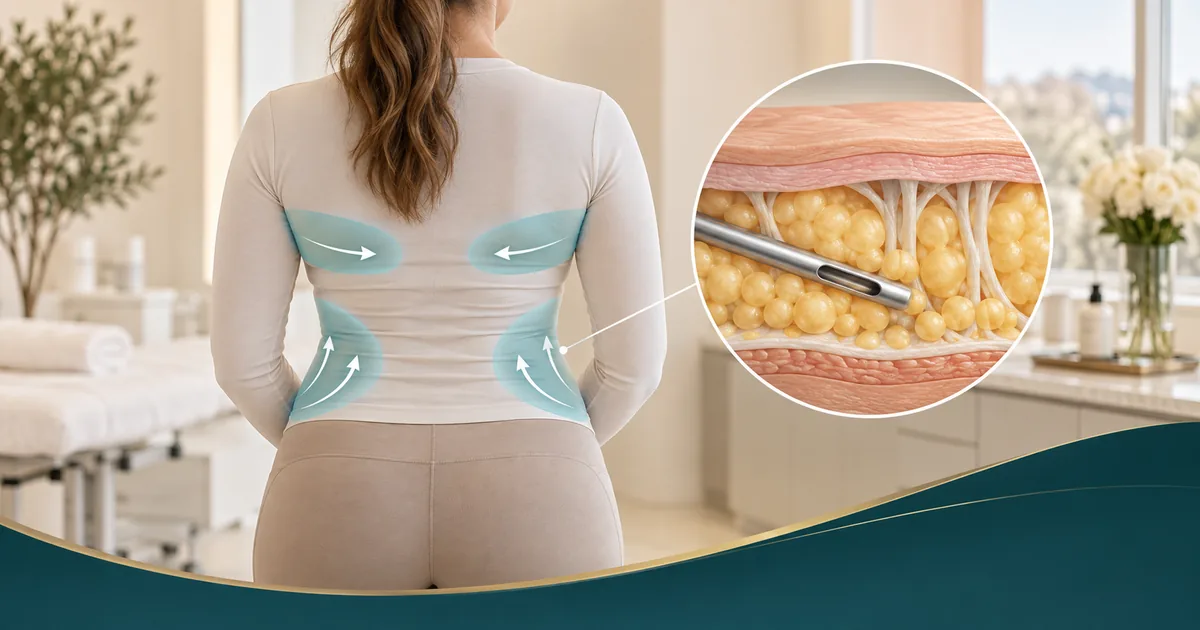
If you have ever wondered why your love handles feel harder than your belly fat, the answer lies in tissue composition. Back and flank fat contains significantly more fibrous connective tissue — dense collagen septae that anchor the fat to the underlying muscle fascia — than the relatively soft, pliable fat found on the abdomen or inner thighs. This fibrous architecture is what makes back and flank fat so resistant to diet and exercise, and it is also what makes it harder for a surgeon to remove.
During liposuction, a cannula passes through the fat layer and breaks up adipose tissue through suction and mechanical disruption. In soft-fat areas like the abdomen, the cannula glides relatively smoothly. In fibrous zones — the back, flanks and bra-roll area — the cannula meets resistance from dense collagen bands. The surgeon must use more force, slower passes and often specialised equipment (power-assisted or ultrasound-assisted devices) to break through these septae effectively. Clinical reviews of liposuction technique consistently note that fibrous zones require longer operating times and carry higher risk of contour irregularity if the tissue is not treated evenly.2
This tissue density also explains why back and flank liposuction produces more post-operative swelling and firmness than abdominal liposuction. The inflammatory response to disrupted fibrous tissue is more pronounced, and the collagen-rich tissue takes longer to remodel. Patients should expect a longer swelling timeline — typically 4–6 months to see the final result, compared with 3–4 months for softer areas.
Hormonal and Genetic Factors
Fat distribution across the back and flanks is strongly influenced by genetics, sex hormones and age. Men tend to accumulate fat preferentially on the flanks and lower back (the classic "love handles" pattern), while women more commonly develop bra-roll fat and upper-back fullness. Cortisol — the stress hormone — is associated with increased truncal fat deposition, including the back and flank area. These hormonal and genetic factors explain why targeted exercise rarely eliminates back and flank fat: the body preferentially stores and defends fat in these locations regardless of overall caloric balance.
A nationwide analysis of 69,424 liposuction patients found that trunk-area procedures (including back and flanks) had complication rates comparable to other body sites when performed by experienced surgeons, confirming that the fibrous nature of the tissue does not inherently increase surgical risk — it increases technical difficulty, which experienced practitioners manage routinely.1
The Zones: Bra Roll, Upper Back, Flanks, Love Handles
Surgeons divide the posterior trunk into four distinct treatment zones. Understanding which zones concern you helps your surgeon plan incision placement, estimate operating time and quote an accurate price — because each additional zone adds both time and cost.
Bra Rolls (Infra-Scapular Fat)
Bra-roll fat sits along the mid-back, just below the scapulae (shoulder blades), in the horizontal band where a bra strap rests. This fat folds over the bra band, creating visible ridges through clothing. The tissue here is moderately fibrous, with a mix of soft subcutaneous fat and denser fibrous septae. Bra-roll liposuction typically removes 200–600 mL per side and produces a dramatic improvement in how clothing fits across the back. This is the most commonly requested back liposuction zone among women.
Upper Back (Supra-Scapular Fat)
Upper back fat accumulates above the shoulder blades and across the upper trapezius region. This zone is less commonly treated as an isolated area but is often addressed as part of a comprehensive back contouring session. The fat here tends to be thinner but sits over dense muscle fascia, requiring precise technique to avoid over-aspiration. Upper back liposuction is most requested by patients who feel their upper back appears wide or thick in photographs.
Flanks (Lateral Waist)
The flanks are the lateral zones between the lower ribs and the iliac crest (top of the hip bone). This is the area most people call "love handles" — though the medical term is simply "flanks." Flank fat is among the most fibrous fat on the body, with thick collagen bands anchoring the subcutaneous fat to the thoracolumbar fascia beneath. Flank liposuction typically removes 300–800 mL per side and is one of the most frequently performed body-contouring zones for both men and women. The flanks are a core component of Lipo 360, which treats the entire midsection circumferentially.
Love Handles (Posterior Iliac Crest)
While "love handles" and "flanks" overlap considerably, some surgeons distinguish the posterior love handle — the fat that bulges directly above and behind the hip bone — as a separate zone. This area is particularly prominent in men and is one of the last fat deposits to shrink with weight loss. Love handle liposuction produces a noticeably narrower waistline from behind and is often combined with flank and abdominal liposuction for comprehensive midsection contouring.
| Zone | Location | Typical Volume Removed | Tissue Density | Most Requested By |
|---|---|---|---|---|
| Bra rolls | Mid-back, below scapulae | 200–600 mL per side | Moderate | Women |
| Upper back | Above scapulae, trapezius area | 150–400 mL per side | Moderate–high | Both |
| Flanks | Lateral waist (ribs to iliac crest) | 300–800 mL per side | High (very fibrous) | Both |
| Love handles | Posterior iliac crest | 200–500 mL per side | High | Men |
Are You a Candidate?
Candidacy for back and flank liposuction depends on three primary factors: skin thickness and quality, weight stability, and realistic expectations about what liposuction can achieve in fibrous zones.
Skin Thickness and Elasticity
Back and flank skin is generally thicker than skin on the arms, inner thighs or chin — which is an advantage. Thicker skin retracts more reliably after fat removal and is less likely to show surface irregularities. The pinch test on the back usually reveals 2–5 cm of tissue in good candidates, with firm skin that snaps back when released. Patients with thin, sun-damaged or stretch-marked back skin may see less satisfying retraction, though this is less common posteriorly than anteriorly.
Age alone does not disqualify candidates. Many patients in their 50s and 60s have excellent back skin quality because the posterior trunk receives less sun exposure and less gravitational stress than the face, neck or abdomen. The skin's recoil capacity, not the calendar, determines whether liposuction alone will produce a smooth result.
Weight Stability
Ideal candidates are within 15–20 lbs (7–9 kg) of their target weight and have maintained that weight for at least six months. Back and flank liposuction is a contouring procedure, not a weight-loss procedure. Patients who are actively losing weight should wait until their weight stabilises, because further loss after surgery changes the fat distribution unpredictably and may reveal skin laxity that was not apparent pre-operatively.
BMI under 30 is the general recommendation, though anatomy matters more than a single number. Patients with a BMI of 30–35 who carry their excess weight predominantly on the flanks and back — with relatively lean limbs and face — may still be excellent candidates. Conversely, a patient with a BMI of 27 whose back fat is minimal but expects dramatic sculpting may be disappointed.
What Makes a Poor Candidate
- Significant skin laxity on the back — rare but seen after massive weight loss; removing fat beneath loose skin worsens the drape
- BMI over 35 — the volume of fat exceeds what can be safely removed in a single session, and remaining untreated fat blunts the visual result
- Active weight fluctuation — gaining or losing more than 5 kg in the three months before surgery makes outcome prediction unreliable
- Unrealistic expectations — back liposuction improves contour; it does not create an athletic V-taper or eliminate all visible fat
- Prior back surgery with significant scarring — scar tissue in the treatment zone makes aspiration unpredictable and increases irregularity risk
| Factor | Ideal Candidate | Borderline | Not Recommended |
|---|---|---|---|
| BMI | Under 30 | 30–35 | Over 35 |
| Skin quality | Thick, elastic, good recoil | Moderate thickness, mild laxity | Thin, stretch-marked, poor recoil |
| Weight stability | Stable 6+ months | Stable 3 months | Actively fluctuating |
| Fat distribution | Localised to back/flanks | Generalised truncal fat | Diffuse obesity |
| Prior surgery | None in treatment zone | Minor prior lipo (revision) | Extensive scarring |
Positioning and Why It Lengthens the Operation
One of the most under-discussed aspects of back and flank liposuction is intraoperative positioning. Unlike abdominal liposuction — where the patient lies supine (face up) for the entire procedure — treating the back and flanks requires multiple position changes during surgery. This is a real practical difference that affects operating time, anaesthesia duration and overall cost.
The Position Sequence
A typical back and flank liposuction case proceeds through two or three positions:
- Prone position (face down): The patient starts face down on the operating table, allowing full access to the upper back, bra rolls and posterior waistline. The surgeon treats these zones first because they are only accessible from this angle. Access incisions are placed in natural skin creases along the mid-back and lateral trunk.
- Lateral decubitus (on the side): The patient is then rolled onto one side, allowing the surgeon to treat the flank and love handle from a lateral approach. After completing one side, the patient is repositioned onto the opposite side. Some surgeons skip this position and access the flanks from the prone position using longer cannulas.
- Supine position (face up): If the flanks extend anteriorly toward the abdomen, the patient is rolled face up at the end to blend the lateral contour with the anterior waistline. This step is essential for avoiding a visible transition line between treated and untreated areas.
Each repositioning requires the entire surgical team to carefully move the patient while maintaining sterile draping, IV lines and monitoring equipment. This typically adds 30–60 minutes to total operating time compared with a single-position procedure. When combined with the slower aspiration required by fibrous tissue, a comprehensive back and flank liposuction case commonly takes 2–4 hours — roughly twice as long as isolated abdominal liposuction of similar volume.
Why This Matters for Anaesthesia
The extended operating time has direct implications for anaesthesia. Isolated flank-only cases can sometimes be performed under local tumescent anaesthesia with IV sedation, but multi-zone back liposuction virtually always requires general anaesthesia or deep IV sedation. General anaesthesia allows safe repositioning without patient discomfort and provides the muscle relaxation needed for optimal positioning. This adds $1,000–$2,500 to the total cost and requires a full pre-operative medical clearance.
Marking in the Standing Position
Because gravity significantly changes how back and flank fat distributes, surgeons always mark treatment zones with the patient standing upright — before any anaesthesia is administered. Fat that bulges prominently while standing may flatten and redistribute when lying prone on the operating table. If the zones were marked in the lying position, the surgeon would undertreat the areas of maximum bulging. Pre-operative standing markings — typically made with a surgical marker in concentric zones — serve as the roadmap for the entire procedure and are essential for symmetrical results.
Recovery: Why Back Liposuction Is More Uncomfortable to Sleep Through
Recovery from back and flank liposuction follows the same general trajectory as other liposuction areas — progressive reduction in swelling, bruising and discomfort over weeks to months — but with one consistently reported difference: sleeping is significantly more uncomfortable in the first two to three weeks. The treatment area covers the surface you lie on, and pressure on freshly treated tissue causes throbbing pain that disrupts sleep.
Week 1: The Acute Phase
Days 1–3: Moderate to significant soreness across the treated back and flanks. The tissue feels bruised and swollen. Moving from sitting to standing and twisting the torso are the most uncomfortable movements. Drainage of pinkish tumescent fluid from incision sites is normal for 24–48 hours. Compression garment worn 24/7 — typically a wraparound vest extending from mid-chest to below the hips.
Days 4–7: Swelling peaks around day 3–4 and begins to subside. Bruising spreads and darkens before starting to fade. Most patients return to desk work by day 5–7, though sitting in a standard office chair may be uncomfortable if the lower flanks were treated. A cushion or lumbar support helps. Pain is managed with oral analgesics — paracetamol (acetaminophen) is preferred; NSAIDs are often avoided in the first week because they increase bruising.
Sleep strategy: Most patients find that sleeping on their stomach or side — with a body pillow for support — is the only comfortable option during week 1. Lying flat on the back puts direct pressure on treated bra-roll and mid-back tissue, which is acutely painful. Recliner chairs are a popular alternative for the first few nights.
Weeks 2–3: Early Improvement
Bruising fades from dark purple to yellow-green. Approximately 50% of swelling resolves, and patients begin to see the outline of their improved contour beneath residual puffiness. The treated tissue feels firm and "lumpy" — this is normal post-liposuction fibrosis (scar tissue forming in the disrupted fat layer) and resolves over the following weeks to months. Manual lymphatic drainage (MLD) massage starting at day 10–14 accelerates fluid clearance and softens fibrotic areas. Light walking and daily activities resume comfortably.
Weeks 4–6: Return to Activity
Most visible swelling has resolved. The compression garment transitions to daytime-only wear. Light cardiovascular exercise (walking, stationary cycling) resumes at week 3–4. Back-specific exercises — twisting movements, lat pulldowns, rows and deadlifts — remain restricted until week 6–8 to allow the treated tissue to heal fully. Most patients describe themselves as "functional but still sore" during this phase. Sleeping on the back becomes comfortable for most patients by week 3–4.
Months 2–6: Final Results
Residual deep swelling continues to resolve through month 4–6. The treated tissue softens as fibrosis remodels. Skin retraction continues throughout this period, with the final contour stabilising at approximately 4–6 months. Patients treated with VASER or PAL technology may notice continued skin tightening through month 6 due to collagen stimulation. Follow-up photography at 6 months allows surgeon and patient to assess the final result and discuss whether any touch-up is needed.
| Timeframe | What to Expect | Allowed Activity |
|---|---|---|
| Days 1–3 | Soreness, swelling, fluid drainage; sleeping on back painful | Rest; light walking only |
| Days 4–7 | Peak swelling subsiding; bruising darkens then fades | Desk work; no lifting over 5 lbs |
| Weeks 2–3 | 50% swelling resolved; tissue feels firm; fibrosis normal | Daily activities; gentle stretching; MLD massage |
| Weeks 4–6 | Most swelling resolved; sleeping on back comfortable | Light cardio; no back/core exercises yet |
| Weeks 6–8 | Contour approaching final result; tissue softening | Full exercise including weights resumes |
| Months 3–6 | Final results; skin retraction complete | All activities unrestricted |
Results and Limits
Back and flank liposuction, when performed on well-selected candidates by experienced surgeons, produces significant and permanent contour improvement. The bra-roll area, flanks and love handles respond well to liposuction, and the results are often described by patients as "transformative for how clothing fits."
What to Expect
Patients typically see a reduction of 2–5 cm in circumference at the waistline and a visible elimination or substantial reduction of bra rolls and love handles. The improvement is most noticeable in fitted clothing, swimwear and from behind — the very angles that bothered patients most before surgery. Results are permanent — removed fat cells do not regenerate — but remaining cells can enlarge with significant weight gain (more than 5 kg), partially blunting the improvement.
The posterior trunk is particularly rewarding for liposuction because the thick skin provides a natural "smoothing layer" over the treated area. Minor aspiration inconsistencies that would show as surface waviness on thinner skin (such as the arms or inner thighs) are more forgiving on the back, where the dermal thickness conceals subtle variations.
What Liposuction Cannot Do
- Create an athletic physique. Back liposuction removes fat; it does not build muscle definition. The V-taper appearance requires developed latissimus dorsi and deltoid muscles — that comes from training, not surgery.
- Tighten loose skin. If significant skin laxity exists — typically after massive weight loss — removing fat may worsen the drape. These patients may need a body lift or excisional procedure in addition to liposuction.
- Correct posture-related fullness. Some patients perceive their upper back as "fat" when the issue is primarily postural kyphosis (forward curvature). Liposuction cannot change skeletal alignment.
- Remove deep or intramuscular fat. Liposuction operates in the subcutaneous plane only. Fat between muscle fibres is not accessible.
Combining with Other Areas
Back and flank liposuction is very commonly combined with abdominal liposuction as part of a Lipo 360 procedure — treating the entire midsection (abdomen, flanks, back) in a single session. This circumferential approach produces the most harmonious result because it addresses the waistline from every angle rather than leaving untreated pockets that create transition lines. Combining areas reduces per-area cost through shared anaesthesia and facility fees, though total aspirate volume must remain within safe limits — generally under 5,000 mL when combined with appropriate tumescent technique.2
Other common combinations include back and flanks with arm liposuction (popular among women addressing multiple upper-body zones) and back with chin and neck liposuction (for patients contouring the full posterior and submental profile).
Risks: Irregularity in Fibrous Zones
Back and flank liposuction shares the general safety profile of liposuction across all body areas — the largest published analysis of 69,424 cases confirms low overall complication rates.1 However, the fibrous nature of back and flank tissue introduces specific risks that warrant discussion.
Contour Irregularity
The dense collagen septae in back and flank fat do not break down uniformly during aspiration. If the cannula disrupts some septae while leaving others intact, the result can be a cobblestone or rippled surface. This is the most common aesthetic complication specific to back liposuction and is more likely when the surgeon lacks experience with fibrous tissue, when cannulas are too large for the tissue density, or when aspiration is rushed. PAL (power-assisted liposuction) and VASER (ultrasound-assisted) reduce this risk by pre-treating the fibrous septae before aspiration, producing more uniform tissue breakdown.3
Asymmetry
Because back and flank liposuction involves treating mirror-image zones on both sides of the body — often with patient repositioning between sides — achieving perfect symmetry is technically demanding. Minor asymmetry is common and usually imperceptible. Significant asymmetry can occur if more fat is removed from one side, if swelling resolves unevenly, or if pre-existing skeletal asymmetry (such as mild scoliosis) becomes more apparent after fat removal.
Seroma
The back and flank area has a larger treatment surface than most other liposuction zones, creating a potential dead space between the skin and underlying fascia where fluid can accumulate. Seromas — pockets of serous fluid — are more common after back liposuction than after arm or chin procedures. Consistent compression garment wear is the primary prevention strategy. Small seromas resolve spontaneously; larger ones may require aspiration (needle drainage) at a follow-up visit.
Full Risk Overview
| Complication | Why Back/Flanks Carry Higher Risk | Prevention |
|---|---|---|
| Contour irregularity | Fibrous septae resist uniform aspiration | PAL/VASER; experienced surgeon; fine cannulas |
| Seroma | Large treatment surface creates dead space | Compression garment 6–8 weeks; MLD massage |
| Asymmetry | Mirror-image zones with repositioning between sides | Pre-op standing marks; intraoperative measurement |
| Prolonged swelling | Dense tissue generates stronger inflammatory response | Compression; MLD from week 2; patience |
| Skin laxity (post-op) | Rare — back skin is thick — but possible after large-volume removal | Conservative volume removal; candidacy screening |
For a broader overview of liposuction complications and how to handle them, including what constitutes botched back liposuction and your revision options, see our guide to when liposuction goes wrong.
What It Costs
Back and flank liposuction cost depends primarily on the number of zones treated, the technique used, geographic location and whether it is combined with other areas. Because the procedure involves longer operating times and often general anaesthesia, it is typically priced higher than single-area liposuction.
| Location | Cost Range | Includes |
|---|---|---|
| United States (average) | $3,500–$7,500 | Surgeon, facility, anesthesia |
| US (NYC / LA / Miami) | $5,500–$9,000 | Same; premium market pricing |
| United Kingdom | £3,000–£7,000 | Surgeon, facility, garment |
| Turkey (all-inclusive) | $1,500–$3,500 | Surgery, hotel, transfers, garments, aftercare |
| Mexico | $2,000–$4,500 | Surgery, facility; travel separate |
What Affects the Price
The single biggest variable is zone count. Treating bra rolls alone costs less than treating bra rolls plus flanks plus love handles. Each additional zone adds 30–60 minutes of operating time, additional anaesthesia and more surgeon effort in fibrous tissue. Technique also matters: VASER and PAL cost $1,000–$2,000 more than traditional tumescent due to specialised equipment. When back and flank liposuction is combined with abdominal liposuction as part of Lipo 360, per-area cost decreases through shared facility and anaesthesia fees — but total cost increases.
For a detailed country-by-country cost breakdown and financing options, see our comprehensive liposuction cost guide. Back and flank liposuction is a cosmetic procedure and is not covered by health insurance.
Frequently Asked Questions
Back liposuction costs between $3,500 and $7,500 in the United States depending on how many zones are treated, the surgeon's experience, and geographic location. In Turkey, all-inclusive packages — including hospital, hotel, transfers and compression garments — range from $1,500 to $3,500. See our full cost guide for detailed breakdowns.
Many patients report that back liposuction recovery is more uncomfortable than abdominal or arm lipo because the tissue is denser and more fibrous. Sleeping is the primary challenge — lying on your back puts direct pressure on the treated area. Most patients sleep on their side or stomach for the first two to three weeks. Pain is managed with oral analgesics and typically resolves within 7–10 days.
Yes. Bra-roll liposuction specifically targets the horizontal fat pads that fold over the bra band along the mid-back. It is one of the most commonly requested back liposuction zones among women. Results are visible once swelling resolves at 3–6 months, and the fat removal is permanent as long as weight remains stable.
Most patients return to desk work within 5–7 days. Compression garments are worn for 6–8 weeks. Light exercise resumes at week 3–4, and full activity including core and back exercises resumes at week 6–8. Final results are visible at 4–6 months. See our full recovery timeline above.
They refer to the same area. "Flanks" is the anatomical term for the lateral waist between the lower ribs and the iliac crest; "love handles" is the colloquial name for excess fat in this zone. Surgeons use the terms interchangeably. The procedure and technique are identical regardless of which term is used.
Yes — back and flank liposuction is very commonly combined with abdominal liposuction as part of a Lipo 360 procedure. Combining areas reduces total anaesthesia time, facility fees and overall recovery compared with staging procedures separately. Total aspirate must stay within safe limits (typically under 5 litres).