
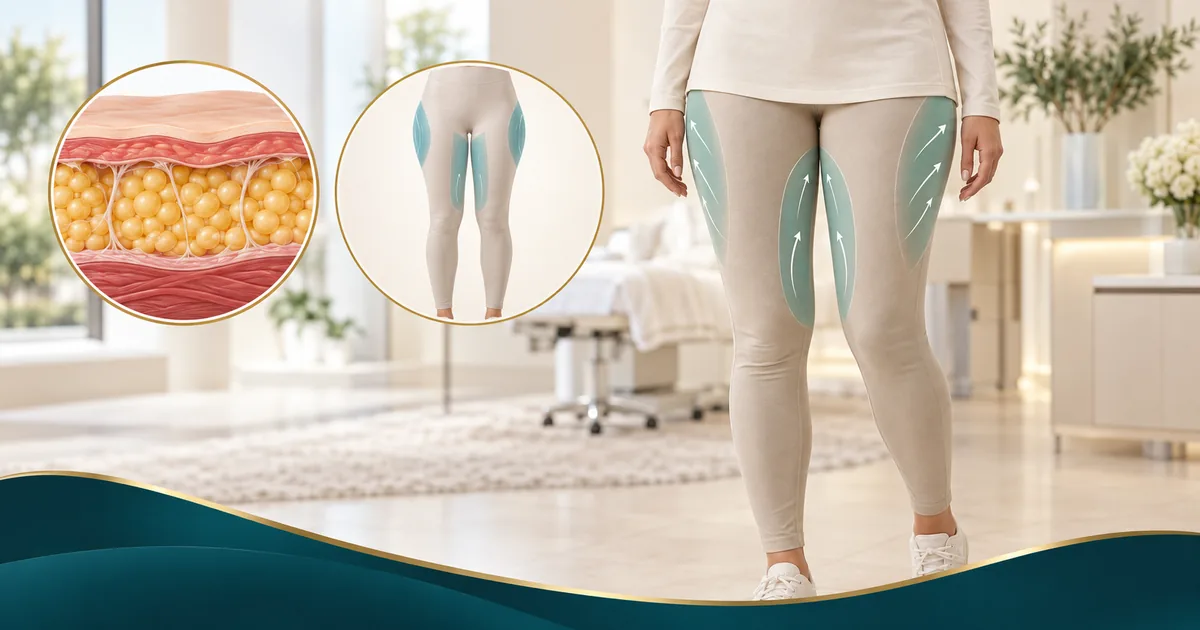
Inner Thigh vs Outer Thigh: Two Different Problems
The thigh is not a single treatment zone — it contains distinct fat compartments that behave differently under the cannula, respond differently to contouring, and carry different risks. Grouping "thigh liposuction" into one category obscures the surgical reality: inner thigh work and outer thigh work are essentially different procedures that happen to share the same limb. Understanding the distinction is essential before committing to either one.
According to ASPS procedural data, thigh contouring is one of the most requested liposuction zones, yet it is also one of the areas where patient expectations most frequently diverge from what surgery can deliver.1 The primary reason is the interplay between fat volume and skin quality — a factor that matters more in the thighs than in almost any other body area.
Inner Thigh: Skin Quality Is the Limiting Factor
The inner (medial) thigh is the area patients most commonly complain about — thighs that rub together, chafing, inability to wear shorts comfortably, and a fullness that persists regardless of weight loss. The fat in this compartment is soft, pliable, and generally straightforward for a surgeon to remove. The problem is not the fat — it is what lies above it.
Inner thigh skin is inherently thinner than skin on the lateral thigh, the abdomen, or the flanks. It has fewer dermal attachments and weaker structural collagen. This means that when fat is removed from beneath it, the skin must contract significantly to drape smoothly over the reduced volume — and inner thigh skin frequently does not contract enough. The result can be loose, crepey skin that looks worse than the original fullness, particularly in patients over 40 or those who have experienced significant weight fluctuations.
The pinch test is critical here. If a surgeon pinches the inner thigh skin and it springs back quickly and firmly, there is enough elasticity for a good result. If it hangs limply or wrinkles like tissue paper, liposuction alone is unlikely to produce a satisfying outcome — the patient may need a medial thigh lift to address the skin excess, or at minimum a conservative approach that removes less fat and preserves the supporting volume beneath the skin.
A large-scale analysis of liposuction outcomes confirms that skin retraction quality is the single strongest predictor of patient satisfaction across all body zones, but the effect is most pronounced in the medial thigh due to its inherently thinner dermis.2
Typical fat removal from the inner thigh ranges from 500 to 1,500 mL per side. Conservative surgeons in patients with borderline skin elasticity may remove only 300–800 mL per side to avoid post-operative skin laxity. The surgical approach uses access incisions hidden in the groin crease and sometimes the medial knee fold, with the cannula working in a fan-shaped pattern from both entry points to ensure even reduction.
Outer Thigh and "Saddlebags": The Fat Is More Fibrous
The outer (lateral) thigh is where saddlebags live — the rounded bulges on the sides of the upper thighs that create a disproportionate silhouette regardless of overall body weight. Saddlebag fat is among the most genetically stubborn deposits in the body. Women with a gynoid (pear-shaped) fat distribution pattern carry a disproportionate amount of fat here, and it is notoriously resistant to caloric deficit. Many patients report that their saddlebags look identical whether they weigh 130 lbs or 160 lbs.
The surgical challenge with the outer thigh is not skin quality — lateral thigh skin is thick, well-anchored, and retracts reliably. The challenge is the fat itself. Outer thigh fat is significantly more fibrous than inner thigh fat. The connective tissue septae running through the lateral compartment are denser and more numerous, making it harder for a standard suction cannula to break up and aspirate the tissue. This is why many surgeons prefer power-assisted liposuction (PAL) or VASER ultrasound-assisted liposuction for saddlebag treatment — the mechanical vibration or ultrasonic energy breaks the fibrous tissue apart before aspiration, producing smoother results and reducing surgeon fatigue during what can be a physically demanding procedure.
Typical fat removal from the outer thigh ranges from 500 to 1,500 mL per side. The symmetry challenge is significant: saddlebags must be reduced proportionally on both sides, and even small discrepancies are visible when the patient stands in front of a mirror. Pre-operative marking with the patient standing is essential — the saddlebag margins become invisible once the patient lies on the operating table.
Access incisions for outer thigh liposuction are placed in the gluteal fold (buttock crease) and sometimes the lateral knee fold. These locations conceal the scars naturally within skin folds. The cannula must navigate the dense fibrous tissue using a cross-tunnelling technique — multiple passes in different directions — to create a smooth, even contour without ridges or depressions.
Are You a Candidate?
Thigh liposuction candidacy assessment is more nuanced than for many other body areas because the thigh combines thin-skinned zones (medial), thick-skinned zones (lateral), and the near-universal presence of cellulite — which liposuction cannot treat and may worsen. Three factors determine candidacy: skin elasticity, weight stability, and realistic expectations about cellulite.
Skin Elasticity: The Make-or-Break Factor
Good skin elasticity is necessary for a satisfactory thigh liposuction result. The pinch test — grasping the skin between thumb and forefinger and releasing — provides a reliable clinical estimate. Skin that snaps back within 1–2 seconds has adequate elasticity. Skin that slowly creeps back or remains tented for several seconds suggests poor retraction potential.
Age correlates with skin elasticity but is not determinative on its own. A 55-year-old with naturally thick dermis and no significant weight fluctuation history may have better thigh skin than a 35-year-old who has gained and lost 25 kg twice. Sun exposure, smoking, and genetics all affect dermal collagen quality independently of age.
Weight Stability
Patients should be within 10–15 lbs of their target weight and weight-stable for at least six months before thigh liposuction. The thigh is one of the first areas to re-accumulate fat during weight gain in gynoid body types, which means a patient who gains 10 kg after surgery may see the saddlebags partially return as remaining fat cells enlarge. Weight stability before surgery ensures the result represents a true contour change rather than a temporary snapshot during a weight-loss trajectory.
| Factor | Good Candidate | Borderline | Poor Candidate |
|---|---|---|---|
| BMI | Under 30 | 30–33 | Over 33 |
| Skin elasticity (inner) | Quick snap-back | Slow retraction | No retraction / crepey |
| Skin elasticity (outer) | Firm, thick skin | Moderate thickness | Thin, loose skin |
| Cellulite | Minimal or none | Mild dimpling | Severe dimpling |
| Weight stability | Stable 6+ months | Stable 3 months | Actively fluctuating |
| Weight loss history | No major fluctuations | Lost 15–25 kg | Lost 30+ kg |
Why Liposuction Does Not Treat Cellulite
This is the single most important expectation to set before thigh liposuction, and the point where the most patient disappointment occurs. Cellulite and subcutaneous fat are related but distinct problems, and liposuction addresses only one of them.
Cellulite is caused by fibrous connective tissue bands (septae) that run vertically from the deep fascia to the underside of the skin. These bands pull the skin surface downward at attachment points, creating the characteristic dimpled or "cottage cheese" appearance. The fat between the bands bulges upward, exaggerating the visual contrast between dimple and mound. This structural architecture is present in an estimated 80–90% of post-pubertal women regardless of body weight, according to published dermatological research.3
Liposuction removes fat volume but does not cut, release, or alter the fibrous septae. The dimpling remains because the structural cause remains. In some cases, removing fat from beneath cellulite-affected skin makes the dimpling more visible — the reduced subcutaneous padding allows the septae to pull the skin inward more prominently, worsening the surface texture even as the overall thigh volume decreases.
Procedures that specifically target cellulite — such as subcision (Cellfina), radiofrequency treatments, or injectable collagenase (QWO, now discontinued) — work by different mechanisms: cutting or dissolving the fibrous bands. These can be performed alongside or after liposuction, but liposuction itself is not a cellulite treatment and should never be presented as one.
If cellulite is your primary concern rather than thigh volume, liposuction is the wrong procedure. Discuss cellulite-specific options with a dermatologist or plastic surgeon before booking thigh lipo.
When a Thigh Lift Is the Right Operation Instead
A thigh lift (thighplasty) removes excess skin — and the fat attached to it — through an incision typically placed in the groin crease (medial thigh lift) or extending down the inner thigh to the knee (vertical thigh lift). It is the appropriate procedure when:
- The primary complaint is loose, hanging skin rather than fat volume
- The patient has lost 30 kg or more and has residual skin excess
- The pinch test reveals thin skin with poor elasticity that will not retract after fat removal
- Skin folds cause chafing, rash, or hygiene concerns
A thigh lift costs $5,000–$10,000 in the US and involves a longer recovery (2–4 weeks) with a permanent scar. Some patients benefit from a combined approach: liposuction first to reduce volume, followed by a thigh lift 3–6 months later to address residual skin. This staged strategy allows the tissue to settle before the surgeon decides how much skin to excise. For more on the procedure itself and its parallels with arm contouring, the assessment principles are similar across extremity areas.
How the Procedure Works
Thigh liposuction is performed as an outpatient procedure lasting 1–3 hours depending on whether one or both compartments (inner and outer) are treated. All modern approaches begin with tumescent infiltration — a dilute solution of lidocaine and epinephrine in saline that numbs the tissue, constricts blood vessels, and separates fat cells for easier removal. The typical infiltration ratio is 2–3 mL of solution per 1 mL of anticipated aspirate, as described in the StatPearls clinical review.4
Cannula Entry Points
The number and location of access incisions depend on which thigh zones are treated:
- Inner thigh: 2–3 incisions per side — groin crease (inguinal fold) and medial knee fold, with an optional mid-thigh access point for longer thighs
- Outer thigh: 2 incisions per side — gluteal fold (buttock crease) and lateral knee fold
- Both zones: 3–4 incisions per side combining the above
All incisions are 3–4 mm and are placed within natural skin folds where possible. By 6–12 months, they typically fade to near-invisible marks that are difficult to identify.
Volume and Symmetry
Fat removal volumes for the thigh are among the largest of any single body area:
- Inner thigh only: 500–1,500 mL per side
- Outer thigh only: 500–1,500 mL per side
- Both compartments: 1,000–2,500 mL per side
When treating both thighs bilaterally, total aspirate can reach 3,000–5,000 mL — placing the procedure in the large-volume liposuction category. Safety guidelines from the ASPS recommend that total aspirate exceeding 5,000 mL requires overnight monitoring and an inpatient setting.1
Symmetry is the primary technical challenge. The surgeon marks the thighs with the patient standing — noting the saddlebag margins, the medial fat distribution, and any pre-existing asymmetries — because these landmarks disappear when the patient lies on the operating table. During the procedure, the surgeon constantly cross-references aspirate volumes between sides and palpates both thighs to match contour. Despite this, minor asymmetry (within 5%) is common and usually unnoticeable in daily life.
Technique Selection
| Technique | Mechanism | Best For | Cost Premium |
|---|---|---|---|
| Tumescent (standard) | Suction only | Soft inner-thigh fat, good skin | Baseline |
| Power-assisted (PAL) | Mechanical vibration | Fibrous outer-thigh/saddlebag fat | +10–20% |
| VASER (ultrasound) | Ultrasound emulsification | Dense fat + borderline skin elasticity | +15–30% |
| BodyTite (RFAL) | Radiofrequency coagulation | Moderate skin laxity, older patients | +25–40% |
For outer thigh and saddlebag work, PAL or VASER is often preferred over standard tumescent because the fibrous tissue resists conventional suction. For inner thigh work, standard tumescent is often sufficient since the fat is softer, but VASER offers the added benefit of collagen stimulation for mild skin tightening. Explore all treatment areas to see how thigh contouring compares to other zones.
Recovery Week by Week
Thigh liposuction recovery is physically more demanding than arm or chin lipo recovery because the legs bear your body weight. Walking, sitting, and standing all engage the treated tissue from day one. Compression garments are harder to conceal and more uncomfortable in warm weather. Despite this, most patients describe the experience as manageable — the discomfort is more "deep soreness" than sharp pain, and it improves steadily each day.
Week 1: The Acute Phase
Days 1–3: Significant swelling, bruising, and soreness. The thighs feel heavy, stiff, and tight beneath the compression garment. Walking is possible and encouraged — short, flat walks of 10–15 minutes several times daily to promote circulation and prevent blood clots. Sitting may be uncomfortable due to pressure on the inner-thigh treatment zone; a donut cushion helps. Fluid drainage from incision sites is normal for 24–48 hours — place towels on chairs and bedding. Pain is managed with prescribed analgesics; avoid NSAIDs for the first week as they increase bruising.
Days 4–7: Swelling peaks around day 3–4, then begins subsiding. Bruising spreads and changes colour (purple to yellow-green). Most patients can return to sedentary desk work by day 5–7, though sitting for prolonged periods (over 2 hours without standing) should be avoided. Walking distances gradually increase. Compression garments must remain on 24/7, including during sleep.
Week 2: Early Improvement
Approximately 40–50% of swelling has resolved. The thighs begin to feel less stiff, and bruising fades noticeably. Daily activities resume — cooking, light housework, driving short distances (if not taking prescription pain medication). Sitting comfort improves. Incision sites should be fully closed. Gentle range-of-motion exercises — leg circles, knee bends — help prevent stiffness. Manual lymphatic drainage (MLD) massage may begin at surgeon discretion, typically around day 10–14.
Week 3: Turning the Corner
Patients begin to see the first meaningful contour improvement beneath residual swelling. The thighs feel softer as the initial tissue firmness (induration) begins to resolve. Light cardiovascular exercise resumes — walking at a brisk pace, stationary cycling at low resistance, swimming (once incisions are fully healed). Lower-body resistance training remains restricted. Compression garments may transition to daytime-only wear at surgeon discretion.
Weeks 4–6: Return to Activity
Most visible swelling has resolved — the thigh contour looks close to the final result, though subtle puffiness persists. Light lower-body exercise (bodyweight squats, low-resistance leg press) resumes around week 4 with surgeon approval. Full exercise — running, heavy squats, jumping, contact sports — resumes at week 6. Compression garments continue during exercise through week 6–8. Most patients consider themselves "fully recovered" for daily life by week 4.
Months 2–6: Final Results Emerge
Residual swelling clears completely. Skin continues to tighten and remodel around the new contour — this is particularly noticeable in VASER and BodyTite patients, where collagen stimulation peaks at 3–4 months. The 6-month measurement represents the permanent result. Follow-up photography at this point allows assessment of whether any touch-up is needed (uncommon when candidacy was appropriate).
| Timeframe | What to Expect | Allowed Activity |
|---|---|---|
| Days 1–3 | Heavy swelling, bruising, fluid drainage | Short walks only; rest with legs elevated |
| Days 4–7 | Peak swelling subsiding | Desk work; walking 15–30 min |
| Week 2 | 40–50% swelling resolved | Driving; light daily activities |
| Week 3 | Contour visibly improved | Brisk walking, stationary cycling |
| Weeks 4–6 | Most swelling resolved | Light weights → full exercise by week 6 |
| Months 2–6 | Final results; skin remodeling complete | All activities including running, sports |
Results and What Photographs Don't Show
Thigh liposuction before-and-after photographs consistently show dramatic improvements in thigh contour — slimmer profiles, reduced saddlebags, and daylight visible between the inner thighs where none existed before. These photographs are real, but they represent optimal outcomes in well-selected candidates photographed at the 6-month mark under controlled lighting.
What Changes
Patients can expect a reduction of 3–8 cm in thigh circumference depending on the volume removed, the zones treated, and baseline measurements. Saddlebag reduction is often the most dramatic visual change — the lateral thigh silhouette transforms from convex to straight or slightly concave when viewed from the front. Inner thigh reduction improves the gap between the legs and reduces friction and chafing during walking.
The change in clothing fit is often the most impactful outcome for patients. Jeans, trousers, and skirts that previously pulled across the thighs or required sizing up to accommodate hip width fit more proportionally after thigh lipo. Many patients report this wardrobe change as more satisfying than the mirror improvement.
What Photographs Don't Show
Several realities are absent from before-and-after galleries:
- Cellulite persistence: Photos are taken under controlled studio lighting that minimises surface texture. Under natural side-lighting, cellulite dimpling is visible post-operatively in most patients who had it pre-operatively — because liposuction does not treat it.
- Residual asymmetry: Minor differences between left and right thighs (within 5%) are present in nearly every outcome but are not highlighted in before-and-after comparisons.
- Skin texture changes: Inner thigh skin may appear slightly crepey or wrinkled after fat removal, particularly in older patients. Photographs taken from specific angles may not reveal this.
- Swelling timeline: The "after" photograph is typically taken at 6 months. At 6 weeks — when patients make their initial emotional assessment — the thighs may still be 15–25% swollen, and the result looks less impressive than it will eventually become.
None of this means the results are poor — thigh liposuction consistently produces high patient satisfaction when expectations are set correctly. It means that patients should judge their result at the 6-month mark, under normal lighting, and against their pre-operative measurements — not against idealised before-and-after galleries.
Risks Specific to the Thigh: Contour Irregularity and Seroma
Thigh liposuction carries the general risks of any liposuction procedure — infection, bleeding, anaesthesia reactions, DVT — but two complications are disproportionately common in thigh treatment compared to other body areas: contour irregularity and seroma formation.
Contour Irregularity
The thigh's combination of thin-skinned zones (medial) and fibrous zones (lateral) makes it uniquely susceptible to surface irregularities. On the inner thigh, where skin is thin, uneven fat removal translates directly into visible rippling, waviness, or depressions — there is no thick dermal layer to mask subtle cannula-path inconsistencies. On the outer thigh, aggressive suctioning through dense fibrous tissue can leave palpable ridges or step-offs at the transition between treated and untreated areas.
Prevention strategies include: using fine cannulas (3 mm or smaller) for medial work, cross-tunnelling technique, conservative fat removal (leaving at least 1 cm of subcutaneous fat as a smooth layer), and VASER or PAL to navigate fibrous tissue more evenly. Surgeon experience with thigh-specific anatomy is the most important variable — thigh contouring requires a different touch than abdominal or flank work.
Seroma
A seroma is a collection of serous fluid (clear, straw-coloured liquid) that accumulates in the space created by fat removal. The thigh is particularly prone to seroma because of the large surface area of tissue disruption and the constant motion of the leg, which prevents the tissue layers from adhering to each other during healing. Published data suggest seroma rates of 5–10% for thigh liposuction versus 2–3% for smaller treatment areas.2
Seromas typically present 1–3 weeks post-operatively as a soft, fluctuant swelling in the treated area. Small seromas often reabsorb spontaneously. Larger seromas may require aspiration (drainage with a needle) — a simple office procedure that resolves the issue in most cases. Rarely, recurrent seromas require placement of a drain. Consistent compression garment wear is the primary prevention strategy, as compression eliminates the dead space where fluid accumulates.
Other Thigh-Specific Risks
| Complication | Why Thighs Carry Higher Risk | Prevention |
|---|---|---|
| Contour irregularity | Thin medial skin; dense lateral fibrous tissue | Fine cannulas; cross-tunnelling; conservative removal |
| Seroma | Large treatment area; constant leg motion disrupts adhesion | Compression garments 4–6 weeks; limit activity week 1 |
| Skin laxity worsening | Inner thigh skin is thin with poor retraction capacity | Accurate candidacy assessment; conservative inner-thigh volumes |
| DVT (deep vein thrombosis) | Lower extremity surgery; immobility risk | Early ambulation; compression stockings; chemoprophylaxis if indicated |
| Numbness / nerve sensitivity | Saphenous nerve runs through medial thigh treatment zone | Experienced surgeon; tumescent hydro-dissection; avoid deep aggressive passes |
For a broader look at what can go wrong with any liposuction procedure and how to handle it, see our guide to botched liposuction and complications.
What It Costs
Thigh liposuction is priced by the number of zones treated. A single zone (inner or outer) costs less than comprehensive thigh contouring that addresses both compartments. For a complete cost breakdown including country comparison, component pricing, and hidden costs, see our dedicated thigh liposuction cost guide.
| Treatment | US Cost | Turkey (All-Inclusive) |
|---|---|---|
| Inner thighs only | $3,000–$7,000 | $1,500–$3,000 |
| Outer thighs (saddlebags) only | $3,000–$7,000 | $1,500–$3,000 |
| Inner + outer (both) | $5,000–$10,000 | $2,500–$3,500 |
| Thigh lift (alternative) | $5,000–$10,000 | $2,500–$5,000 |
Combining thigh lipo with other procedures — Lipo 360, arm lipo, or abdomen liposuction — reduces per-area cost by 15–25% through shared anaesthesia and facility fees. See the full liposuction cost guide for cross-area pricing comparisons.
Frequently Asked Questions
Thigh liposuction costs $3,000–$7,000 in the US for inner or outer thighs, or $5,000–$10,000 when treating both areas. In Turkey, all-inclusive packages start at $1,500–$3,500. The price depends on how many zones are treated, the technique used (VASER and PAL cost 15–30% more), and your surgeon's location. See our thigh lipo cost breakdown for details.
No. Thigh liposuction removes subcutaneous fat but does not treat cellulite. Cellulite is caused by fibrous septae pulling the skin downward — a structural problem that liposuction cannot address. Removing fat beneath dimpled skin can make cellulite appear worse by reducing the padding that partially smooths the surface. If cellulite is your primary concern, discuss subcision (Cellfina) or other cellulite-specific treatments with your surgeon.
Inner thigh liposuction targets the medial compartment where thighs touch or rub together. The fat is soft but the overlying skin is thin and may not retract well — making skin quality the limiting factor. Outer thigh liposuction targets saddlebags on the lateral thighs. The fat is denser and more fibrous (often requiring PAL or VASER), but the overlying skin is thick and retracts reliably. Each zone can be treated separately or together.
Most patients return to desk work within 5–7 days. Compression garments are worn for 4–6 weeks. Walking is encouraged from day 1 — short walks initially, gradually increasing distance. Light exercise (cycling, brisk walking) resumes at week 3. Running and heavy lower-body weights resume at week 6. Final results appear at 3–6 months as residual swelling resolves and skin retracts. See our recovery timeline above for detailed week-by-week milestones.
Yes — outer thigh liposuction is one of the most effective treatments for saddlebags. These genetically determined fat deposits on the lateral thighs are notoriously resistant to diet and exercise but respond well to liposuction because the overlying skin in this area has good elasticity and retracts reliably. PAL or VASER techniques are often preferred for saddlebag treatment due to the fibrous nature of lateral thigh fat.
A thigh lift (thighplasty) is the better option when the primary concern is loose, hanging skin rather than excess fat — most commonly after major weight loss of 30 kg or more. If the pinch test shows thin skin with poor elasticity, liposuction will worsen the sagging rather than improve it. A thigh lift removes skin through incisions in the groin crease, producing a tighter contour but leaving a permanent scar. Some patients benefit from a staged approach: liposuction first, then thigh lift 3–6 months later.