
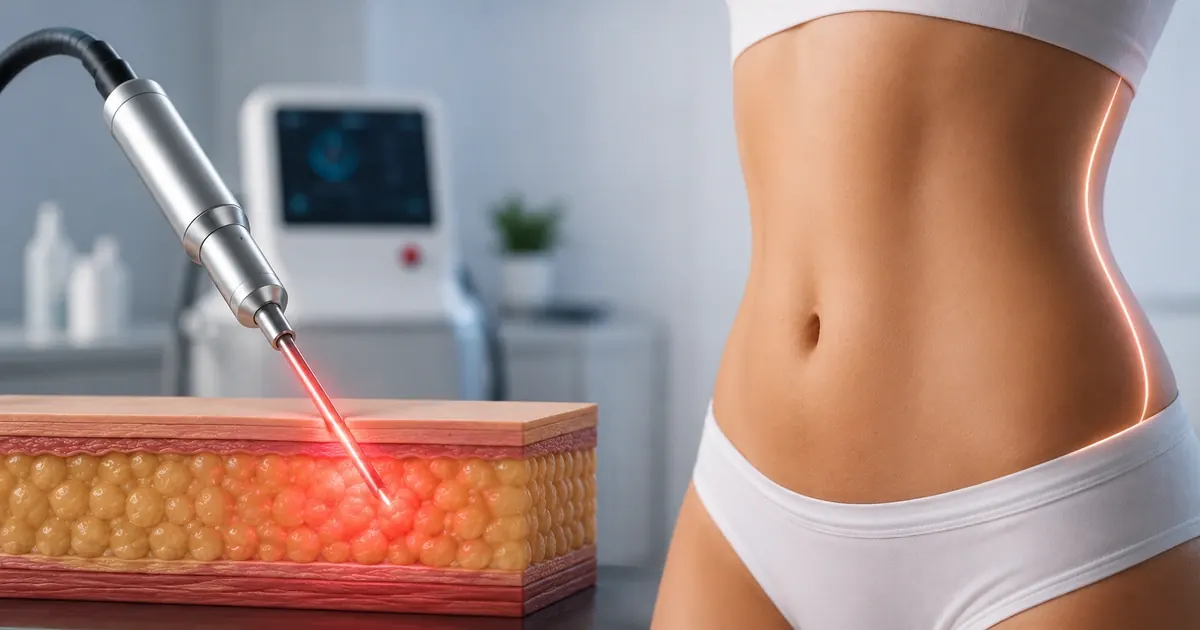
What Laser Lipo Promises
Laser-assisted lipolysis (marketed under brand names including SmartLipo, SlimLipo, and others) is promoted with two main claims:
- Effective fat removal with less trauma and faster recovery than traditional liposuction
- Skin tightening — unique to laser lipo; not possible with traditional suction alone
The "less trauma / faster recovery" claim is largely unsubstantiated in peer-reviewed literature for equivalently sized procedures. The skin tightening claim has more evidence behind it, but the magnitude is often overstated in marketing.

What the Evidence Actually Shows
On Fat Removal
Laser lipo does effectively remove fat. The laser energy causes direct photomechanical and thermal disruption of adipocyte (fat cell) membranes — histological studies confirm lipolysis at the cellular level.1 The liquefied fat is then suctioned, producing similar volume reduction to traditional liposuction.
A 2025 systematic review confirmed laser-assisted lipolysis as an effective method for fat reduction with an acceptable safety profile.2 Fat removal outcomes are broadly comparable to traditional liposuction for equivalent treatment areas.
The Histology of Laser Lipolysis
At the cellular level, laser energy is absorbed by the lipid content of adipocytes, causing a rapid temperature rise within the fat cell. This thermal effect disrupts the phospholipid bilayer of the cell membrane — a process confirmed by histological specimens showing ruptured adipocytes, extracellular lipid pools, and coagulated capillaries in the immediate treatment zone.1 The optical absorption characteristics of the laser wavelength determine how selectively this energy targets fat versus surrounding fibrous tissue and blood vessels.
Histological studies also document a secondary effect in the overlying dermis: heat conducted from the subdermal laser fibre induces collagen fibre contraction and triggers fibroblast activity, laying the foundation for the skin-tightening effect that develops over months, as an evaluation of tissue thermal effects from laser-assisted lipolysis demonstrated.3 The degree of dermal heating — and thus the tightening response — is directly related to the energy delivered and the proximity of the fibre to the dermal layer, which is why technique and surgeon experience are critical variables in outcomes.
The Randomised Trial Evidence
The strongest clinical evidence for laser lipo's skin-tightening advantage comes from a randomised controlled trial comparing 980 nm diode laser-assisted lipolysis with traditional liposuction for submental (chin) fat reduction.4 The trial found significantly greater skin retraction in the laser group at 6-month follow-up, with higher patient satisfaction scores for neck contour. The submental region was chosen specifically because its relatively thin skin layer and small treatment volume make the thermal effect from the laser more clinically detectable than in thicker body areas.
The limitations of this RCT are worth noting: the study focused on a single anatomical area (submental), used a single wavelength (980 nm), and had a 6-month follow-up horizon. Extrapolating these results to larger body areas — the abdomen, flanks, or thighs — requires caution, as the diffusion of laser energy across greater tissue volumes reduces the concentration of thermal effect at any one point. The trial nonetheless provides the clearest controlled evidence that the skin-tightening benefit is a real and measurable clinical outcome, not merely a theoretical one.
On Skin Tightening
Laser energy heats the dermis and subdermal tissue, stimulating collagen remodelling. Studies document measurable retraction in the treated skin zone.3 A randomised controlled trial comparing 980 nm diode laser lipo to traditional liposuction for submental fat found significantly better skin contraction in the laser group.4
However, the key caveat is that this effect is modest and area-dependent:
- Best documented for small areas (chin/neck, inner arms) where the skin-to-tissue ratio is favourable
- Less clearly demonstrated for large body surface areas
- Does not reliably correct established skin laxity — only enhances retraction in patients who already have reasonable elasticity
On Safety
Laser lipo is a surgical procedure with the same general risk profile as traditional liposuction (infection, seroma, contour irregularity). The additional risk specific to laser energy is thermal injury — skin burns or deeper tissue damage if the laser fibre contacts the dermis or energy settings are inappropriate, as thermal effects research documents.3 This risk is uncommon but higher in inexperienced hands than with traditional liposuction.
Realistic Results Timeline
| Post-op timeframe | What to expect |
|---|---|
| Days 1–5 | Significant bruising and swelling; compression garment worn; reduced activity |
| Weeks 1–2 | Swelling begins to resolve; shape change visible in smaller areas; most patients return to desk work |
| Weeks 3–6 | Noticeable improvement; residual swelling and firmness normal; activities gradually resume |
| Months 2–3 | Substantial result visible; skin tightening effect beginning to develop via collagen remodelling |
| Months 3–6 | Final result; skin tightening effect reaches its maximum at around 3–6 months |
These timelines are the same as for traditional liposuction — there is no consistent evidence that laser lipo heals faster or has shorter visible swelling. The timeline for the additional skin tightening benefit extends to 3–6 months as collagen remodelling is a gradual process.
Who It's Best (and Not Best) For
Best candidates for laser lipo:
- Localised fat deposits in smaller treatment areas (chin, inner arms, bra area)
- Patients with mild skin laxity in the treatment area where modest skin tightening would be beneficial
- Healthy, stable weight patients with realistic expectations
- Non-smokers (smoking impairs collagen response)
Not ideal for:
- Large-volume fat removal across multiple areas (traditional or VASER may be more appropriate)
- Significant skin laxity (no lipo technique corrects loose skin adequately — a lift procedure is needed)
- Patients seeking weight loss (liposuction is body contouring, not a weight-loss procedure)
- Patients wanting the maximum cost-efficiency for fat removal only (traditional lipo is equivalent at lower cost)
Risks and Complications Specific to Laser Lipo
Laser lipo carries the full risk profile of traditional liposuction, plus an additional category of complications arising from the thermal energy delivered by the laser fibre. Understanding both layers of risk is essential for informed consent.
Thermal Burn Risk
The defining additional risk of laser-assisted lipolysis is thermal injury to the skin or underlying tissue. If the laser fibre passes too close to the dermis, or if excessive energy is delivered to a localised area, the heat can cause a full-thickness skin burn. This is distinct from the superficial erythema that resolves within days — thermal burns from misdirected laser energy can result in scarring, hyperpigmentation, or contour deformity. The risk is directly tied to surgeon experience and technique: continuous movement of the laser fibre, real-time temperature monitoring, and adherence to safe energy parameters are the primary safeguards, as published tissue thermal effects data confirms.3 Clinics performing high volumes of laser lipo with experienced operators report thermal complication rates well below 1%; the risk rises substantially in less experienced settings.
Seroma Formation
Seroma — a collection of serous fluid in the treatment cavity — is a recognised complication of all liposuction techniques, but the thermal effect of laser energy on tissue can increase localised fluid production in some cases. Seromas present as a soft, fluctuant swelling in the weeks following surgery and typically resolve with aspiration. Consistent use of compression garments in the post-operative period is the primary preventive measure. The overall seroma rate for laser lipo in published series is comparable to traditional liposuction when compression protocols are followed.
Risks Shared with All Liposuction
Laser lipo carries the same general risks as every liposuction technique. These include infection at incision sites, haematoma (blood collection), temporary or prolonged numbness in the treatment zone, contour irregularities (waviness or depressions), and — in large-volume procedures — the systemic risks of fluid shifts and anaesthetic complications. These risks are not amplified by the laser component and are managed through standard surgical protocols: sterile technique, compression garments, staged volumes, and appropriate anaesthetic care.
| Complication | Approximate frequency | Laser-specific? |
|---|---|---|
| Thermal burn / skin injury | <1% (experienced surgeons); higher in inexperienced hands | Yes — laser only |
| Seroma | 2–10% (varies by area and compression compliance) | No — all lipo; possibly slightly higher with laser |
| Contour irregularity | 5–20% (minor); clinically significant in ~2–5% | No — all lipo techniques |
| Infection | <1% with sterile technique | No — all lipo techniques |
| Temporary numbness | Common; resolves within weeks to months in most cases | No — all lipo techniques |
| Haematoma | 1–3% | No — all lipo techniques |
Laser Lipo vs Other Methods
For a full comparison of laser lipo against VASER and traditional liposuction — including a side-by-side table of technique, evidence, and cost — see the complete technique comparison guide.
For those considering non-surgical fat reduction alternatives (CoolSculpting/cryolipolysis), note that these are fundamentally different in mechanism, volume capability, and timeframe. Laser lipo is a surgical procedure with immediate fat removal; non-surgical methods work gradually over months and are appropriate for small, mild deposits only.
Frequently Asked Questions
-
Yes. Fat cells removed by laser lipo do not regenerate. However, remaining fat cells in other areas can enlarge with weight gain — maintaining a stable weight after surgery is important for lasting results.
-
Initial shape improvement is visible at 2–4 weeks as early swelling resolves. Significant results typically appear at 6–8 weeks. Final results, including any skin tightening effect, develop over 3–6 months as residual swelling resolves and collagen remodelling completes.
-
For the right patient — small area, mild laxity, good skin elasticity — the modest skin tightening benefit may justify the 15–30% cost premium over traditional lipo. For large-volume fat removal where skin tightening is not a priority, traditional lipo achieves comparable fat removal results at lower cost.
-
SmartLipo is a brand name for one type of laser-assisted lipolysis system. Laser lipo is the general term covering all systems (SmartLipo, SlimLipo, CoolLipo, and others). All use laser energy to liquefy fat before suction; clinical outcomes are broadly comparable between systems.
-
The same general risks as all liposuction (infection, seroma, contour irregularity), plus an additional risk specific to laser energy: thermal burn to skin or deeper tissue if the fibre contacts the dermis or energy is misapplied. This is uncommon with experienced surgeons but higher in inexperienced hands — surgeon experience matters more for laser lipo than for traditional lipo.
-
Laser lipo is a surgical procedure performed under anaesthesia that removes fat cells through suction in a single session — results are visible within weeks and volume reduction is significant. CoolSculpting is non-surgical: it freezes fat cells which the body gradually eliminates over 2–4 months, making it appropriate only for small, mild deposits. Laser lipo can treat larger volumes and delivers faster, more predictable results; CoolSculpting avoids surgery and anaesthesia but has a lower ceiling on what it can achieve. Cost per area is broadly similar; laser lipo typically costs more upfront but achieves more in a single treatment. Neither procedure is a weight-loss treatment.